
Murray Family’s Quest to Locate MIA New Zealand at Expo 2025
Off The Top of My Head
By Paul Murray
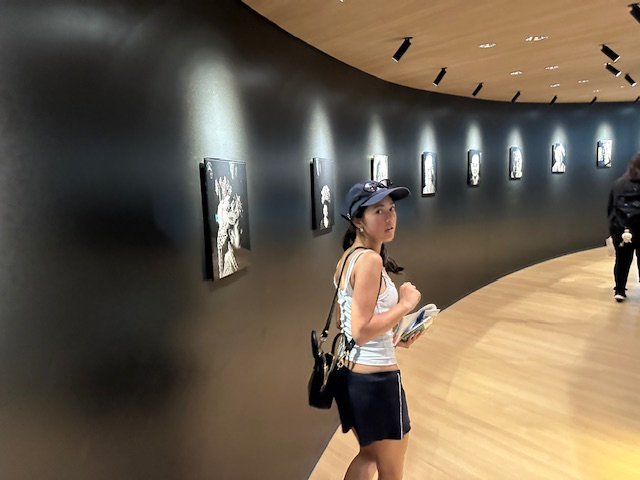
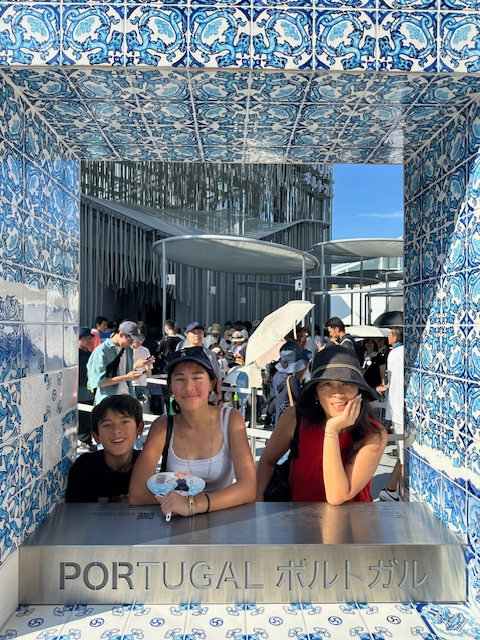
My family and I recently flew to Tokyo on our annual pilgrimage to visit my wife Sanae’s parents. This year. we also visited the World Expo in Osaka, Japan.
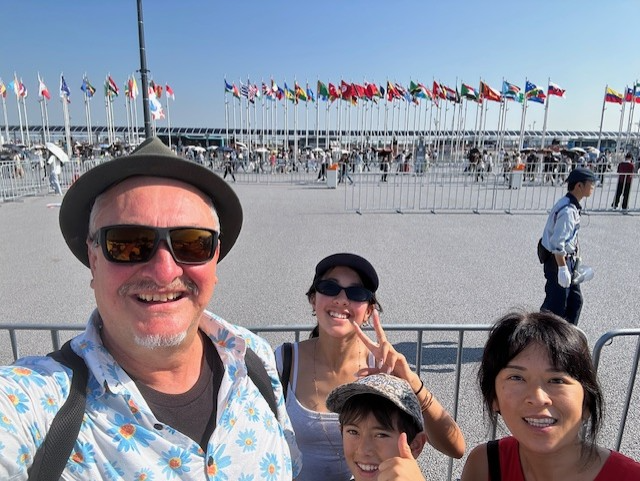
It was supposed to be a grand cultural exchange—an opportunity to see how nations present themselves and to proudly check out the New Zealand pavilion to see how we stack up against the world, but as we arrived at the venue beneath the myriad national flags, Aotearoa was not to be found….Crickets!

We flew from Karamea to Tokyo, transferred to the shinkansen, and barrelled down to Osaka at 300km/h. We battled through tides of people, stood for hours in a line in the baking sun, and spent thousands of dollars—not to mention a sizable chunk of our family holiday in the hunt for the New Zealand pavillion/display.

It was 37°C in the shade! Seriously HOT and HUMID…I drank six litres of water that day and, miraculously, never once had to visit the urinals. My pores turned me into a human sprinkler system.
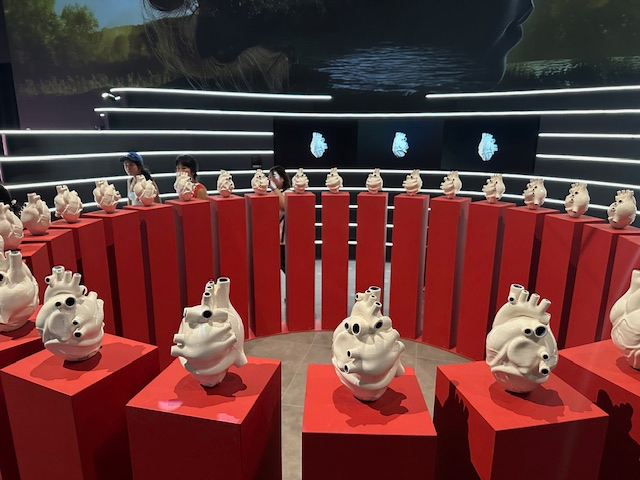
But Expo 2025 itself? Absolutely fantastic. An awe-inspiring collection of nations showing off their best sides—art, culture, history, technology, food, sport, music, innovation. Many countries I’d never thought twice about now have a permanent place in my imagination. Palau? Turns out they’ve got some fascinating ideas about ocean conservation. Tuvalu? Yes, Tuvalu—population 9,646—was there with a display, proudly waving the flag and showing the world what they’re about.
To put a bit of perspective on the size of the exposition, the area inside the wooden ring that surrounds the pavillions is a little over 6 ha. The event runs from April 13 to October 13, 2025. Over 200,000 people per day visit the show and the total number of visitors is expected to exceed 28 million. According to the Asia Pacific Institute of Research, the event will boost the local Osaka economy by an estimated $US20 billion as visitors take the opportunity to explore the region after attending the EXPO.
The Japanese, whose penchant for cute animated characters is well known, have really raised the “kawaii” bar with the Osaka EXPO mascot MYAKU-MYAKU, an amorphous. multi-eyed, happy and colourful character who has won the hearts of EXPO attendees and become he event’s icon. The character, which appears to be sexless and possibly prefers the pronoun “it,” has also spawned a myriad or merchandising opportunities and the character adorns everything from towels, key chains, cookies, pens and hats to umbrellas, shoes, watches and even underpants! (There is also a MYAKU-MYAKU tamagochi!)

“MYAKU-MYAKU” is a mysterious being born from the fusion of cells and water. The red parts symbolize life’s dividing, multiplying cells, while the blue represents pure, ever-changing water. Constantly shifting shape, MYAKU-MYAKU sometimes forgets its own original form, but for now it has taken on a human-like appearance. It thrives in sunlight, delights in rainy days, and eagerly absorbs rain into its body. Dreaming of being recognised by all before Expo 2025 in Osaka, MYAKU-MYAKU looks forward to meeting people from around the world.
MYAKU-MYAKU Bio:
Birthplace: A small spring somewhere in Kansai.
Personality: Friendly but goofy, often making silly mistakes.
Special Skills: Able to change its shape into various forms and finding rainbows after it rains.
Favourite Thing to Do: Interacting with all kinds of living beings and things
Over 150 countries and regions have displays at the EXPO (76% of countries in the world). These countries did not attend World EXPO in Osaka in 2025: Greece, Mexico, Estonia, Argentina, Niue, Russia, North Korea, Afghanistan and Iran due to issues like financial instability or political tensions with Japan. while New Zealand did not have a pavilion due to a lack of government commitment.
Tonga was there. Fiji was there. Nauru—yes, Nauru—was there (Pop. 11,497). Even Papua New Guinea had a presence. But New Zealand? The land of the All Blacks, Middle-earth, kiwifruit, and pineapple lumps? AWOL. Nowhere. Zip. Nada. Not a bean. The Kiwi Pavilion was as extinct as the moa.
Is New Zealand really that broke? Could we not scrape together enough coins from back of the couch to put up at least a modest stall in the Commons Pavilion? Maybe a card table with some Whittaker’s samples, a bloke with a guitar strumming Crowded House, an All Black haka, and a looping video of Milford Sound?
Instead, New Zealanders abroad had to endure the humiliation of explaining that our country was too busy or too poor or too disorganised to show up at the biggest international showcase of the decade. What message does that send? Don’t come visit? Don’t invest? We’re closed until further notice?
Ironically, the only NZ representation I found was at Disneyland, in the “It’s a Small World After All” ride. There, a smiling Māori lady in a grass skirt and two kiwis standing under cabbage trees swaying back and forth. It wasn’t much, but hey—it was something. Compared to EXPO 2025, Disney is making us look good.

So here we are, watching the world march proudly onto the global stage while New Zealand lurks backstage, mumbling, “Yeah-Nah, mate, not today.” Meanwhile, Tuvalu’s out there punching well above its weight, proving that even the smallest voices can be heard—while ours is MIA.
If this is our international strategy, then perhaps New Zealand’s new motto should be:
“New Zealand: The World’s Best Kept Secret… ”







###################################################################################
Letter to N.Z. Prime Minister Christopher Luxon requesting an answer as to why New Zealand failed to show up at the most significant international promotional forum: World EXPO Osaka 2025:
September 19, 2025
The Rt Hon Christopher Luxon
Prime Minister of New Zealand
Parliament Buildings
Wellington, New Zealand
Cc: Hon Todd McClay, Minister of Trade
Cc: Hon Matt Doocey, Minister for Economic Development
Cc: Hon Louise Upton, Minister of Tourism
Cc: Hon Paul Goldsmith, Minister for Arts, Culture and Heritage
Cc: Hon Christopher Hipkins Leader of the Opposition
Subject: Absence of a New Zealand Presence at Expo 2025, Osaka
Dear Prime Minister,
As a proud New Zealand resident, deeply committed to my community and the future of our country. I recently travelled with my wife, who is Japanese, and our two New Zealand-born children to visit Expo 2025 in Osaka, Japan. While we were greatly impressed by the international displays of culture, innovation, trade, and tourism from around the world, we were disheartened to discover that New Zealand had no pavilion, exhibition, or visible presence at the event.
Expo 2025 is an extraordinary opportunity for nations to showcase their art, culture, traditions, food, technology, history, innovations, sport, and music on the world stage. With over 200,000 visitors per day between April and October, the Expo offers unparalleled exposure to prospective tourists, investors, and business collaborators. Countries both large and small—Tuvalu included—were represented with pride and impact. Australia’s pavilion, for example, was so popular that we were unable to gain entry due to long queues.
By contrast, New Zealand’s absence was conspicuous. It was, frankly, embarrassing not to find our country represented, and it left my family and I concerned about the message this sends internationally. What impression are we leaving with the millions of visitors attending this event? That New Zealand has nothing to offer? That we are closed for investment? That we do not wish to promote our culture, products, services, and innovations to the world?
Understandably, some countries—such as Russia—are absent for specific geopolitical reasons. However, New Zealand’s omission raises troubling questions. Was this a deliberate policy decision? If so, who made it, and on what grounds? Was the decision financial? If so, what does it signal about our priorities and ability to invest in opportunities for trade, tourism, and global collaboration?
New Zealand has so much to offer such as world-class art, culture, technology, food, and natural beauty. To miss the chance to share this with a global audience feels like a significant lost opportunity—not only for tourism and trade, but for the international reputation of our nation.
I respectfully request clarification on:
- Why New Zealand chose not to participate in Expo 2025?
- Who made the decision and what factors influenced it?
- What assessment has been made of the potential consequences for New Zealand’s international profile, trade, and tourism?
- Are there are plans to ensure New Zealand participates in future Expositions or similar global showcases?
As proud NZ resident and patriot who loves this country and confidently represents it abroad, I believe the New Zealand absence in Osaka reflects poorly on the country, and I hope the Government will provide reassurance that this was not a missed opportunity without careful consideration and that due consideration is given to showcase Aotearoa in the next World EXPO in Belgrade in 2027.
Thank you for your time and attention to this important matter. I look forward to your response.
Yours Sincerely,
Paul John Murray
(Contact Details Supplied)
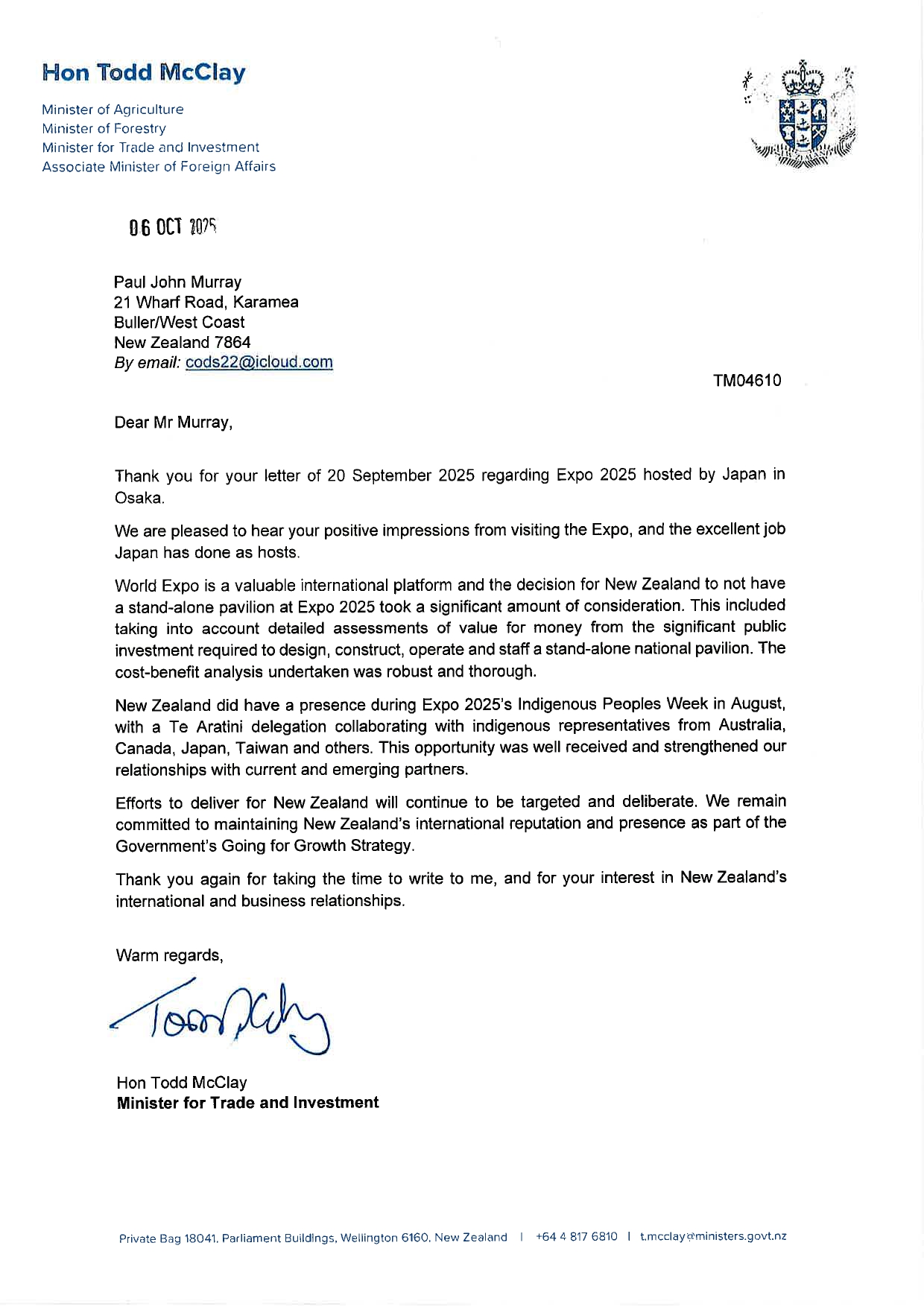
Response from Minister for Agriculture, Forestry, Trade and Investment and Foreign Affairs, The Hon Todd McClay





















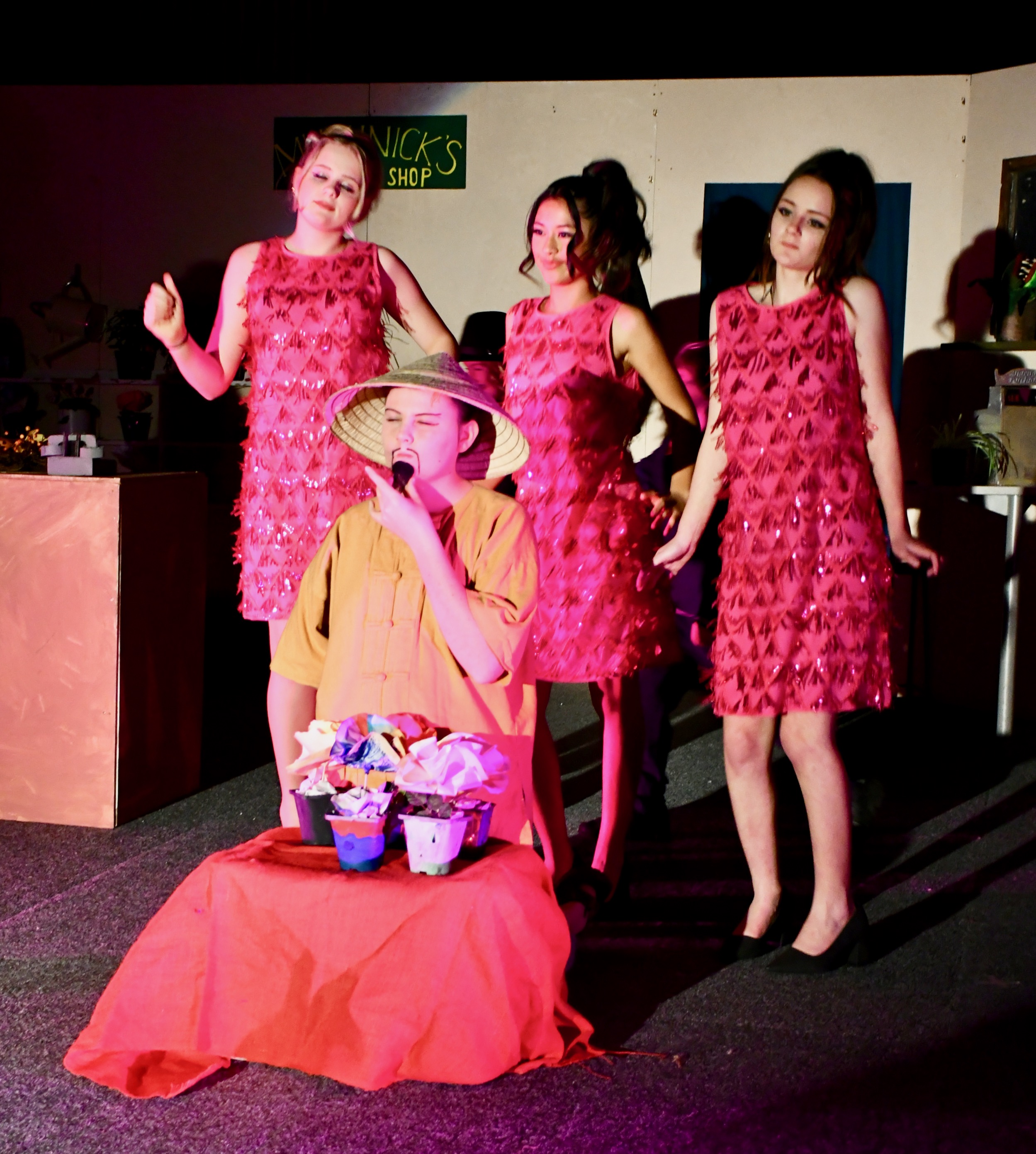


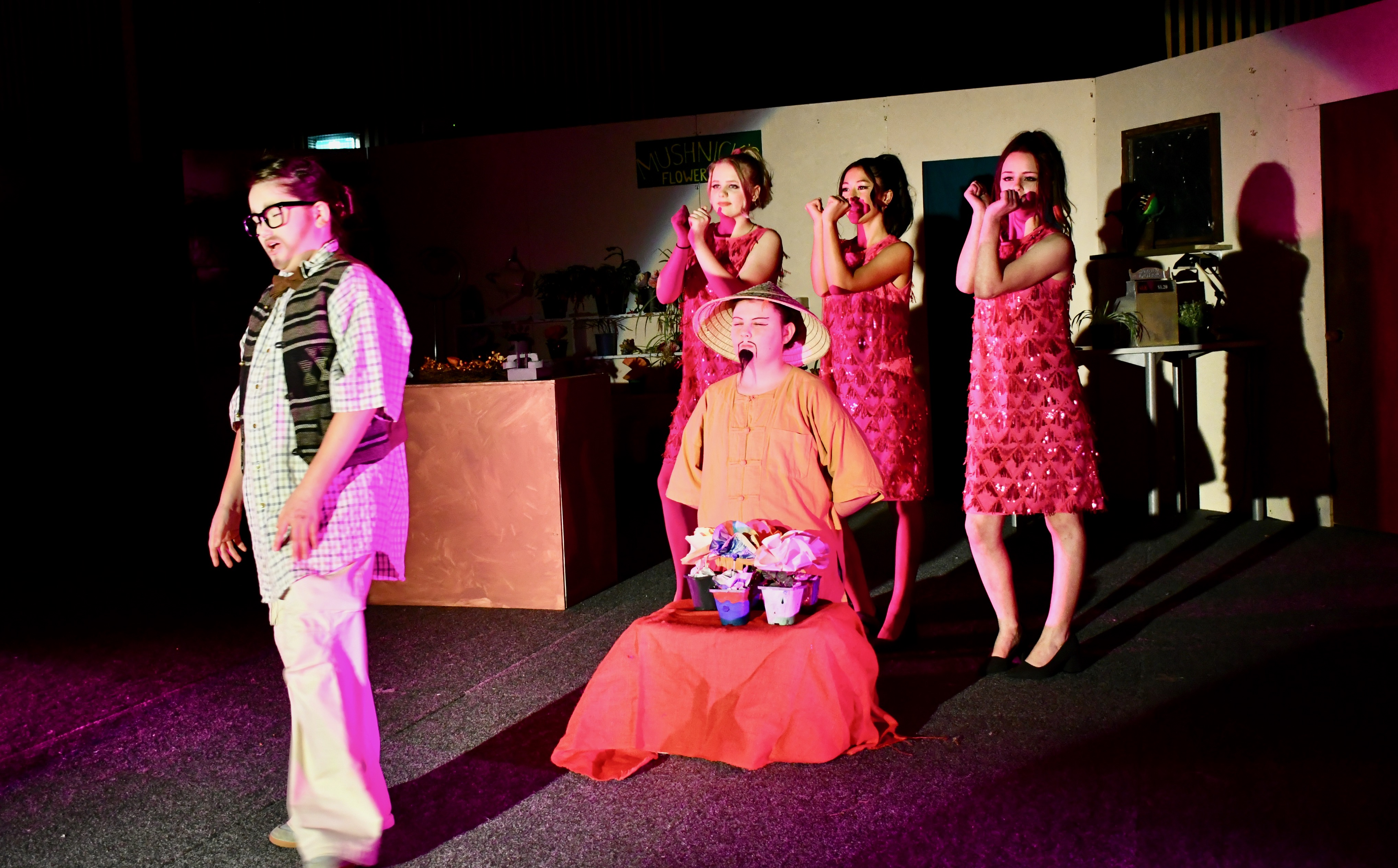













































































































































































































































































































































































Antique Antique Shop Owners of Japan
Off The Top of My Head
By Paul Murray
A few years ago, I was exploring the back streets of the old Japanese city of Kamakura, which was the de facto capital of Japan during the Kamakura Period (1185–1333). The city is steeped in history and is home to many grand temples, shrines and the very popular “Daibutsu” or “Great Buddha.”
On my walk, I happened across a tiny antique shop run by a very elderly gentleman who may have been older than some of the artefacts he had on display in his emporium. He was elegantly dressed in a fine kimono, and despite it being a hot summer day, he seemed cool and calm in the stifling heat and still air of his shop. He was extremely knowledgeable about his collection and was happy to discuss the provenance and historical significance of the items he had on display.
Among his collection was a gnarled piece of tsuge (Japanese boxwood) that resembled an enraged minatour sliding into a turn after a charge, seemingly having missed his target and wheeling back onto his foe to send him to oblivion. I immediately fell in love with the piece and wanted to purchase it, but assumed it would be well beyond my means. However, as there was no price tag on the beast, so I asked what he let it go for…”Oh, there’s no price tag?” He asked. “I can’t see one,” I replied, taking the sculpture to him. “It’s ¥7,500,” he said, seemingly off the cuff. At that time, it was about $US70, which was well below what I was expecting and within my budget, so “SOLD,” I said, and the Mad Minatour is now one of my favourite objet d’arts on display in my New Zealand home.
Last week, I was at it again, trawling the backstreets of Tokyo in search of antique treasures…this time in Ōmori, which is an old central Tokyo suburb that was the childhood home of famous Japanese film director Akira Kurosawa. Kurosawa popularised the Samurai film genre and brought Japanese cinema to the world. Kurosawa combined Japanese and Western storytelling traditions, producing films of visual grandeur and moral messaging. His work is respected internationally for its innovative artistry and profound humanity.
Ōmori also housed a brutal POW camp in WWII. The site is now the site of the popular Heiwajima boat racing arena, where punters place their bets on the first two finishers among six powerboats piloted by jockey-sized racers in colourful “silks” roaring around three laps of a 600m course. Ironically, “Heiwajima” means “Peace Island,” which belies the site’s past but, hopefully, heralds its future.
(Image from https://www.heiwajima.gr.jp/en/)
While exploring Ōmori, I was fortunate to come across 大塚陶器店 the Otsuka Ceramic Shop, which, at first glance, seemed cluttered, decrepit, unkempt and derelict…just the kind of place I was looking for!
On display were a broad range of antique Japanese pottery, cups, bowls, sake sets, sculptures and vases. The aged owner was reclining fast asleep at the back of the store, which enabled me the chance of quiet inspection and contemplation of his displays, which were coated with a thick layer of black, sooty dust. I was possibly his only customer for the month, but the slumbering owner was delightfully nonchalant about the possibility of making a sale, choosing to remain comatose over the pursuit of commerce.
Among his wares was a delightfully crafted wooden sake decanter and set of cups that I caught my attention and spurred my desire for ownership. Again, there was no price on the items, so I politely roused the Old Boy from his slumber to enquire their worth. In a very similar scenario to the experience I had in Kamakura many years earlier, he seemingly randomly said, “¥2.500.” (Currently about $US15). Again, I was surprised, thinking the set would be much more, “SOLD,” I said, and he began wrapping them in old newspaper and popped them into a recycled shopping back for me to carry home.
Despite the lack of a cash register, payment was in cash as I don’t think the aged antique merchant had Internet, credit card facilities or had even ever considered such new-fangled nonsense…He opened a drawer from an old chest and retrieved my change from a paper bag full of banknotes. This speaks to the lack of petty crime in Japan that an elderly gentleman could keep wads of cash in an insecure and easily accessible location without concern is a wonderful testament to the honesty, respect and social responsibility of Japanese people.
I took my antique find home, shared my treasure-hunting story with my wife Sanae and showed her the photos of the shop. After she stopped laughing, she noticed the Jōmon dogū figurines in one of the photos…She is particularly interested in the Jōmon period (circa 14,000 BC to 300 BC) history and cultural traditions, so I promised to return the next morning and ask about the statues to see if I could possibly procure one for her.
So, I dutifully arrived at the shop at 9:00 am the following day, only to find the shutters down and the shop very closed. I peered through the post slot in the roller door, and Sensi was in the back of the store reading the morning paper. “Ëxcuse me,” I shouted through the hole, “Yes?” he replied. “What time do you open?” I asked. “10:00 a.m.,” he said firmly. “OK,” I said, “I’ll come back then.”
I returned at 10:00 a.m. and the shop roller door was half open, but Sensei was nowhere to be seen. I waited another 15 minutes or so and eventually stuck my head under the door and said, “Sumimasen” to hear “‘Gomaenasai” from behind me and down the street, and there was Sensai, marching back from a shopping expedition in his white singlet, shorts and sandals, shopping bag in hand, very apologetic for having forgotten I was coming.
I reminded him that we had spoken the day before, and that I’d purchased the wooden sake set. Unsurprisingly, he remembered me as I really must have been his only customer for the day. I asked about the Jōmon dogū figurines, and he was quite surprised that I knew what they were. He laughed quite a lot when I enquired about the authenticity of the dogū. Genuine Jōmon dogū are museum pieces or the preserve of wealthy private collectors, and he honestly informed me they were not genuine Jōmon-era artefacts.
There were about a dozen dogū statuettes to choose from, and after some quiet deliberation and some enthusiastic encouragement from Sensai, I decided on the large one…¥4,500 (About $US30). Before my shopping spree, I’d done a bit of online research to make sure I didn’t get touched on the purchase. On Ebay, the asking price for 10 cm similar replica dogū statues was about $US65, so I was in good shape. I dropped the hammer on Sensei’s offering, which was twice the height and half the price!
Jōmon period (縄文時代), people were peaceful hunter-gatherers and early agriculturalists with a common culture. They were largely sedentary and had a well-established and complex society, religious beliefs and cultural traditions, which included artistic pursuits of which their remnant pottery and ceramic sculptures demonstrate.
I asked Sensei a few questions about his fascinating store. It turns out his father had started the business in 1948 as a means of post-WWII survival. He’d taken it over when his father retired and was himself now 86 years old and doesn’t have an heir willing to continue the family legacy. So, sadly. the Otsuka Ceramic Shop may soon be closed forever…perhaps Sensei will have a “closing down sale”? Keep an eye out for that antique hunters, there’s sure to be bargains galore!
I’ve always found it curious that, in general, Japanese people, (with a few notable exceptions, private collectors, traders, galleries, museums etc) see little value in antiques, preferring new. clean, disposable, fashionable and whatever the current trend suggests is popular.
Back in the “Bubble Economy” days, it was quite common to find Japanese antiques on the roadside awaiting pick-up and disposal by the rubbish trucks. An Irish friend created a great business by going around collecting antique “rubbish,” giving it a clean up and a polish and exporting it to Europe for resale at premium prices.
As my wife and I both forgot our wedding anniversary….again…I decided to give the dogū to her as a belated anniversary gift. Romance is not dead in the Murray household!
Happy 17th Wedding Anniversary My Darling!
Seventeen happily married years without a cross word! What an incredible wife you are and mother to our two amazing children…Who will soon, hopefully, be wonderful adults.
Thank you for your compassion, kindness and consideration and for forgiving my many foibles.
You are vastly more beautiful and interesting today than the happy day I met you, incredibly, over 20 years ago. Thank you for being my wife and for making my fabulous life ever more wonderful.
Please accept this somewhat unusual wedding anniversary gift from your somewhat eccentric, but loving husband.
Jōmon dogū figurines are thought to represent the religious beliefs, artistic practices, and social structures of Jōmon period peoples and symbolise fertility, safety, social etiquette and protection from illness.
Let’s continue together to keep our family healthy safe and strong and to develop our artistic appreciation, creativity and sensibilities and our family spirit.
Thank you my LOVE for everything you do, you are and all you share with me.
I will love you, Diva, Winston and “Kawa” Murray unconditionally into perpetuity and continue to provide for you all and to, laugh, share life’s experiences,, explore possibilities and grow wise and happily old together.
Grace, Peace, Love and Happiness,
Your forever husband,
Paul.
愛しい人、17回目の結婚記念日おめでとう!
口喧嘩一つせず、幸せな結婚生活17年!あなたは本当に素晴らしい妻であり、二人の素敵な子供たちのお母さんです。きっともうすぐ素敵な大人になるでしょう。
あなたの思いやり、優しさ、そして思いやり、そして私の多くの欠点を許してくれてありがとう。
20年以上前にあなたに出会ったあの幸せな日よりも、今のあなたはずっと美しく、魅力的です。私の妻でいてくれて、そして私の素晴らしい人生をさらに素晴らしいものにしてくれてありがとう。
少し変わっているけれど、愛情深いご主人からの、少し変わった結婚記念日の贈り物を受け取ってください。
縄文土偶は、縄文時代の人々の宗教的信仰、芸術的慣習、そして社会構造を表し、豊穣、安全、社会的な礼儀、そして無病息災の象徴であると考えられています。
これからも一緒に、家族の健康、安全、そして力強さを保ち、芸術的な鑑賞力、創造性、感性、そして家族の絆を育んでいきましょう。
愛しい人よ、あなたがしてくれたこと、あなたがいてくれること、そして私と分かち合ってくれたことすべてに感謝します。
ディーヴァ、ウィンストン、そして「カワ」・マレーを、私は永遠に無条件に愛し、これからもあなたたちを支え続け、共に笑い、人生の経験を分かち合い、可能性を探求し、共に賢く、幸せに歳を重ねていきます。
恵み、平和、愛、そして幸福を、
永遠の夫より、
ポールより
Rate this: