The insurer sells certainty. The customer discovers uncertainty….and the customer pays for both.
There’s an old saying that insurance is something you buy hoping you’ll never need it. Having recently had the misfortune of actually needing it, I’d like to propose an amendment: Insurance is something you pay for religiously, hoping you’ll never discover what you’ve actually purchased.
Back in 2013, I wrote an article for The Rongolian Star entitled Insurance Companies…Who’s Watching These Crooks?It was a somewhat irreverent examination of an industry that has perfected the art of collecting money today in exchange for promises about tomorrow. Thirteen years later, I’m delighted to report that I’ve undertaken some extensive firsthand research into the subject.
Unfortunately, this research has cost me approximately $110,000 in insurance premiums, involved a failed septic system, several months of correspondence, an unsuccessful complaint to the Insurance & Financial Services Ombudsman, and the prospect of finding another $45,000 to repair something that worked perfectly well for almost six decades. All things considered, I wish I’d just gone fishing.
A maternity hospital, a septic tank and 60 years of uninterrupted service….
The Karamea Maternity Hospital and its hardworking septic system, 1965–2025.
In 1965, the New Zealand Government built a maternity hospital in Karamea, a small, remote community on the northern West Coast of the South Island. This wasn’t some ramshackle collection of recycled timber knocked together by a couple of blokes after a few beers. It was a government-funded public building, constructed to the high standards and engineering practices of the day, designed to provide essential medical services to the community. Naturally, it required a reliable wastewater disposal system.
A properly engineered septic tank and associated soakage field were installed, and for almost 60 years this unglamorous, but essential infrastructure quietly went about its business. Babies were born. Generations came and went. The maternity hospital eventually became an accommodation business and now a residential property. Throughout the building’s many metamorphoses, the septic system continued doing what septic systems are supposed to do. Until October 2025….When it stopped.
Not after years of observable progressive failure. Not following decades of complaints about its performance. Not because someone had suddenly decided to convert the property into a commercial sewage-processing facility. It simply ceased functioning satisfactorily.
A drainlayer investigated and identified a rise in the water table and associated groundwater saturation of the disposal field as the problem. Wastewater could no longer disperse through the ground as intended. The solution was straightforward, if financially rather confronting…Replace the failed system…Estimated cost: approximately $45,000…Bugger!
Still, I wasn’t particularly worried at first. After all, I’d insured the property continuously since 2004.I’d paid an estimated average of $5,000 a year in premiums. Over 22 years, that’s approximately $110,000. I hadn’t made a previous claim. Surely, I thought, this was precisely why people paid insurance premiums…No worries, just fill out a claim form and Robert’s your Mother’s Brother…Right?
The extraordinary difference between suddenly and…suddenly…
My insurer, NZI, a division of IAG New Zealand, declined the claim. The essential issue was whether the failure constituted sudden and accidental loss or damage covered by the policy. Now, I’m not a lawyer, but I do have a reasonable grasp of the English language. If something has been functioning satisfactorily for almost 60 years and then abruptly ceases functioning, I would ordinarily describe that as a sudden failure, but apparently, the insurance industry has a rather more sophisticated understanding of the word.
You see, a system can stop working suddenly without necessarily having suffered sudden physical damage. Its deterioration might have been gradual, even if the consequences became apparent all at once…And that is aapparently a perfectly legitimate distinction. But here’s where things become interesting…Nobody has established that the groundwater conditions responsible for this particular failure changed gradually. Equally, I cannot establish that they changed suddenly. Nobody knows.
The West Coast Regional Council’s hydrology department kindly supplied detailed information about the extraordinary rainfall events that affected Karamea in October 2025. The region had experienced an unusually wet winter and spring. Soils were saturated, river levels were elevated, and significant rainfall events occurred in October. At one monitoring station in the Karamea ranges, rainfall intensities exceeded estimated 50-year and 100-year return-period thresholds over six- and twelve-hour durations respectively. On 21 October, the Karamea River reached approximately 3,007 cubic metres per second, its highest recorded flow since 2013. There was, in other words, rather a lot of water about.
Unfortunately, nobody had thought to install a continuous groundwater monitoring station beneath the septic field of the former Karamea maternity hospital. An astonishing oversight! The council confirmed that its available groundwater measurements were too infrequent to determine whether there had been a rapid rise beneath my property during the relevant period. Measurements from another bore approximately 700 metres away could not automatically be assumed to represent conditions beneath my particular property. So the evidence cannot tell us precisely what happened.
But because I cannot demonstrate that the physical loss or damage occurred suddenly, my claim doesn’t satisfy the insurer’s interpretation of the policy requirements. The fact that the system suddenly stopped working is not, on its own, sufficient. Apparently, I should have been monitoring the underground hydrological conditions surrounding my septic system for the past 22 years. Perhaps I should also have employed a full-time geotechnical engineer, just in case….Silly me…I merely paid the premiums with the understanding and belief that if there was such a problem, I would be covered by the insurer.
Half a billion dollars here, a billion dollars there…
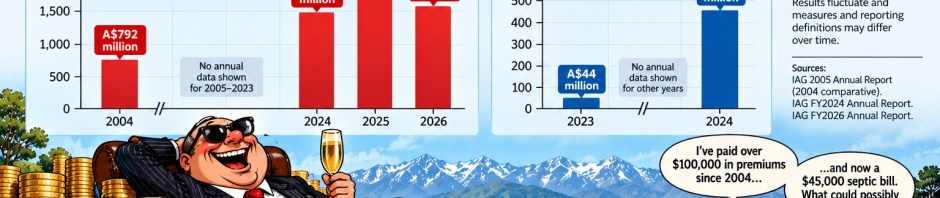
Now, let’s examine the financial circumstances of the organisations involved. IAG New Zealand reported an insurance profit of approximately NZ$563 million for the financial year ending June 2026. Its Australian parent, Insurance Australia Group, reported net profit after tax of approximately A$1.022 billion. Meanwhile, international insurance brokerage and professional services company AON reported approximately US$3.695 billion in net income attributable to shareholders for 2025.
Different companies, different currencies and different measures of profitability, of course. Aon is an insurance intermediary, not the underwriter responsible for deciding my claim. But the figures provide a fascinating glimpse into the enormous sums of money circulating through the insurance industry. Billions and billions and billions of dollars….
Meanwhile, down here in Karamea, I’m trying to find $45,000 to replace a failed septic system. To put that into perspective, $45,000 represents approximately 0.008% of IAG New Zealand’s reported $563 million annual insurance profit. Not eight per cent. Not eight-tenths of one per cent…Eight-thousandths of one per cent!
Of course, insurers don’t determine claims by comparing their profits with their customers’ financial circumstances. Nor should they. Insurance is a contractual arrangement, not a charitable donation. I understand that, but it does rather highlight the extraordinary financial imbalance between the parties. One side has billions of dollars in financial resources, extensive legal expertise, specialist assessors and entire departments devoted to interpreting risk.
The other side has a failed septic tank, a $45,000 bill and a reasonably well-developed sense of indignation. I know which side I’d back in a legal contest.
Justice for all…(Terms and conditions apply)
Having exhausted the insurer’s complaints process, I approached the Insurance & Financial Services Ombudsman Scheme. A free, independent dispute resolution service…Wonderful! Here, surely, was an opportunity for an ordinary New Zealander to have his complaint assessed without needing to mortgage the family home to pay a lawyer.
At a recent conference I attended, I heard New Zealand’s Chief Ombudsman, John Allen, speak about the importance of fairness, accessibility and equitable access to justice. It was an inspiring address. One of the messages I took from it was that access to justice should not depend upon how wealthy you are, how influential you might be or whether you can afford an army of legal advisers. An admirable principle.
Unfortunately, there’s a rather substantial difference between the principle of accessible justice and the practical reality of pursuing a dispute against a multinational insurance corporation. The insurance Ombudsman considered my complaint, examined the additional hydrological information and ultimately concluded that I had not demonstrated a sudden and accidental loss covered by the policy. The complaint was closed. I was informed that if I wished to pursue the matter further, I could take action through the Disputes Tribunal or the courts….Ah! The Courts! Of course! Why didn’t I think of that?
I’ll just engage a suitably experienced insurance lawyer, commission an independent hydrological investigation, obtain expert engineering evidence and prepare myself for a legal contest with an international insurance group. Perhaps I’ll retain a King’s Counsel while I’m at it! After all, what could possibly be more sensible than spending tens of thousands of dollars pursuing a disputed $45,000 insurance claim?
And there’s the rub. The suggestion that I can pursue the matter through the courts is legally correct. But legal rights and practical access to justice are not necessarily the same thing. I cannot know what the Ombudsman intended by offering that advice. It may simply be the standard explanation provided when the complaints process ends. Nevertheless, the practical consequence is unmistakable.
For someone without the financial resources to fund litigation, being told to take on a billion-dollar insurance corporation in court can sound remarkably like being told to go away. The door to justice may be technically open. But if you cannot afford the price of admission, what practical difference does that make?
The curious economics of insurance…
Insurance companies have a fascinating business model. They calculate risk. They price risk. They collect premiums to cover risk. They invest the money collected from managing risk. And when an insured event occurs, they assess whether the particular loss falls within the risks they have agreed to cover. That’s how insurance works…Fair enough.
But from the customer’s perspective, there is something deeply unsatisfactory about discovering, after decades of faithfully paying premiums, that the protection you thought you were purchasing may depend upon producing scientific evidence that never existed in the first place. I didn’t commission a hydrological survey when the property was insured in 2004. The insurer didn’t require one. Nobody suggested I should monitor groundwater levels. The premiums were accepted without difficulty. Year after year…For 22 years. But when the system failed, the absence of detailed scientific evidence became central to the question of whether the claim was covered.
And that raises a broader issue. Should insurers do more to explain, at the point of sale, the kinds of evidence policyholders may need to establish a claim involving older infrastructure? Should insurers undertake more comprehensive investigations before declining technically complex claims? And should the evidential expectations placed upon ordinary consumers reflect what it is realistically possible for them to establish? These seem to me perfectly reasonable questions. Especially when the insurer initially proposed an engineering inspection of the property but ultimately declined the claim without proceeding with that investigation.
Who’s watching the people watching the insurance companies?
There’s another curious dimension to all this. In October 2025, New Zealand’s Financial Markets Authority announced that IAG had admitted breaches of fair-dealing requirements involving misleading representations about insurance products. The resulting court-imposed penalty was $19.5 million. Those breaches were unrelated to my claim, and I make no suggestion that they establish wrongdoing in this case, but they do remind us that even very large, sophisticated financial institutions can get things seriously wrong.
Which brings me back to the question I asked in 2013. Who’s watching the insurance companies? And perhaps, just as importantly, how effective are the protections available to an ordinary customer who believes an insurer has treated them unfairly?
The Insurance & Financial Services Ombudsman Scheme provides an important independent service, but it operates within the law and the terms of insurance contracts. It cannot simply order an insurer to pay because a customer has experienced an unexpected financial catastrophe, and when that process ends, the remaining legal avenues may be financially impractical.
So where does that leave the ordinary person? Holding a policy. Holding a repair bill, and wondering what happened to the peace of mind they thought they’d been buying.
The insurer sells certainty. The customer discovers uncertainty…and the customer pays for both.
That, to me, is the central absurdity of this entire experience. For 22 years, I paid insurance premiums in the reasonable expectation that I was protecting my property against unforeseen misfortune. When misfortune finally arrived, the argument became one of legal definitions, evidential standards and whether the failure of a 60-year-old engineered wastewater system met the precise contractual requirements for cover. I understand the legal reasoning. I understand the insurer’s position. I even understand why the Ombudsman reached the conclusion it did, but understanding something doesn’t necessarily make it feel fair.
The system was constructed by the New Zealand Government in 1965, when the building was a maternity hospital. It performed its intended function for almost 60 years. It then stopped working during a period of unusually wet weather and significant hydrological activity. Nobody can now establish precisely how the groundwater beneath the property changed during that period, and because I cannot demonstrate the required sudden physical loss or damage, the claim has been declined…Case closed…Except, of course, for the $45,000 problem. That remains very much open.
A modest proposal…
Perhaps we should introduce a new form of insurance policy. We could call it Peace of Mind Insurance. Under this revolutionary arrangement, the insurer would clearly explain what is covered, what isn’t covered, and what evidence might reasonably be required to establish a claim. When a longstanding customer suffers a substantial and unforeseen loss, the insurer would undertake a thorough investigation before deciding whether to pay. Where the evidence is genuinely inconclusive, both parties would have a fair opportunity to understand the reasons for the decision and the realistic options available. And where a dispute arises, the customer would have access to a resolution process that doesn’t ultimately depend upon possessing a small fortune.
Radical stuff, I know! It might even catch on. Until then, I’ll continue contemplating the extraordinary irony of this shitty situation.
A septic system built by the New Zealand Government in 1965 gave almost 60 years of dependable service. An insurance relationship lasting 22 years, and costing approximately $110,000, has left me facing a $45,000 bill with no assistance. The multinational insurance industry continues to generate enormous profits, and I’m left wondering whether the only thing more thoroughly processed than the contents of my septic tank is my insurance claim.
The insurer sells certainty. The customer discovers uncertainty…and the customer pays for both.
From Sunny Karamea, where the birds are singing, the Tasman Sea is sparkling, the insurance industry is prospering…and shit is still hitting the fan!
The author provided IAG Ltd, the Insurance & Financial Services Ombudsman Scheme and NZI Insurance company an opportunity to give its version of events, they declined. However, in the email communication subsequently received, an officer of the Customer Complaint Division of IAG was not responsive to the content of this article.
Dear XXXXXXXXXXXXXXXXXXXXXXX
I am writing to invite both NZI/IAG and the Insurance & Financial Services Ombudsman Scheme to comment on an article I have prepared for publication in The Rongolian Star, entitled “Insurance Company Profits by Taking the PISS!”
I have attached the complete 11-page draft article, including its illustrations and graphs, for your consideration.
The article concerns my experience with an insurance claim arising from the failure of the wastewater disposal system at the former Karamea Maternity Hospital, and the subsequent dispute resolution process.
It is written in my usual Off the Top of My Head style, combining personal experience, satire, humour and social commentary. While the language is occasionally colourful and the illustrations deliberately provocative, the underlying issues are serious.
Before publishing, I want to give both organisations a fair opportunity to review the material, correct any factual inaccuracies and explain their respective positions.
As outlined in the article, the property was constructed by the New Zealand Government in 1965 as a maternity hospital. Its wastewater disposal system operated reliably for almost 60 years before ceasing to function satisfactorily in October 2025, following an exceptionally wet winter and spring.
The estimated replacement cost is approximately $45,000.
I have maintained insurance on the property since 2004, paying an estimated $110,000 in premiums over that period, without previously making a claim.
NZI/IAG declined the claim on the basis that I had not established a sudden and accidental loss covered by the policy. The IFSO Scheme subsequently upheld that position, and Karen confirmed in her correspondence of 15 October 2026 that the complaint process had concluded.
I acknowledge the legal reasoning: the initial burden rests with the insured to establish a covered loss. I also accept that an abrupt loss of function does not necessarily establish sudden physical damage.
However, my continuing concern is the practical difficulty of proving the timing and mechanism of an underground failure when the necessary historical groundwater monitoring information simply does not exist.
The West Coast Regional Council’s hydrological evidence does not establish that groundwater beneath the property rose suddenly. Equally, it does not establish that groundwater conditions changed gradually. The available information is insufficient to determine precisely what occurred.
I am not suggesting that this uncertainty automatically entitles me to insurance cover. Rather, I question whether the investigation and evidential expectations were reasonable in the circumstances, and whether the resulting outcome reflects the protection that a longstanding policyholder might reasonably believe they had purchased.
The article also examines the financial disparity between a policyholder facing a substantial uninsured repair bill and a major multinational insurance group, along with the practical accessibility of legal remedies following an unsuccessful complaint.
I would particularly welcome your responses to the following questions:
Accuracy: Does either organisation identify any factual inaccuracies, misleading statements or material omissions in the attached article, including its descriptions of the claim, the investigations undertaken and the complaint process?
Investigation: Why did NZI/IAG not proceed with the engineering inspection that had initially been contemplated? Would an independent on-site investigation have assisted in establishing the physical condition of the wastewater disposal system and the possible cause of its failure?
Evidence: What evidence would NZI/IAG reasonably expect a policyholder to produce to demonstrate sudden physical loss or damage in circumstances where historical groundwater measurements are unavailable?
Hydrological uncertainty: Does either organisation dispute my understanding that the available evidence cannot reliably establish whether groundwater conditions beneath the property changed suddenly or gradually during the relevant period?
Policyholder expectations: Does NZI/IAG consider that the policy wording and the evidence required to establish cover for failures of older underground infrastructure are sufficiently clear to ordinary policyholders?
Dispute resolution: Does the IFSO Scheme wish to comment on the practical difficulties faced by complainants who cannot afford to pursue further legal action, even where the formal right to do so remains available?
Illustrations and commentary: Does either organisation wish to respond to any particular representation, criticism or implication conveyed by the article’s satirical illustrations or commentary?
I appreciate that the insurer and the IFSO Scheme have distinct responsibilities, and I invite each organisation to address only those questions relevant to its role.
I also recognise that the IFSO process has concluded. This is not another request to reopen the complaint, but an opportunity to provide comment for a proposed publication examining my experience and the wider questions it raises.
I acknowledge the confidentiality obligations referred to in Karen’s correspondence of 15 October. I have sought to present my own account of events rather than reproduce confidential IFSO communications. If the Scheme considers that any specific passage of the draft raises a confidentiality concern, I would appreciate that passage being identified, together with the relevant basis for the concern, so I can consider it before publication.
Likewise, if either organisation considers that the article’s financial information, illustrations or descriptions of its conduct require correction or clarification, please identify the relevant material and provide the supporting information.
I would welcome a written statement from each organisation explaining its position. Please indicate whether your response may be quoted and attributed in the published article.
I propose to allow seven calendar days from receipt of this email for responses. If additional time is reasonably required, please let me know within that period.
I will consider all comments in good faith and make appropriate factual corrections before publication. I believe readers deserve to hear the perspectives of both the policyholder and the organisations involved.
Thank you for your time and consideration.
Kind Regards,
Paul Murray
Director, Iltamara Ltd
Writer and Publisher, The Rongolian Star
Karamea, West Coast, New Zealand
Attachment:Rongo RS Article DRAFT Insurance Company Profits by Taking the PISS.pdf (11 pages)
Paul Murray is the founder of the LivinginPeace Project. www.livinginpeace.com Paul originally from Australia, but have been living in New Zealand for 24 years. Before that he was in Japan for a decade working as a journalist. He met his wife Sanae in Japan and they married in 2008.


Insurance Company Profits by Taking the PISS!
Off the Top of My Head
By Paul Murray
The insurer sells certainty. The customer discovers uncertainty….and the customer pays for both.
There’s an old saying that insurance is something you buy hoping you’ll never need it. Having recently had the misfortune of actually needing it, I’d like to propose an amendment: Insurance is something you pay for religiously, hoping you’ll never discover what you’ve actually purchased.
Back in 2013, I wrote an article for The Rongolian Star entitled Insurance Companies…Who’s Watching These Crooks? It was a somewhat irreverent examination of an industry that has perfected the art of collecting money today in exchange for promises about tomorrow. Thirteen years later, I’m delighted to report that I’ve undertaken some extensive firsthand research into the subject.
Unfortunately, this research has cost me approximately $110,000 in insurance premiums, involved a failed septic system, several months of correspondence, an unsuccessful complaint to the Insurance & Financial Services Ombudsman, and the prospect of finding another $45,000 to repair something that worked perfectly well for almost six decades. All things considered, I wish I’d just gone fishing.
A maternity hospital, a septic tank and 60 years of uninterrupted service….
In 1965, the New Zealand Government built a maternity hospital in Karamea, a small, remote community on the northern West Coast of the South Island. This wasn’t some ramshackle collection of recycled timber knocked together by a couple of blokes after a few beers. It was a government-funded public building, constructed to the high standards and engineering practices of the day, designed to provide essential medical services to the community. Naturally, it required a reliable wastewater disposal system.
A properly engineered septic tank and associated soakage field were installed, and for almost 60 years this unglamorous, but essential infrastructure quietly went about its business. Babies were born. Generations came and went. The maternity hospital eventually became an accommodation business and now a residential property. Throughout the building’s many metamorphoses, the septic system continued doing what septic systems are supposed to do. Until October 2025….When it stopped.
Not after years of observable progressive failure. Not following decades of complaints about its performance. Not because someone had suddenly decided to convert the property into a commercial sewage-processing facility. It simply ceased functioning satisfactorily.
A drainlayer investigated and identified a rise in the water table and associated groundwater saturation of the disposal field as the problem. Wastewater could no longer disperse through the ground as intended. The solution was straightforward, if financially rather confronting…Replace the failed system…Estimated cost: approximately $45,000…Bugger!
Still, I wasn’t particularly worried at first. After all, I’d insured the property continuously since 2004.I’d paid an estimated average of $5,000 a year in premiums. Over 22 years, that’s approximately $110,000. I hadn’t made a previous claim. Surely, I thought, this was precisely why people paid insurance premiums…No worries, just fill out a claim form and Robert’s your Mother’s Brother…Right?
The extraordinary difference between suddenly and…suddenly…
My insurer, NZI, a division of IAG New Zealand, declined the claim. The essential issue was whether the failure constituted sudden and accidental loss or damage covered by the policy. Now, I’m not a lawyer, but I do have a reasonable grasp of the English language. If something has been functioning satisfactorily for almost 60 years and then abruptly ceases functioning, I would ordinarily describe that as a sudden failure, but apparently, the insurance industry has a rather more sophisticated understanding of the word.
You see, a system can stop working suddenly without necessarily having suffered sudden physical damage. Its deterioration might have been gradual, even if the consequences became apparent all at once…And that is aapparently a perfectly legitimate distinction. But here’s where things become interesting…Nobody has established that the groundwater conditions responsible for this particular failure changed gradually. Equally, I cannot establish that they changed suddenly. Nobody knows.
The West Coast Regional Council’s hydrology department kindly supplied detailed information about the extraordinary rainfall events that affected Karamea in October 2025. The region had experienced an unusually wet winter and spring. Soils were saturated, river levels were elevated, and significant rainfall events occurred in October. At one monitoring station in the Karamea ranges, rainfall intensities exceeded estimated 50-year and 100-year return-period thresholds over six- and twelve-hour durations respectively. On 21 October, the Karamea River reached approximately 3,007 cubic metres per second, its highest recorded flow since 2013. There was, in other words, rather a lot of water about.
Unfortunately, nobody had thought to install a continuous groundwater monitoring station beneath the septic field of the former Karamea maternity hospital. An astonishing oversight! The council confirmed that its available groundwater measurements were too infrequent to determine whether there had been a rapid rise beneath my property during the relevant period. Measurements from another bore approximately 700 metres away could not automatically be assumed to represent conditions beneath my particular property. So the evidence cannot tell us precisely what happened.
But because I cannot demonstrate that the physical loss or damage occurred suddenly, my claim doesn’t satisfy the insurer’s interpretation of the policy requirements. The fact that the system suddenly stopped working is not, on its own, sufficient. Apparently, I should have been monitoring the underground hydrological conditions surrounding my septic system for the past 22 years. Perhaps I should also have employed a full-time geotechnical engineer, just in case….Silly me…I merely paid the premiums with the understanding and belief that if there was such a problem, I would be covered by the insurer.
Half a billion dollars here, a billion dollars there…
Now, let’s examine the financial circumstances of the organisations involved. IAG New Zealand reported an insurance profit of approximately NZ$563 million for the financial year ending June 2026. Its Australian parent, Insurance Australia Group, reported net profit after tax of approximately A$1.022 billion. Meanwhile, international insurance brokerage and professional services company AON reported approximately US$3.695 billion in net income attributable to shareholders for 2025.
Different companies, different currencies and different measures of profitability, of course. Aon is an insurance intermediary, not the underwriter responsible for deciding my claim. But the figures provide a fascinating glimpse into the enormous sums of money circulating through the insurance industry. Billions and billions and billions of dollars….
Meanwhile, down here in Karamea, I’m trying to find $45,000 to replace a failed septic system. To put that into perspective, $45,000 represents approximately 0.008% of IAG New Zealand’s reported $563 million annual insurance profit. Not eight per cent. Not eight-tenths of one per cent…Eight-thousandths of one per cent!
Of course, insurers don’t determine claims by comparing their profits with their customers’ financial circumstances. Nor should they. Insurance is a contractual arrangement, not a charitable donation. I understand that, but it does rather highlight the extraordinary financial imbalance between the parties. One side has billions of dollars in financial resources, extensive legal expertise, specialist assessors and entire departments devoted to interpreting risk.
The other side has a failed septic tank, a $45,000 bill and a reasonably well-developed sense of indignation. I know which side I’d back in a legal contest.
Justice for all…(Terms and conditions apply)
Having exhausted the insurer’s complaints process, I approached the Insurance & Financial Services Ombudsman Scheme. A free, independent dispute resolution service…Wonderful! Here, surely, was an opportunity for an ordinary New Zealander to have his complaint assessed without needing to mortgage the family home to pay a lawyer.
At a recent conference I attended, I heard New Zealand’s Chief Ombudsman, John Allen, speak about the importance of fairness, accessibility and equitable access to justice. It was an inspiring address. One of the messages I took from it was that access to justice should not depend upon how wealthy you are, how influential you might be or whether you can afford an army of legal advisers. An admirable principle.
Unfortunately, there’s a rather substantial difference between the principle of accessible justice and the practical reality of pursuing a dispute against a multinational insurance corporation. The insurance Ombudsman considered my complaint, examined the additional hydrological information and ultimately concluded that I had not demonstrated a sudden and accidental loss covered by the policy. The complaint was closed. I was informed that if I wished to pursue the matter further, I could take action through the Disputes Tribunal or the courts….Ah! The Courts! Of course! Why didn’t I think of that?
I’ll just engage a suitably experienced insurance lawyer, commission an independent hydrological investigation, obtain expert engineering evidence and prepare myself for a legal contest with an international insurance group. Perhaps I’ll retain a King’s Counsel while I’m at it! After all, what could possibly be more sensible than spending tens of thousands of dollars pursuing a disputed $45,000 insurance claim?
And there’s the rub. The suggestion that I can pursue the matter through the courts is legally correct. But legal rights and practical access to justice are not necessarily the same thing. I cannot know what the Ombudsman intended by offering that advice. It may simply be the standard explanation provided when the complaints process ends. Nevertheless, the practical consequence is unmistakable.
For someone without the financial resources to fund litigation, being told to take on a billion-dollar insurance corporation in court can sound remarkably like being told to go away. The door to justice may be technically open. But if you cannot afford the price of admission, what practical difference does that make?
The curious economics of insurance…
Insurance companies have a fascinating business model. They calculate risk. They price risk. They collect premiums to cover risk. They invest the money collected from managing risk. And when an insured event occurs, they assess whether the particular loss falls within the risks they have agreed to cover. That’s how insurance works…Fair enough.
But from the customer’s perspective, there is something deeply unsatisfactory about discovering, after decades of faithfully paying premiums, that the protection you thought you were purchasing may depend upon producing scientific evidence that never existed in the first place. I didn’t commission a hydrological survey when the property was insured in 2004. The insurer didn’t require one. Nobody suggested I should monitor groundwater levels. The premiums were accepted without difficulty. Year after year…For 22 years. But when the system failed, the absence of detailed scientific evidence became central to the question of whether the claim was covered.
And that raises a broader issue. Should insurers do more to explain, at the point of sale, the kinds of evidence policyholders may need to establish a claim involving older infrastructure? Should insurers undertake more comprehensive investigations before declining technically complex claims? And should the evidential expectations placed upon ordinary consumers reflect what it is realistically possible for them to establish? These seem to me perfectly reasonable questions. Especially when the insurer initially proposed an engineering inspection of the property but ultimately declined the claim without proceeding with that investigation.
Who’s watching the people watching the insurance companies?
There’s another curious dimension to all this. In October 2025, New Zealand’s Financial Markets Authority announced that IAG had admitted breaches of fair-dealing requirements involving misleading representations about insurance products. The resulting court-imposed penalty was $19.5 million. Those breaches were unrelated to my claim, and I make no suggestion that they establish wrongdoing in this case, but they do remind us that even very large, sophisticated financial institutions can get things seriously wrong.
Which brings me back to the question I asked in 2013. Who’s watching the insurance companies? And perhaps, just as importantly, how effective are the protections available to an ordinary customer who believes an insurer has treated them unfairly?
The Insurance & Financial Services Ombudsman Scheme provides an important independent service, but it operates within the law and the terms of insurance contracts. It cannot simply order an insurer to pay because a customer has experienced an unexpected financial catastrophe, and when that process ends, the remaining legal avenues may be financially impractical.
So where does that leave the ordinary person? Holding a policy. Holding a repair bill, and wondering what happened to the peace of mind they thought they’d been buying.
The insurer sells certainty. The customer discovers uncertainty…and the customer pays for both.
That, to me, is the central absurdity of this entire experience. For 22 years, I paid insurance premiums in the reasonable expectation that I was protecting my property against unforeseen misfortune. When misfortune finally arrived, the argument became one of legal definitions, evidential standards and whether the failure of a 60-year-old engineered wastewater system met the precise contractual requirements for cover. I understand the legal reasoning. I understand the insurer’s position. I even understand why the Ombudsman reached the conclusion it did, but understanding something doesn’t necessarily make it feel fair.
The system was constructed by the New Zealand Government in 1965, when the building was a maternity hospital. It performed its intended function for almost 60 years. It then stopped working during a period of unusually wet weather and significant hydrological activity. Nobody can now establish precisely how the groundwater beneath the property changed during that period, and because I cannot demonstrate the required sudden physical loss or damage, the claim has been declined…Case closed…Except, of course, for the $45,000 problem. That remains very much open.
A modest proposal…
Perhaps we should introduce a new form of insurance policy. We could call it Peace of Mind Insurance. Under this revolutionary arrangement, the insurer would clearly explain what is covered, what isn’t covered, and what evidence might reasonably be required to establish a claim. When a longstanding customer suffers a substantial and unforeseen loss, the insurer would undertake a thorough investigation before deciding whether to pay. Where the evidence is genuinely inconclusive, both parties would have a fair opportunity to understand the reasons for the decision and the realistic options available. And where a dispute arises, the customer would have access to a resolution process that doesn’t ultimately depend upon possessing a small fortune.
Radical stuff, I know! It might even catch on. Until then, I’ll continue contemplating the extraordinary irony of this shitty situation.
A septic system built by the New Zealand Government in 1965 gave almost 60 years of dependable service. An insurance relationship lasting 22 years, and costing approximately $110,000, has left me facing a $45,000 bill with no assistance. The multinational insurance industry continues to generate enormous profits, and I’m left wondering whether the only thing more thoroughly processed than the contents of my septic tank is my insurance claim.
The insurer sells certainty. The customer discovers uncertainty…and the customer pays for both.
From Sunny Karamea, where the birds are singing, the Tasman Sea is sparkling, the insurance industry is prospering…and shit is still hitting the fan!
The author provided IAG Ltd, the Insurance & Financial Services Ombudsman Scheme and NZI Insurance company an opportunity to give its version of events, they declined. However, in the email communication subsequently received, an officer of the Customer Complaint Division of IAG was not responsive to the content of this article.
Dear XXXXXXXXXXXXXXXXXXXXXXX
I am writing to invite both NZI/IAG and the Insurance & Financial Services Ombudsman Scheme to comment on an article I have prepared for publication in The Rongolian Star, entitled “Insurance Company Profits by Taking the PISS!”
I have attached the complete 11-page draft article, including its illustrations and graphs, for your consideration.
The article concerns my experience with an insurance claim arising from the failure of the wastewater disposal system at the former Karamea Maternity Hospital, and the subsequent dispute resolution process.
It is written in my usual Off the Top of My Head style, combining personal experience, satire, humour and social commentary. While the language is occasionally colourful and the illustrations deliberately provocative, the underlying issues are serious.
Before publishing, I want to give both organisations a fair opportunity to review the material, correct any factual inaccuracies and explain their respective positions.
As outlined in the article, the property was constructed by the New Zealand Government in 1965 as a maternity hospital. Its wastewater disposal system operated reliably for almost 60 years before ceasing to function satisfactorily in October 2025, following an exceptionally wet winter and spring.
The estimated replacement cost is approximately $45,000.
I have maintained insurance on the property since 2004, paying an estimated $110,000 in premiums over that period, without previously making a claim.
NZI/IAG declined the claim on the basis that I had not established a sudden and accidental loss covered by the policy. The IFSO Scheme subsequently upheld that position, and Karen confirmed in her correspondence of 15 October 2026 that the complaint process had concluded.
I acknowledge the legal reasoning: the initial burden rests with the insured to establish a covered loss. I also accept that an abrupt loss of function does not necessarily establish sudden physical damage.
However, my continuing concern is the practical difficulty of proving the timing and mechanism of an underground failure when the necessary historical groundwater monitoring information simply does not exist.
The West Coast Regional Council’s hydrological evidence does not establish that groundwater beneath the property rose suddenly. Equally, it does not establish that groundwater conditions changed gradually. The available information is insufficient to determine precisely what occurred.
I am not suggesting that this uncertainty automatically entitles me to insurance cover. Rather, I question whether the investigation and evidential expectations were reasonable in the circumstances, and whether the resulting outcome reflects the protection that a longstanding policyholder might reasonably believe they had purchased.
The article also examines the financial disparity between a policyholder facing a substantial uninsured repair bill and a major multinational insurance group, along with the practical accessibility of legal remedies following an unsuccessful complaint.
I would particularly welcome your responses to the following questions:
I appreciate that the insurer and the IFSO Scheme have distinct responsibilities, and I invite each organisation to address only those questions relevant to its role.
I also recognise that the IFSO process has concluded. This is not another request to reopen the complaint, but an opportunity to provide comment for a proposed publication examining my experience and the wider questions it raises.
I acknowledge the confidentiality obligations referred to in Karen’s correspondence of 15 October. I have sought to present my own account of events rather than reproduce confidential IFSO communications. If the Scheme considers that any specific passage of the draft raises a confidentiality concern, I would appreciate that passage being identified, together with the relevant basis for the concern, so I can consider it before publication.
Likewise, if either organisation considers that the article’s financial information, illustrations or descriptions of its conduct require correction or clarification, please identify the relevant material and provide the supporting information.
I would welcome a written statement from each organisation explaining its position. Please indicate whether your response may be quoted and attributed in the published article.
I propose to allow seven calendar days from receipt of this email for responses. If additional time is reasonably required, please let me know within that period.
I will consider all comments in good faith and make appropriate factual corrections before publication. I believe readers deserve to hear the perspectives of both the policyholder and the organisations involved.
Thank you for your time and consideration.
Kind Regards,
Paul Murray
Director, Iltamara Ltd
Writer and Publisher, The Rongolian Star
Karamea, West Coast, New Zealand
Attachment:Rongo RS Article DRAFT Insurance Company Profits by Taking the PISS.pdf (11 pages)
Rate this:
Share this:
Related
About LivinginPeaceProject
Paul Murray is the founder of the LivinginPeace Project. www.livinginpeace.com Paul originally from Australia, but have been living in New Zealand for 24 years. Before that he was in Japan for a decade working as a journalist. He met his wife Sanae in Japan and they married in 2008.