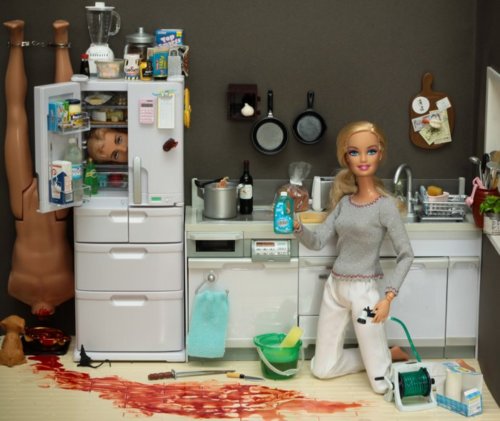
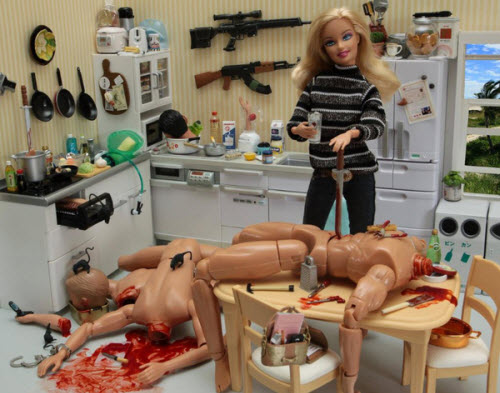
Augmented Barbie

Barbie & Louise

BoHo Barbie

Dominatrix Barbie
Life-Size Anatomically Correct Barbie
In Washington DC , at a Metro Station, on a cold January morning in 2007, a man with a violin played six Bach pieces for about 45 minutes. During that time, approximately 2000 people went through the station, most of them on their way to work.
After about four minutes, a middle-aged man noticed that there was a musician playing. He slowed his pace and stopped for a few seconds, and then he hurried on to meet his schedule.
About four minutes later, the violinist received his first dollar. A woman threw money in the hat and, without stopping, continued to walk.
At six minutes, a young man leaned against the wall to listen to him, then looked at his watch and started to walk again.
At ten minutes, a three-year old boy stopped, but his mother tugged him along hurriedly. The kid stopped to look at the violinist again, but the mother pushed hard and the child continued to walk, turning his head the whole time. This action was repeated by several other children, but every parent – without exception – forced their children to move on quickly.
At forty-five minutes: The musician played continuously. Only six people stopped and listened for a short while. About twenty gave money but continued to walk at their normal pace. The man collected a total of $32.
After one hour:
He finished playing and silence took over. No one noticed and no one applauded. There was no recognition at all.
No one knew this, but the violinist was Joshua Bell, one of the greatest musicians in the world. He played one of the most intricate pieces ever written, with a violin worth $3.5 million dollars. Two days before, Joshua Bell sold-out a theater in Boston where the seats averaged $100 each to sit and listen to him play the same music.
This is a true story. Joshua Bell, playing incognito in the D.C. Metro Station, was organized by the Washington Post as part of a social experiment about perception, taste and people’s priorities.
This experiment raised several questions:
In a common-place environment, at an inappropriate hour, do we perceive beauty?
If so, do we stop to appreciate it?
Do we recognize talent in an unexpected context?
One possible conclusion reached from this experiment could be this:
If we do not have a moment to stop and listen to one of the best musicians in the world, playing some of the finest music ever written, with one of the most beautiful instruments ever made…
How many other things are we missing as we rush through life?”
May there always be work for your hands to do;
May your purse always hold a coin or two;
May the sun always shine on your windowpane;
May a rainbow be certain to follow each rain;
May the hand of a friend always be near you;
May God fill your heart with gladness to cheer you,
and may you be in heaven a half hour before the devil knows you’re dead.
<########################################################>
London, Dec 14 : Historians believe that the remains of St. Nicholas, the man who inspired Father Christmas, are buried at Jerpoint Abbey in County Kilkenny, Ireland.
The bishop was buried in the cathedral church in Myra, which became a pilgrimage site, but Irish historians claim that the early crusaders brought his remains back to Jerpoint Abbey.
“It is an amazing story and yet very few people in Ireland know about St Nicholas”s connection with this country. Every year now we get visitors to the site, but still not that many,” The Telegraph quoted Philip Lynch, an historian and chairman of Callan Heritage Society in Co Kilkenny, as saying.
“There is a great story about a notorious old miser. He never gave the children any Christmas presents, instead he delighted in bringing them to Jerpoint and showing them Father Christmas”s grave,” he added.
It has previously believed that St Nicholas’s remains were taken to Bari in southern Italy in the 11th century after Italian sailors looted his grave.
However, Lynch claims there is evidence to suggest that a French family who settled in Ireland shortly after 1169 were responsible for moving his remains.
He believes that the crusading family, called the de Frainets, exhumed the tomb after they were routed by their enemies, and brought the content to southern Italy, which was then Norman lands.
When they were subsequently forced out of Italy by the Genoese, the remains were entrusted to relatives in Nice, who moved them to family lands in Kilkenny for safe keeping.
Nicholas de Frainet built a dedicated Cistercian Abbey at Jerpoint where St Nicholas’s remains were then interred in 1200.
“St Nicholas Church is still standing and there is a slab on the ground which marks St Nicholas”s grave,” Lynch said. (ANI)
(Submitted by Karan Jakhad)His name was Fleming, and he was a poor Scottish farmer. One day, while trying to make a living for his family, he heard a cry for help coming from a nearby bog. He dropped his tools and ran to the bog.
There, mired to his waist in black muck, was a terrified boy, screaming and struggling to free himself. Farmer Fleming saved the lad from what could have been a slow and terrifying death.
The next day, a fancy carriage pulled up to the Scotsman’s sparse surroundings. An elegantly dressed nobleman stepped out and introduced himself as the father of the boy Farmer Fleming had saved.
‘I want to repay you,’ said the nobleman. ‘You saved my son’s life.’
‘No, I can’t accept payment for what I did,’ the Scottish farmer replied waving off the offer. At that moment, the farmer’s own son came to the door of the family hovel.
‘Is that your son?’ the nobleman asked.
‘Yes,’ the farmer replied proudly.
‘I’ll make you a deal. Let me provide him with the level of education my own son will enjoy, if the lad is anything like his father, he’ll no doubt grow to be a man we both will be proud of.’ And that he did.
Farmer Fleming’s son attended the very best schools and in time, graduated from St. Mary’s Hospital Medical School in London, and went on to become known throughout the world as the noted Sir Alexander Fleming, the discoverer of Penicillin.
Years afterward, the same nobleman’s son who was saved from the bog was stricken with gonorrhea.
What saved his life this time? Penicillin.
The name of the nobleman? Lord Randolph Churchill .. His son’s name?
Sir Winston Churchill.
Someone once said: What goes around comes around.
Work like you don’t need the money.
Love like you’ve never been hurt.
Dance like nobody’s watching.
Sing like nobody’s listening..
Live like it’s Heaven on Earth.
And drink like Winston.
Hey Ladies, Garfunkel here again…I’m SO ready for you to call. I’m looking for a special hard-lovin’ woman to share my passion for life, love and funkin’.
It’s been a good while since I have been with a lady…in fact it’s been 45 years…so I’ve some spunk bottled up inside me like you wouldn’t believe!
So give me a call and I’ll release my love all over you…7826XXX
(If I’m not home…please leave a message with Mum and I’ll call you straight back and invite you round for a cuppa tea to meet my parents, we’ll read some psalms, heal the sick, cure the lame and I might even show you my extensive collection of used tissues!)
PS: If I miss your call, be sure to leave your name, age, bra size, hair length and underpants colour so that I can call you back with a mental picture of you in mind.
***Disclaimer: The Rongolian Lonely Hearts Club is a comedic parody, any resemblance to real persons living or dead is unintentional and purely coincidental.***
You know you’re Australian when:
Ten Rongolian Star Christmas Present Suggestions
1: The Bureaucratic Machine: The Most Useless Gadget Ever Invented!
2: The Jesus Toaster: Give us this day our Daily Bread…
The Jesus Toaster
3: The Claytons Husband: The Man you have when you’re not having a Man…
The HandyMan
4: A Housewife’s Dream!
A Christmas Present that Really SUCKS
5: For the ShutterBug
Camera Lens Coffee Cup with Lid
6: The Disposable Toilet (Perfect for Displaced Cantabrians)
The Cardboard Crapper
7: The Seedy Stuntman
The Bungy Bird Feeder
8: For Cool Canines
Doggles
9: Handy Undies
HanderPants
10: For the Firearm Enthusiast
Self Gun Control (Gun Control Begins at Home)
Rate this: