As a schoolgirl, Elise Burkevics was “way too cool for farming” despite attending Urrbrae Agricultural High School in Adelaide, South Australia, which specialises in training young people with agricultural aspirations.
More interested in art and design during her school years, it wasn’t until Burkevics graduated and entered the wide world that she discovered a passion for getting her hands dirty and the completion of a permaculture design course with Fair Harvest in Margaret River, Western Australia, really galvanized her passion for growing food and sparked her interest in the environment and sustainable living.
Burkevics moved to New Zealand in 2014 to pursue another passion–snowboarding– and applied to do a permaculture internship in the autumn of 2015 at the LivinginPeace Project in Karamea at the top of the West Coast of the South Island to put her theoretical understanding of permaculture into practice and gain valuable hands-on experience while waiting for the snowfields to open.
The LivingInPeace Project began in 2004 and is located in Karamea at the top of the West Coast of the South Island of New Zealand. It combines the elements of Art, Travel, Permaculture and Education into a sustainable business.
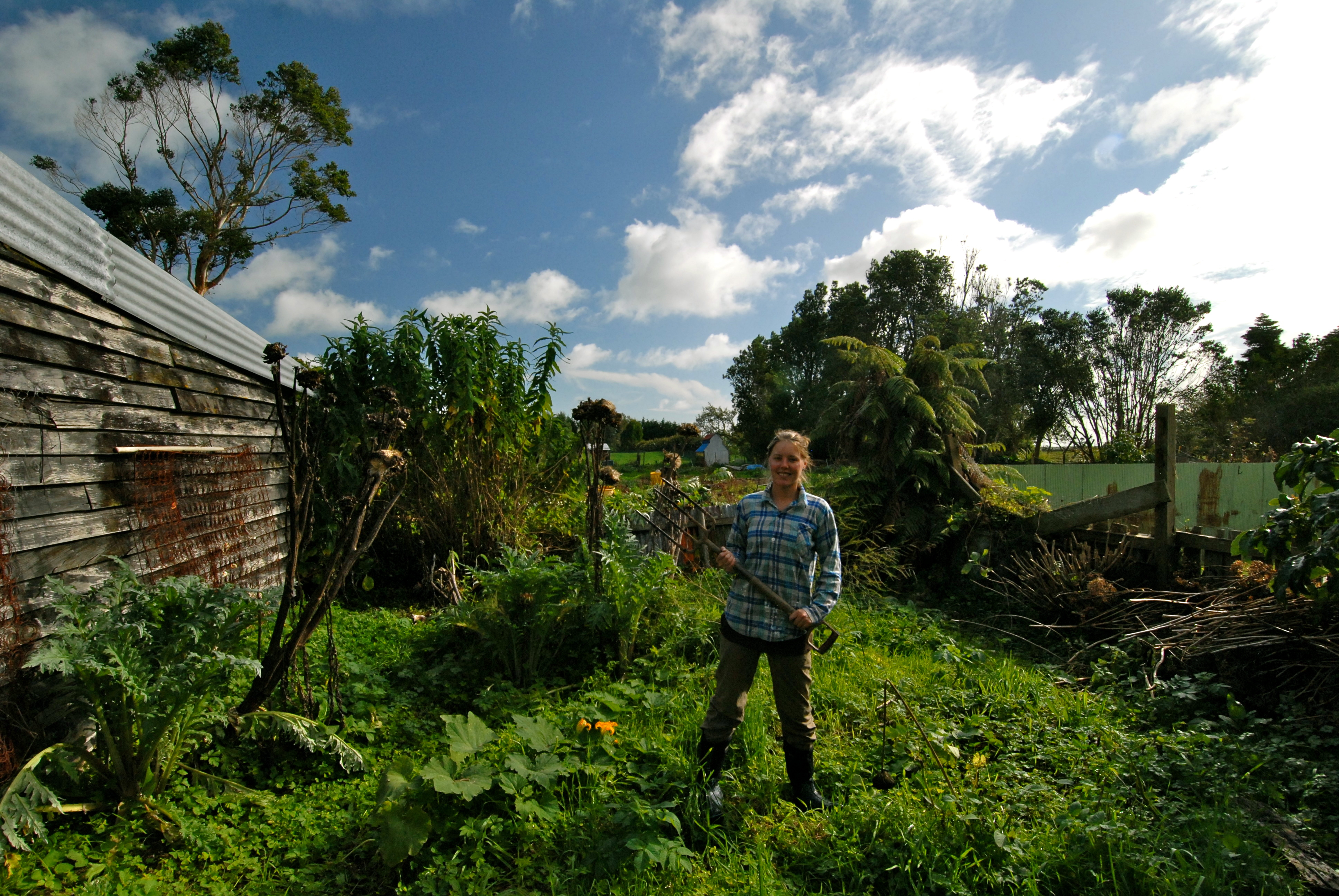
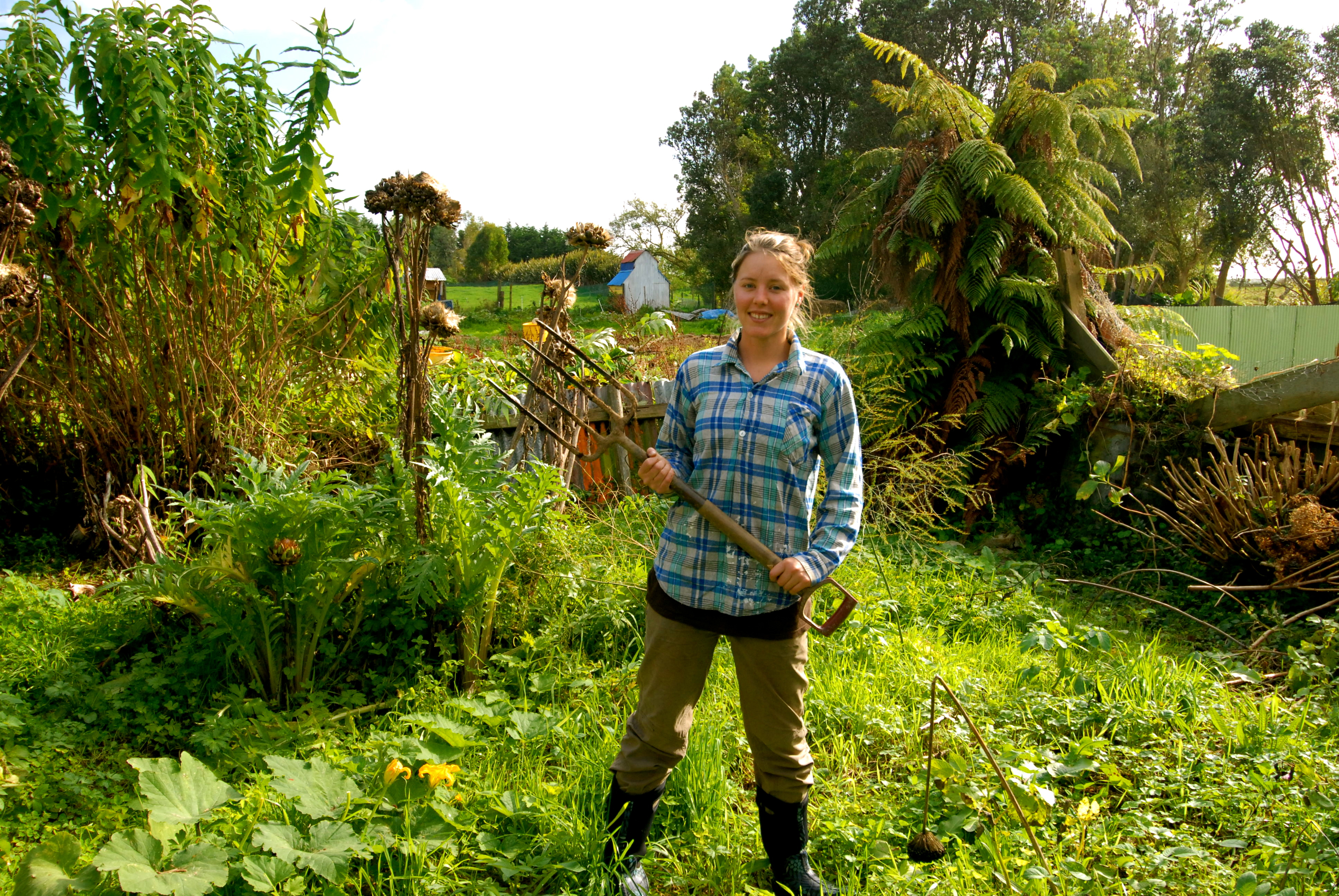
LivingInPeace Project founder Paul Murray offered Burkevics a chance to test her mettle and gave her an opportunity to shine. She enthusiastically accepted the challenge of transforming a neglected patch of garden that had become and jungle into a functional, artistically designed and fertile vegetable patch that would feed the Murray Family with fresh organic produce year-round.
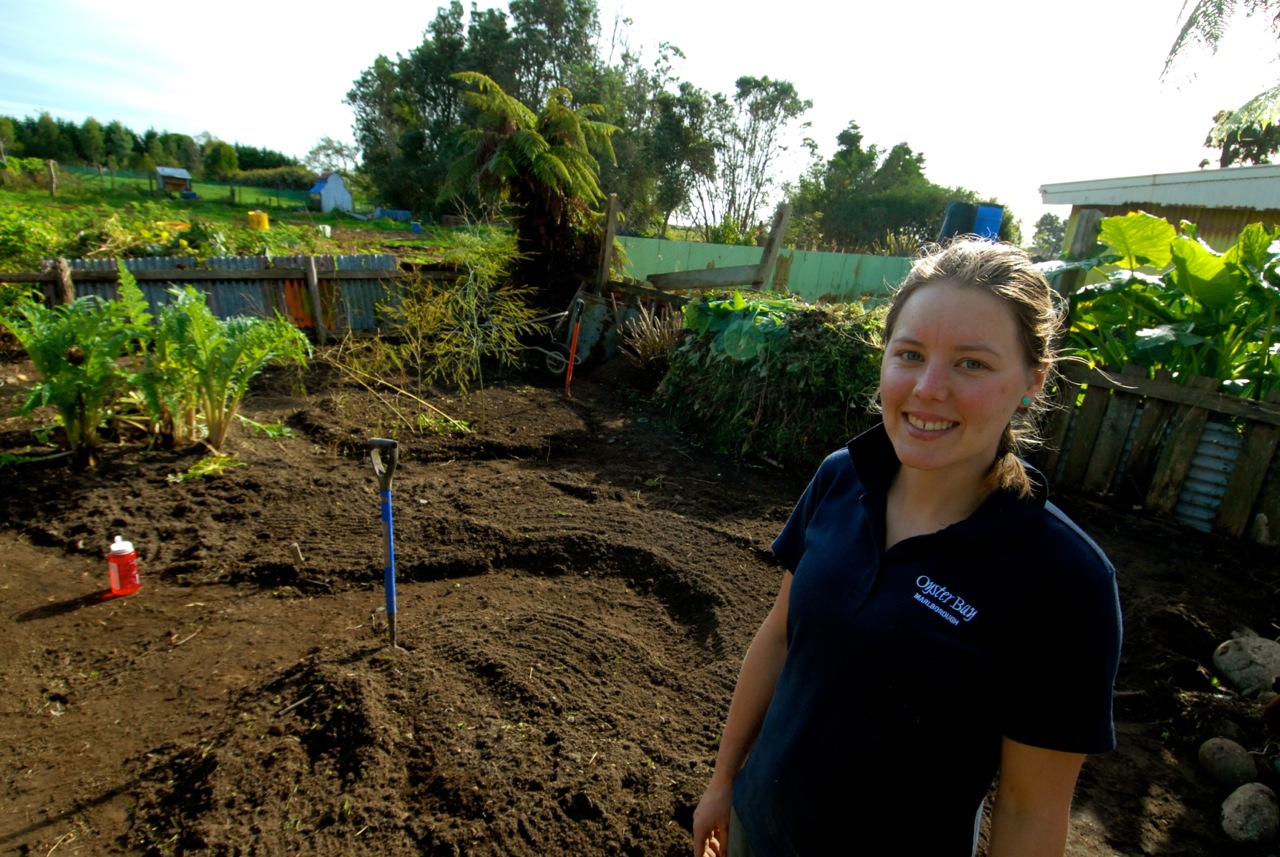
Elise Burkevics Prepares to Tackle the Jungle
After a discussion to establish the project objectives, Burkevics was given complete management authority to create the garden and she set to work with pick, shovel, fork and spade.
The garden had been continuously cropped for about 10 years, but left fallow for a year while the property owners were absent and had gone wild with weeds and overgrowth. This presented a significant challenge and one Burkevics accepted with glee.
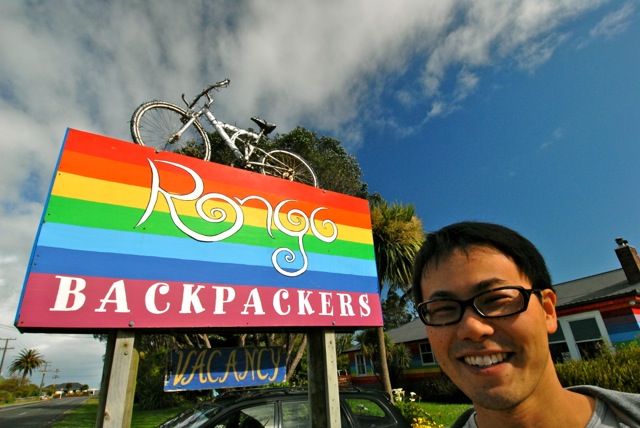
She first sat down and drew up a plan in line with her permaculture design training and decided to first remove the weeds and discover what existing plants, if any, could be incorporated into the garden design. The focus was on food production, so ornamental plants, flowers and non-edible vegetation was removed to make way for vegetables, herbs and fruit. So out came the hydrangeas and other ornamental plants, which were relocated to a garden at Rongo Backpackers & Gallery, one of the accommodation facilities at the LivingInPeace Project to enhance the landscaping around the hostel.
Day 2: Work Begins
The garden was once fertile and productive with a diverse range of edible plants. Burkevics embarked on an archeological dig to unearth the lost garden and determine if any of the plants could be rescued from the jungle and incorporated into the new design.
Day 4: Taming the Jungle
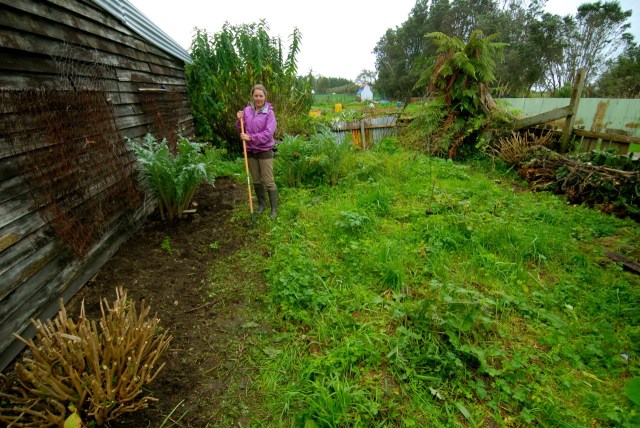
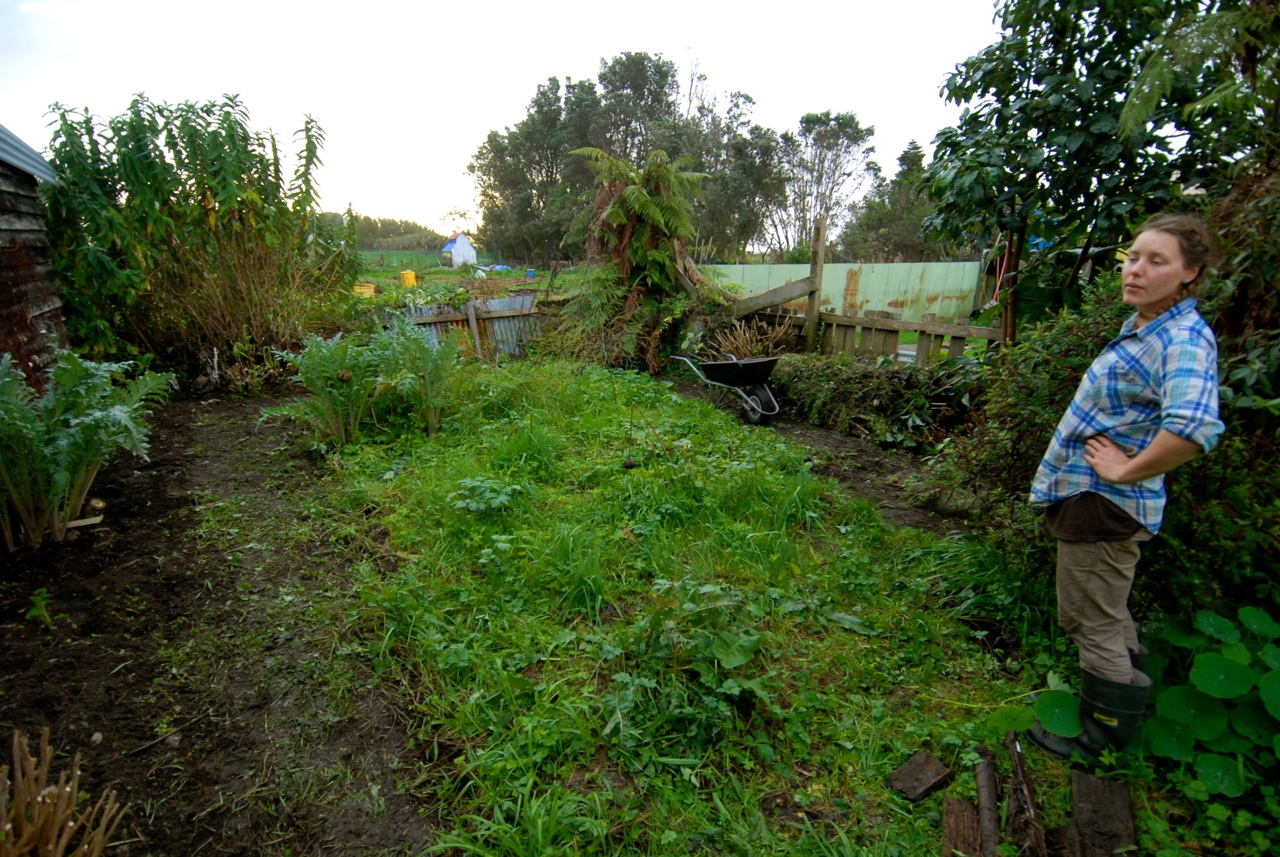
On Day 5, Murray decided Burkevics deserved some assistance and Wwoofer Kyla McLachlan offered to help. Together, they removed all the wild vegetation, tamed the jungle and started work on rebuilding the garden.
Kyla McLachlan and Elise Burkevics hard at work
Burkevics was happy to have some help and much progress was made when Kyla McLachlan arrived to assist.
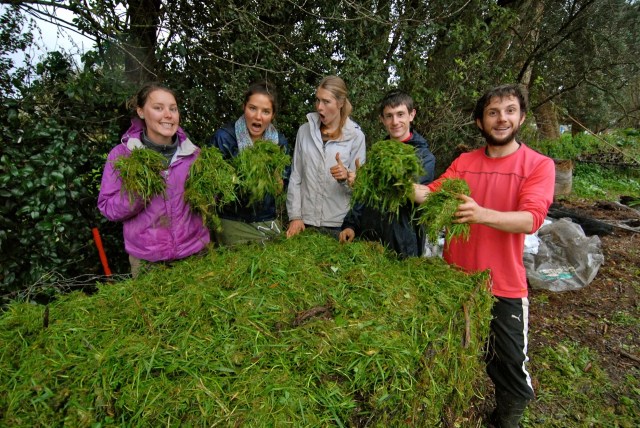
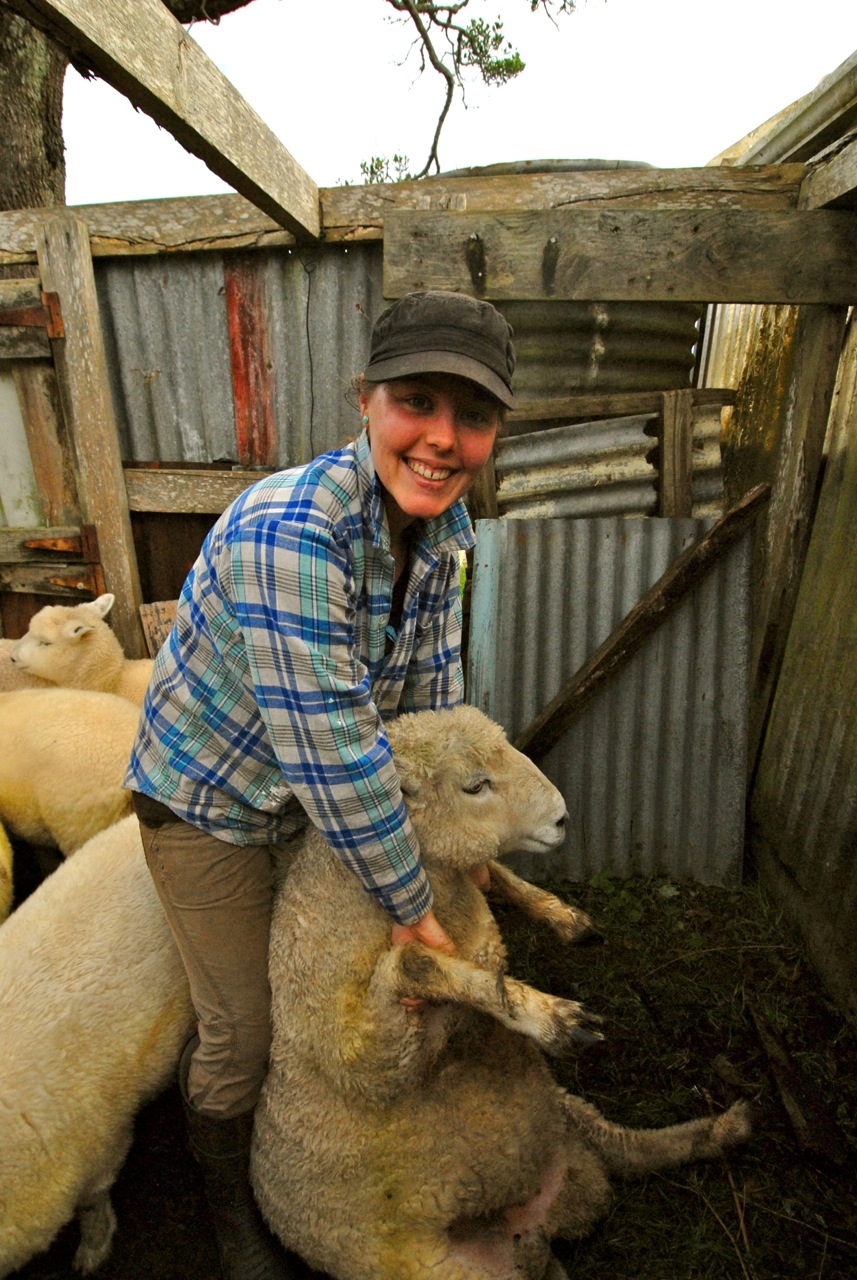
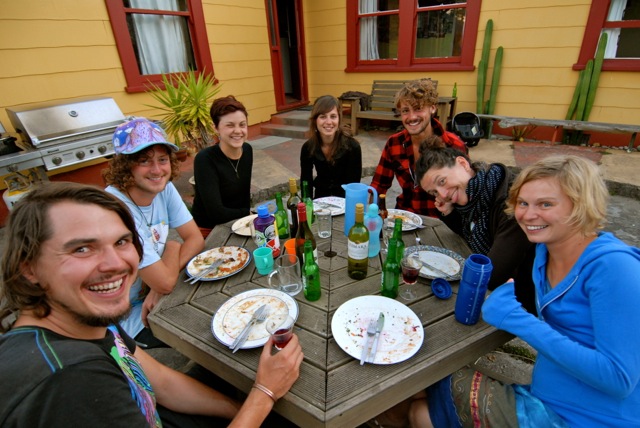
On Day 6, there was an opportunity to take a break from the project and do some other work on the LivingInPeace Project Permaculture Farm, so Burkevics and McLachlan joined the other members of the Wwoofing crew to make some compost and trim the sheep’s feet…and drink some beer.
Left to Right: Elise Burkevics, Kyla Mclachlan, Ruth Schrapper, Peter Dickinson and Jamie Tillett The LivingInPeace Project Wwoofing Crew.
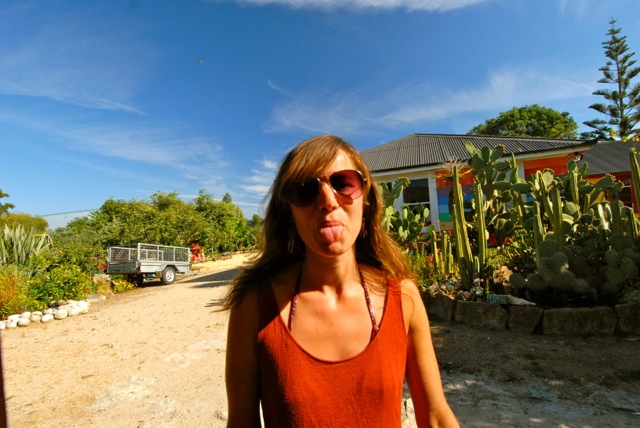
Elise Burkevics and Friend
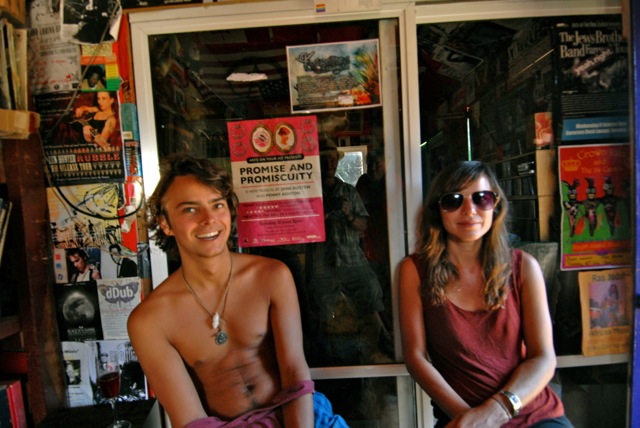
Elise Burkevics (left) and Kyla McLachlan
After a break, work on there garden resumed with gusto and Burkevics and McLachlan worked well together…progress was rapid. The garden design began to take shape, the pathways formed and the vegetable beds created. They lay cardboard along the pathways as a means of preventing the return of weeds and to provide a base for the river sand that was carted in to line the paths.
Day 6: The garden begins to take shape, pathways are created and lined with cardboard ready to be covered in river sand.
Burkevics applied her love of design to the project and came up with a garden layout that was not only functional and practical, but also aesthetically attractive.
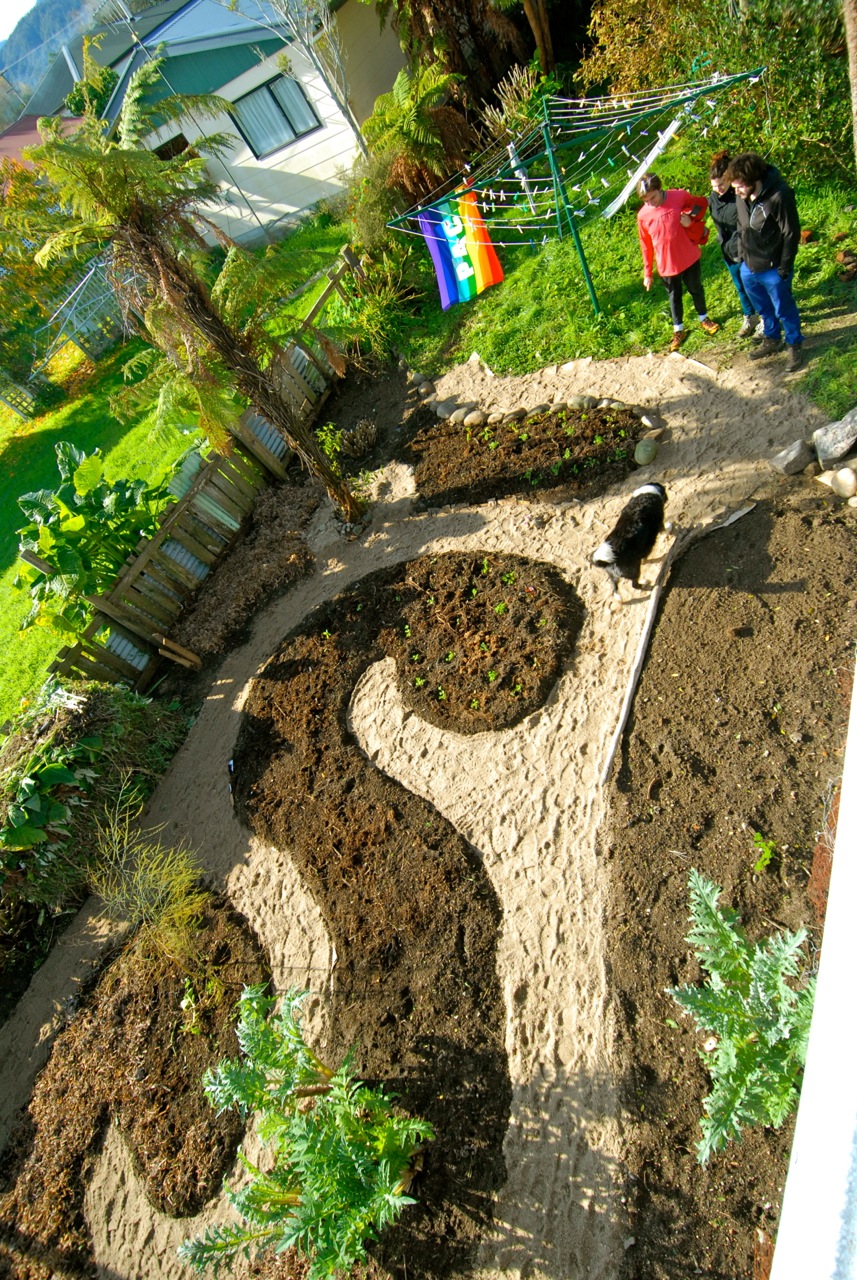
Once the sand was laid on the pathways, the garden beds were clearly defined and the white sand formed an attractive contrast with the rich, dark alluvial Karamea soil.
“Moo” inspects progress as the gardens begin to take shape.
Driftwood and granite river rocks were collected to edge the gardens and further enhance their aesthetic appeal and then the planting began. Silverbeet, brassica, lettuce and other seedlings were planted into the well-composted garden beds to provide a banquet of winter vegetables for the Murray Family to enjoy.
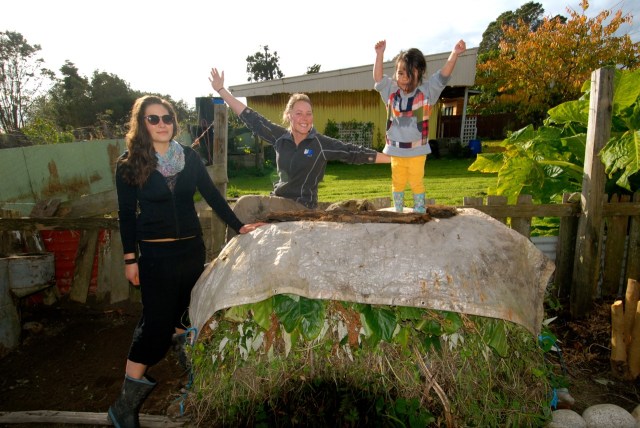
The weeds, grass, sticks and other organic material was piled up and covered to slowly break down and provide compost for the garden beds for the following season.
Diva Murray came to celebrate the completion of the garden reclamation project and climbed to the top of Mt Compost.
Many people stopped by to see the amazing transformation from jungle to garden on one week.
Kyla McLachlan, Elise Burkevics and Diva Murray stand in the completed gardens inspecting the newly planted seedlings.
Ten days later, the garden was complete. The mess of overgrown vegetation gone and in its place, tidy, aesthetically pleasing and productive garden beds with the promise of an abundance of winter vegetables.
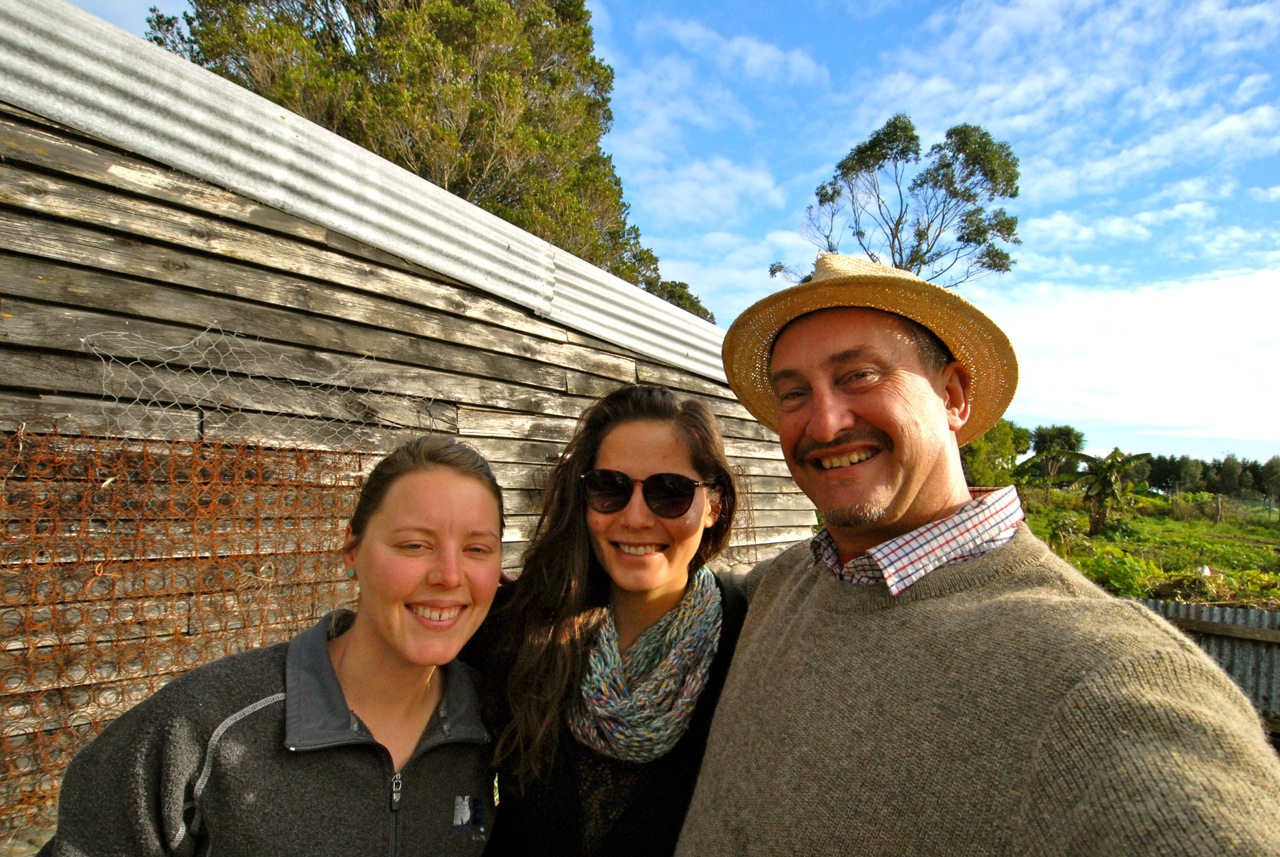
Very Happy: Client Paul Murray (right) was rather pleased with the results of the transformation of his overgrown former garden into neat artistic, functional and productive food patch by Elise Burkevics and Kyla McLachlan.
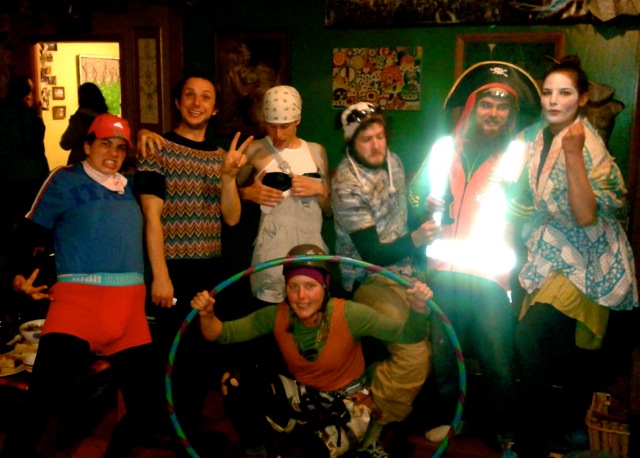
“Anachronism” Party at Rongo Backpackers & Gallery: May 27, 2015. Elise Burkevics (with Hula Hoop) and Kyla McLachlan (as a geisha). (Photo by Tristan Lockerbie)
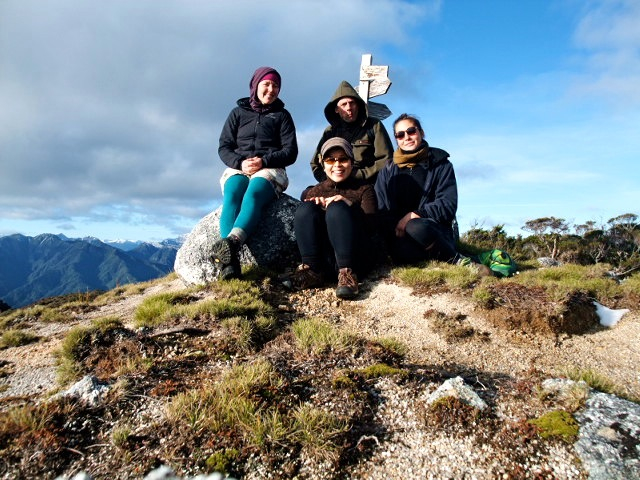
To celebrate the completion of the project, Burkevics and McLachlan joined the rest of the LivingInPeace Wwoofing Crew for an “Anachronism” dress-up dinner party and climbed Mt Stormy the following day. Thank you Ladies, Great Job!
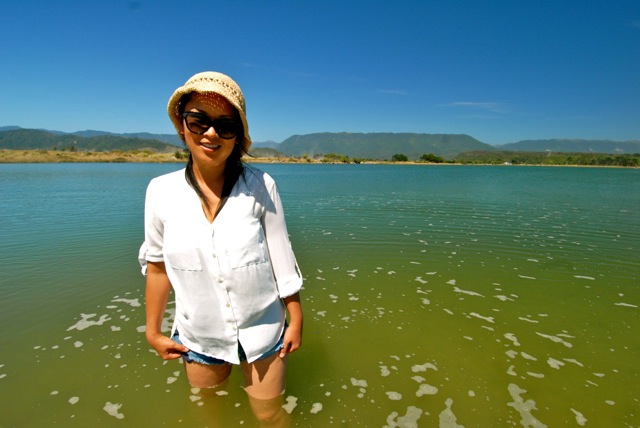
Elise Burkevics (left) and Kyla McLachlan (right) atop Mt Stormy. (Photo by Mitsuyo Numata)
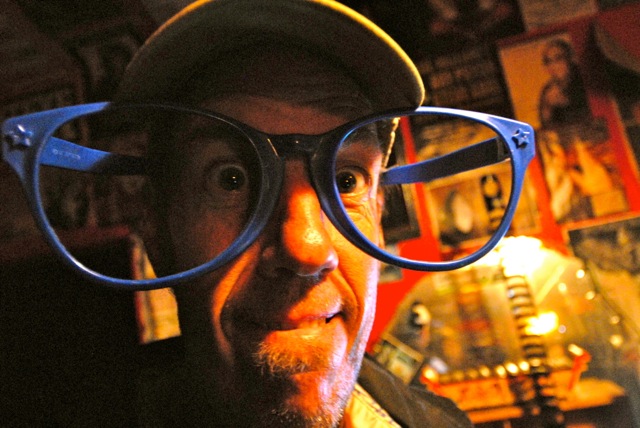
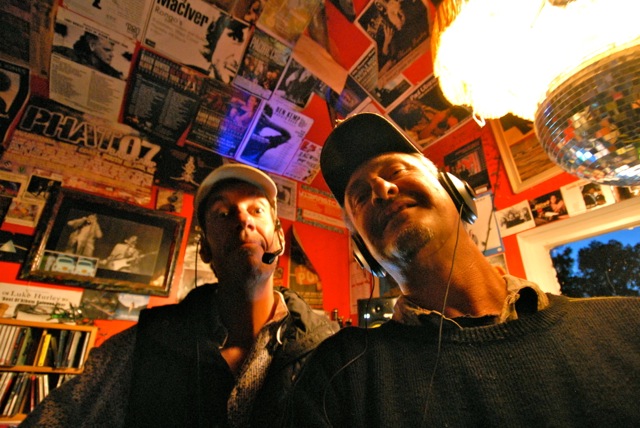
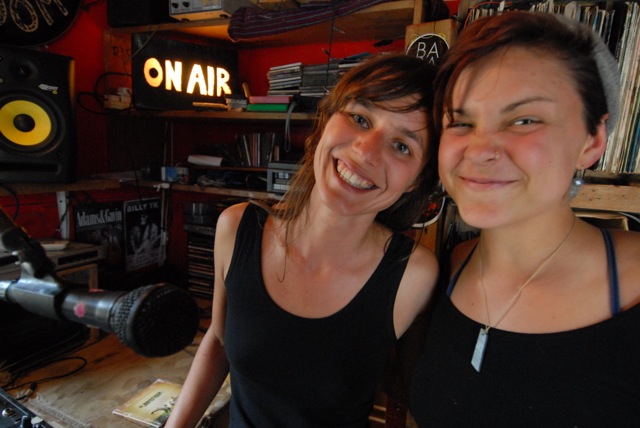
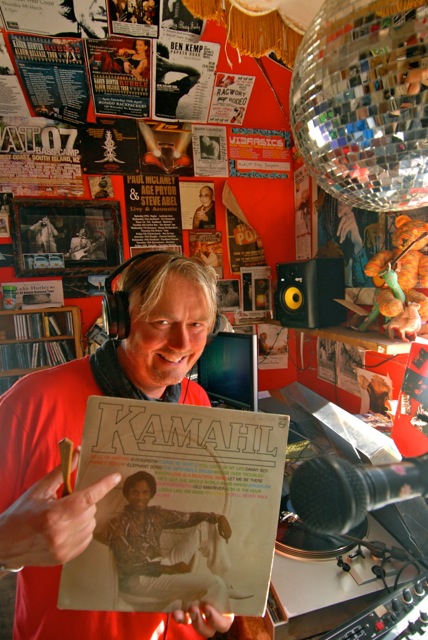
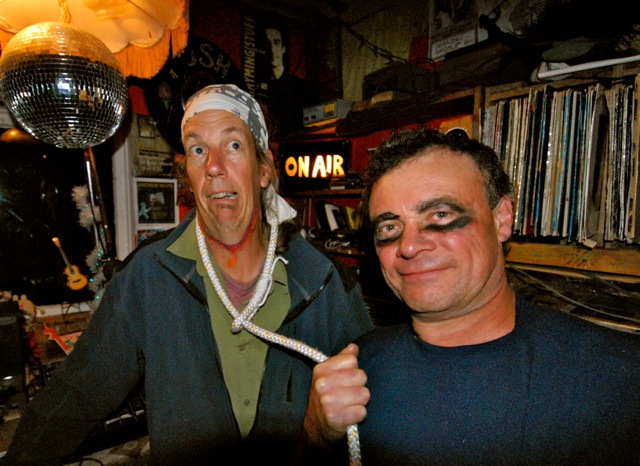
DJs Crap and Echo team up to bring the Karamea Radio public the music of the Appalacians, Ozarks and the Deep South…HillBilly Music tonight, put on your overalls, get your banjos out, knock out a couple teeth, marry your sister, chew on some straw, cook up a raccoon, go blind guzzlin’ moonshine, shoot some meth, saddle up a pig and get on down to this good ole HillBilly Hoedown…You’re Welcome!
This year we’re bringing the Hui back to it’s roots with a 4 day immerse experience.
The Hui’s focus is Moving On, set to a timely backdrop of blossoming regeneration in the Garden City of Christchurch, Aotearoa. This year we’re incorporating Gift Culture and Open Space Technology (OCT) along with the usual PiNZ AGM.
All ages and levels of experience welcome.
We start with a Welcome Day on…Friday 3rd April –
Creating space, Arrivals & Introductions.
Workshops & Meetings.
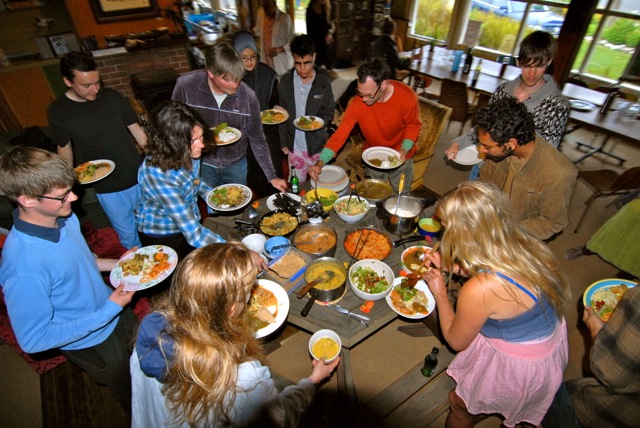
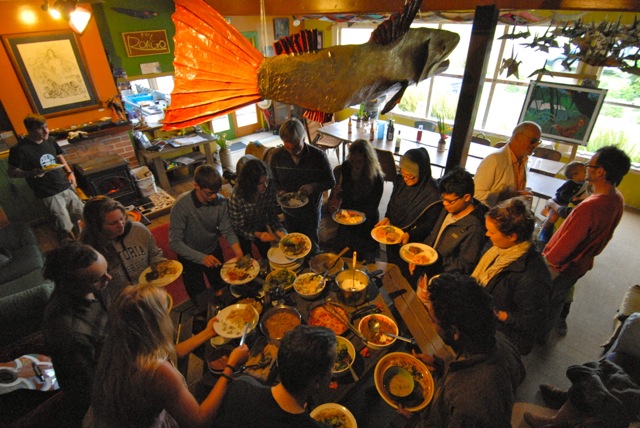
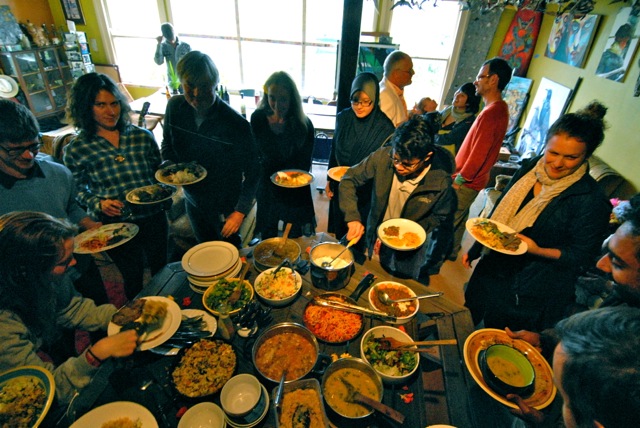
Potluck Evening Meal.
Then we will take a day each to explore the3 Permaculture Ethics…
Saturday – Earth Care – Kaitiakitanga
Provision for all life systems to continue and multiply.
Earth care encompasses care of the soil, care of all living systems, concepts like Gaia….
Sunday – People Care – Whanaungatanga
Provision for people to access the resources necessary for their existence.
People Care starts with the self – if you don’t take care of yourself you can’t care for anyone else! From the self, People Care spreads out to kin and community…
Monday – Fair Share – Manaakitanga
This is sometimes called “Surplus Share” or “Share our Resources”.
By governing our own needs, we can set resources aside to further our ethics.
Set limits to consumption, growth and population.
We’ll explore how to harness the ethics and principles of permaculture in all areas of our lives to move us towards Sustainability, Regeneration & Abundance by using a blend of Presentations, Talks, Open Circles and OST.
Plus Music, Movies and Stories to entertain us in the evenings.
And plenty of time for sharing, connecting and exploring all things permaculture & beyond!
Fresh local organic Food & Drink provided. Though, this year there is no accommodation at the Hui site. After careful consideration, Central New Brighton School Hall was chosen to host. This has kept the ticket prices as low as possible, and the hui easily accessible and open to more people. Watch this space for information on lift shares, accommodation & billeting options.
Planning the 2015 Hui has been a great adventure so far…. We invite you to join us for a long weekend of Learning, Sharing & Dancing!
Book Review: “Feral: Rewilding the Land, Sea and Human Life” by George Monbiot
Off the Top of My Head
By Paul Murray
Oxford-educated Zoologist and writer George Monbiot takes on the subject of rewilding in his latest book “Feral” and makes it real by searching out and documenting practical examples of its successful application and exploring possibilities of furthering the concept to restore damaged ecosystems for the betterment of human life by recognising that the natural world is integral to our well being.
Wikipedia describes “Rewilding” as “large-scale conservation aimed at restoring and protecting natural processes and core wilderness areas, providing connectivity between such areas, and protecting or reintroducing apex predators and keystone species.”
Conservation is a hot topic these days and everyone has their own perception of what it is and how it should be applied. Monbiot introduces the concept of the “Shifting Baseline Theory” whereby people and conservation groups only seek to restore the environment to the level of their personal experience and recollection of how it once was, not necessarily how it naturally existed, or its natural state. Rewilding is a process that permits nature to conserve and restore itself.
Jasper James/Getty Images
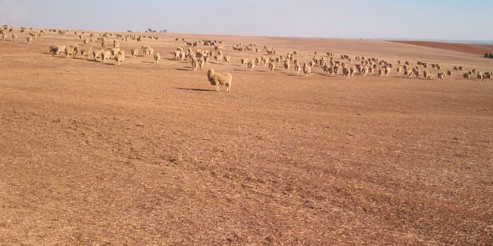
In many parts of the world, relentless grazing by sheep, goats and other livestock limits the re-establishment of the natural environment by browsing young plants and preventing them from reaching maturity. Monbiot suggests that large tracts of Scotland, Ireland, England and Wales (where he lives) are devoid of woodland, forest and have depleted ecosystems as a result of centuries of overgrazing in a chapter he titled “Sheepwrecked.” The same certainly applies in Australia and New Zealand and all other countries where broad-scale grazing practices are common and landscapes are devoid of vegetation and the natural life systems it supports. Rewilding offers a positive means of correcting the damage done and restoring biodiversity.
A “sheepwrecked” landscape
Rewilding is no longer merely an idea or theoretical concept; it has been successfully applied with numerous unexpected benefits. Perhaps the best example is the reintroduction of wolves to Yellowstone National Park in the United States. Wolves had been absent from the park for about 70 years after having been completely hunted out. This led to a proliferation of grazing animals, particularly red deer (or elk), which were then permitted to reproduce freely in an environment without predators. The increase in deer numbers resulted in a marked decrease in vegetation, loss of habitat for birds and animals that had sheltered in the grass and woodlands that existed there before heavy grazing by deer drastically altered the original landscape.
The reintroduction of a dominant predator, in this case wolves, led to an initial reduction in deer numbers, but also a change in the behavior of the deer. They no longer grazed in the valleys, canyons, gulches and gorges, zones where they felt vulnerable to predation. They were restricted to the grasslands and plains where they were able to more easily escape wolf attack. This enabled the vegetation to re-establish in the less open areas, woodlands returned, saplings were allowed to become trees, the trees and the shelter they provide allowed birds to return, small animals found home in the undergrowth, rabbits and mice returned providing a food source for weasels, foxes and birds of prey, which also fed on the carrion left by the wolves.
Bears also came to feed on the berries, carrion and assisted the wolves in the ecological reengineering process by eating deer calves. Beavers came down the rivers and recolonised the banks, built their dams, slowed the flow of the river, which rehydrated the land, facilitating further vegetation growth and stabilising the riverbanks, reducing erosion and soil loss, the river meandered less, the entire ecosystem became more robust, balanced and steadfast. The reintroduction of wolves changed the entire landscape, significantly increased the biodiversity and health of the environment and initiated a natural top-down succession process that has been termed a “trophic cascade.”
The idea of reintroducing wolves to the Yellowstone National Park met with significant resistance, but proponents of rewilding overcame the challenges to the ideas and the people who feared their grandmothers might be eaten and were permitted to release a few wolves into the park to see what effect they would have on the ecosystem. The results far exceeded all expectations and did much to establish the concept of rewilding as a means of repairing damaged landscapes. No grandmas died, no houses were blown down, no one was mauled when the moon was full…the net result definitely justified the means and Yellowstone is now significantly more valuable as a national park, sustains vastly more plants and animals and is far more stable environmentally since the wolves were returned.
How Wolves Change Rivers:
Oceans too can be rewilded; in fact the process is simpler than land rewilding as there are less physical barriers to the movement of plants and animals through the water. The creation of marine reserves around the world has produced remarkable results in quickly restoring fish stocks, species diversity and seabed vegetation. By prohibiting fishing trawlers from regions of the ocean, breeding zones and ecologically significant areas, the number, size and types of aquatic species soon recover and proliferate. Monbiot states that by allowing fish and other marine life the protection they need to regenerate their numbers, fish catches and associated economic return outside the marine reserves have increased.
Another interesting revelation in the book is the importance of whales to the ocean environment and indeed the entire Earth. Whales eat fish, plankton and krill, and it turns out that they also sustain their food sources. Monbiot convincingly demonstrates that removing whales from the ecosystem leads to a trophic collapse of fish, plankton and krill numbers, quite the opposite of claims by the Japanese government and others that removing whales will increase fish numbers and improve catches and allow more food for humans.
Whales feed in the dark depths of the ocean and then return to the surface for air. In the photic zone, the upper levels of the ocean where sunlight penetrates the water, the whales release what scientists politely refer to as “faecal plumes,” meaning they defecate in the water, effectively fertilsing the ocean in the photic zone where photosynthesis occurs. Whale excrement is rich in iron and nitrogen and these nutrients significantly enhance the growth of plankton, which in turn, supports other aquatic life.
By deep diving and returning to the surface, the whales also create turbulence in the water that circulates plankton back up into the photic zone where it can reproduce. The plankton, like all plants, absorbs carbon dioxide and sunlight as it grows. It then sinks to the ocean floor effectively removing carbon from atmospheric circulation and storing it. The sequestration of CO2 by plankton is an important process in the balancing of carbon levels in the atmosphere and Monbiot suggests that the action of whales removes “tens of millions of tonnes” of carbon from the atmosphere, benefits of which reach far beyond the ocean and assists human life and the general health of the planet as well.
How Whales Change Climate:
In addition to significant environmental benefits, rewilding has been shown to generate a much better financial return from rural land than grazing. Environmental tourism, bird and animal watchers, botanical tour groups etc. are attracted to rewilded areas, spending money as they go, Monbiot lists numerous examples in his book of vastly better economic results from eco-tourism than agriculture.
The Anthropecene epoch is in danger of being remembered historically by future peoples as the stupidest, most apathetic, ignorant and indecisive generation ever for its inaction and inability to accept and meet current environmental challenges and for our unwillingness to change, even though we know we must.
Nature knows nothing of shifting baseline theory, as its memory is timeless. In fact, time is all nature requires to fully restore itself. Rewilding is a simple and cost-effective means of restoring damaged environments, it’s as simple as removing grazing animals from an ecosystem and allowing it to regenerate, create habitat, shelter, food sources that permit and sustain wild animals. Perhaps it’s time for humans to respect the power of nature to heal itself, defer to a greater authority on the subject of eco-management and allow natural systems to rewild themselves for the great benefit of all concerned.
Transcript of TED Talk on Rewilding by George Monbiot:
When I was a young man, I spent six years of wild adventure in the tropics working as an investigative journalist in some of the most bewitching parts of the world. I was as reckless and foolish as only young men can be. This is why wars get fought. But I also felt more alive than I’ve ever done since. And when I came home, I found the scope of my existence gradually diminishing until loading the dishwasher seemed like an interesting challenge. And I found myself sort of scratching at the walls of life, as if I was trying to find a way out into a wider space beyond. I was, I believe, ecologically bored.
Now, we evolved in rather more challenging times than these, in a world of horns and tusks and fangs and claws. And we still possess the fear and the courage and the aggression required to navigate those times. But in our comfortable, safe, crowded lands, we have few opportunities to exercise them without harming other people. And this was the sort of constraint that I found myself bumping up against. To conquer uncertainty, to know what comes next, that’s almost been the dominant aim of industrialized societies, and having got there, or almost got there, we have just encountered a new set of unmet needs. We’ve privileged safety over experience and we’ve gained a lot in doing so, but I think we’ve lost something too.
Now, I don’t romanticize evolutionary time. I’m already beyond the lifespan of most hunter-gatherers, and the outcome of a mortal combat between me myopically stumbling around with a stone-tipped spear and an enraged giant aurochs isn’t very hard to predict. Nor was it authenticity that I was looking for. I don’t find that a useful or even intelligible concept. I just wanted a richer and rawer life than I’ve been able to lead in Britain, or, indeed, that we can lead in most parts of the industrialized world.
And it was only when I stumbled across an unfamiliar word that I began to understand what I was looking for. And as soon as I found that word, I realized that I wanted to devote much of the rest of my life to it.
The word is “rewilding,” and even though rewilding is a young word, it already has several definitions. But there are two in particular that fascinate me. The first one is the mass restoration of ecosystems.
One of the most exciting scientific findings of the past half century has been the discovery of widespread trophic cascades. A trophic cascade is an ecological process which starts at the top of the food chain and tumbles all the way down to the bottom, and the classic example is what happened in the Yellowstone National Park in the United States when wolves were reintroduced in 1995. Now, we all know that wolves kill various species of animals, but perhaps we’re slightly less aware that they give life to many others. It sounds strange, but just follow me for a while. Before the wolves turned up, they’d been absent for 70 years. The numbers of deer, because there was nothing to hunt them, had built up and built up in the Yellowstone Park, and despite efforts by humans to control them, they’d managed to reduce much of the vegetation there to almost nothing, they’d just grazed it away. But as soon as the wolves arrived, even though they were few in number, they started to have the most remarkable effects. First, of course, they killed some of the deer, but that wasn’t the major thing. Much more significantly, they radically changed the behavior of the deer. The deer started avoiding certain parts of the park, the places where they could be trapped most easily, particularly the valleys and the gorges, and immediately those places started to regenerate. In some areas, the height of the trees quintupled in just six years. Bare valley sides quickly became forests of aspen and willow and cottonwood. And as soon as that happened, the birds started moving in. The number of songbirds, of migratory birds, started to increase greatly. The number of beavers started to increase, because beavers like to eat the trees. And beavers, like wolves, are ecosystem engineers. They create niches for other species. And the dams they built in the rivers provided habitats for otters and muskrats and ducks and fish and reptiles and amphibians. The wolves killed coyotes, and as a result of that, the number of rabbits and mice began to rise, which meant more hawks, more weasels, more foxes, more badgers. Ravens and bald eagles came down to feed on the carrion that the wolves had left. Bears fed on it too, and their population began to rise as well, partly also because there were more berries growing on the regenerating shrubs, and the bears reinforced the impact of the wolves by killing some of the calves of the deer.
But here’s where it gets really interesting. The wolves changed the behavior of the rivers. They began to meander less. There was less erosion. The channels narrowed. More pools formed, more riffle sections, all of which were great for wildlife habitats. The rivers changed in response to the wolves, and the reason was that the regenerating forests stabilized the banks so that they collapsed less often, so that the rivers became more fixed in their course. Similarly, by driving the deer out of some places and the vegetation recovering on the valley sides, there was less soil erosion, because the vegetation stabilized that as well. So the wolves, small in number, transformed not just the ecosystem of the Yellowstone National Park, this huge area of land, but also its physical geography.
Whales in the southern oceans have similarly wide-ranging effects. One of the many post-rational excuses made by the Japanese government for killing whales is that they said, “Well, the number of fish and krill will rise and then there’ll be more for people to eat.” Well, it’s a stupid excuse, but it sort of kind of makes sense, doesn’t it, because you’d think that whales eat huge amounts of fish and krill, so obviously take the whales away, there’ll be more fish and krill. But the opposite happened. You take the whales away, and the number of krill collapses. Why would that possibly have happened? Well, it now turns out that the whales are crucial to sustaining that entire ecosystem, and one of the reasons for this is that they often feed at depth and then they come up to the surface and produce what biologists politely call large fecal plumes, huge explosions of poop right across the surface waters, up in the photic zone, where there’s enough light to allow photosynthesis to take place, and those great plumes of fertilizer stimulate the growth of phytoplankton, the plant plankton at the bottom of the food chain, which stimulate the growth of zooplankton, which feed the fish and the krill and all the rest of it. The other thing that whales do is that, as they’re plunging up and down through the water column, they’re kicking the phytoplankton back up towards the surface where it can continue to survive and reproduce. And interestingly, well, we know that plant plankton in the oceans absorb carbon from the atmosphere — the more plant plankton there are, the more carbon they absorb — and eventually they filter down into the abyss and remove that carbon from the atmospheric system. Well, it seems that when whales were at their historic populations, they were probably responsible for sequestering some tens of millions of tons of carbon every year from the atmosphere.
And when you look at it like that, you think, wait a minute, here are the wolves changing the physical geography of the Yellowstone National Park. Here are the whales changing the composition of the atmosphere. You begin to see that possibly, the evidence supporting James Lovelock’s Gaia hypothesis, which conceives of the world as a coherent, self-regulating organism, is beginning, at the ecosystem level, to accumulate.
Trophic cascades tell us that the natural world is even more fascinating and complex than we thought it was. They tell us that when you take away the large animals, you are left with a radically different ecosystem to one which retains its large animals. And they make, in my view, a powerful case for the reintroduction of missing species. Rewilding, to me, means bringing back some of the missing plants and animals. It means taking down the fences, it means blocking the drainage ditches, it means preventing commercial fishing in some large areas of sea, but otherwise stepping back. It has no view as to what a right ecosystem or a right assemblage of species looks like. It doesn’t try to produce a heath or a meadow or a rain forest or a kelp garden or a coral reef. It lets nature decide, and nature, by and large, is pretty good at deciding.
Now, I mentioned that there are two definitions of rewilding that interest me. The other one is the rewilding of human life. And I don’t see this as an alternative to civilization. I believe we can enjoy the benefits of advanced technology, as we’re doing now, but at the same time, if we choose, have access to a richer and wilder life of adventure when we want to because there would be wonderful, rewilded habitats.
And the opportunities for this are developing more rapidly than you might think possible. There’s one estimate which suggests that in the United States, two thirds of the land which was once forested and then cleared has become reforested as loggers and farmers have retreated, particularly from the eastern half of the country. There’s another one which suggests that 30 million hectares of land in Europe, an area the size of Poland, will be vacated by farmers between 2000 and 2030.
Now, faced with opportunities like that, does it not seem a little unambitious to be thinking only of bringing back wolves, lynx, bears, beavers, bison, boar, moose, and all the other species, which are already beginning to move quite rapidly across Europe? Perhaps we should also start thinking about the return of some of our lost megafauna.
What megafauna, you say? Well, every continent had one, apart from Antarctica. When Trafalgar Square in London was excavated, the river gravels there were found to be stuffed with the bones of hippopotamus, rhinos, elephants, hyenas, lions. Yes, ladies and gentlemen, there were lions in Trafalgar Square long before Nelson’s Column was built. All these species lived here in the last interglacial period, when temperatures were pretty similar to our own. It’s not climate, largely, which has got rid of the world’s megafaunas. It’s pressure from the human population hunting and destroying their habitats which has done so.
And even so, you can still see the shadows of these great beasts in our current ecosystems. Why is it that so many deciduous trees are able to sprout from whatever point the trunk is broken? Why is it that they can withstand the loss of so much of their bark? Why do understory trees, which are subject to lower sheer forces from the wind and have to carry less weight than the big canopy trees, why are they so much tougher and harder to break than the canopy trees are? Elephants. They are elephant-adapted. In Europe, for example, they evolved to resist the straight-tusked elephant, elephas antiquus, which was a great beast. It was related to the Asian elephant, but it was a temperate animal, a temperate forest creature. It was a lot bigger than the Asian elephant. But why is it that some of our common shrubs have spines which seem to be over-engineered to resist browsing by deer? Perhaps because they evolved to resist browsing by rhinoceros.
Isn’t it an amazing thought that every time you wander into a park or down an avenue or through a leafy street, you can see the shadows of these great beasts? Paleoecology, the study of past ecosystems, crucial to an understanding of our own, feels like a portal through which you may pass into an enchanted kingdom. And if we really are looking at areas of land of the sort of sizes I’ve been talking about becoming available, why not reintroduce some of our lost megafauna, or at least species closely related to those which have become extinct everywhere? Why shouldn’t all of us have a Serengeti on our doorsteps?
And perhaps this is the most important thing that rewilding offers us, the most important thing that’s missing from our lives: hope. In motivating people to love and defend the natural world, an ounce of hope is worth a ton of despair. The story rewilding tells us is that ecological change need not always proceed in one direction. It offers us the hope that our silent spring could be replaced by a raucous summer.
A New Zealand Government Department authorised by a covertly suspicious and deliberately rhetorical Act of Parliament and compounded by a dubiously tacit Royal Approval to receive official complaints.
Karamea Ministry of Red Tape, Front Office, Monday February 2nd 2015, 11 a.m.
Red Scarlett: “Troops! Attention!”
stomp……stomp……stomp……stomp………stomp…..
DBeelzePub: “Time for elevenses!! Final orders!!”
Inspector Clouseau: “Yeah cobba! I’ll have a four and a half of Jack Daniel’s!”
DBeelzePub: “Ice sir?”
Inspector Clouseau: “Yeah strewth! What the hell! Make it a double!”
Silly Hillary: ….puff…..puff…puff…….. “The sky is falling! The sky is falling and I’m off to to tell the President!”
DBeelzePub: “A snifter, Madam?”
Silly Hilary: “Well, I’m on a hi-carb, high fibre diet..so…um…..?”
DBeelzePub: “ There we are madam! A Gin and Tonic shaken not stirred! I have added a squeezed meat pie and three crushed weetbix and even included one of those ridiculously silly umbrellas!”
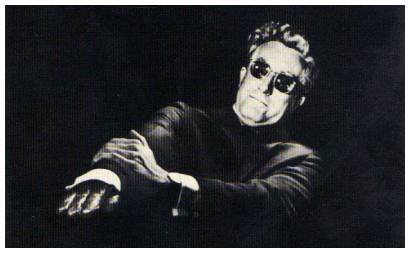
Dr. StrangeLove : “Ya! I need a second opinion! Ya!”
Doctor Ahmed El Kabir: “Quack! Quack! Quack!”
Silly Hillary “I do not believe that you are a doctor!”
Doctor Ahmed El Kabir: “Well goodness gracious me! I can hear your heart going boompty boompty boom boom!”
Silly Hillary: “Impostor! Show me your credentials!”
Doctor Ahmed El Kabir: “Satisified Madam Sahbi!”
Silly Hillary: “Well I do declare! Handsome! You had better take my temperature doctor!”
Doctor StrangeLove: “Ya fraulein! Open wide! Say Ah! I am going to give you 10 cc of Podium Penthouse Barbie Doll! Zen you will tell ze truth and nothing but ze truth! Ya!”
Silly Hillary: “You prick!”
Inspector Clouseau: “Senator Silly Hillary Clinton I arrest you in the name of the law!”
Silly Hillary: “Whatever the crime, I Plead the 5th!”
Inspector Clouseau: “You Madame, have been charged with International War Crimes complicit with the secret destabilisation of the proud Muslim nations of the Middle East!
Silly Hillary: “It was President Bollocks O’Bananas idea! I’m just a porn!
Inspector Clouseau: “Guilty as charged! You Madame, will face Madame Guillotine at dawn!”
Silly Hillary: “Oh my! I’m going to get my own wax work! Eat dirt Taylor Swift!”
Doctor Ahmed El Kabir: “Why is the American CIA funding and arming diametrically opposed fundamentalist groups in Syria and Iraq!”
Silly Hillary: “I want to see a lawyer!”
Rumpole of the Bailey : “Allow me to introduce myself! Rumpole QC!”
Silly Hillary: “Hump Roll?”
Rumpole of the Bailey: “Rumpole! Horace Rumpole! Here is my ID!”
Silly Hillary: “Oh wow! My! That is a real mouth full!”
Father Ted: “I’m Father Ted! I’m here to take your last confession child!”
Silly Hillary: “Father! Your cockpit is wide open!”
Father Ted: “It’s t’ scouts motto! Always be prepared!”
Silly Hillary: “It’s been yonks since my last confession Father!”
Father Ted: “On your knees child and I will allow you to partake of the Holy Sacraments!”
Silly Hillary: “After my last confession, will I be with child Father?”
Father Ted: “No child! When I take confession, I always wear an Immaculate Contraception!
Kapow!!!!
Radio Karamea 107.5 FM with Claptrap Eriction…”I shot my dickoff etc!” …….. “I shot my dickoff, I shot my dickoff, but I did not shoot my booty!”
Mr. Covert: “Freeze or I’ll shoot!”
Father Ted: “Patience lad! Holster your weapon and I’ll tend to you next!”
Mr. Covert: “ C’mon Senator Clinton! Pull up your panties, I’ve got a rescue copter at the Karamea airport!”
Karamea Airport, Opapara
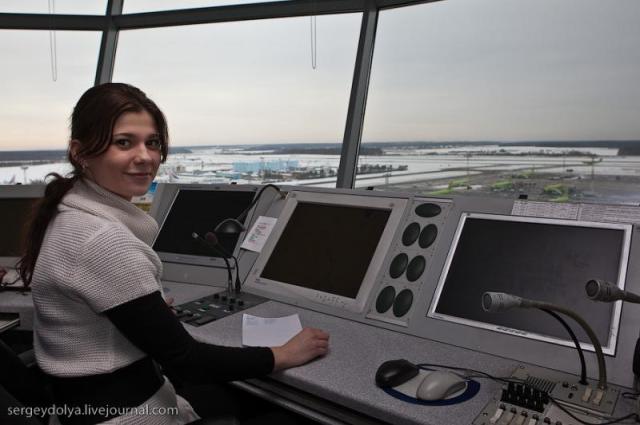
Captain America: “Karamea Control Tower! This is US 9-11requesting takeoff over!”
Karamea Control Tower: “Da! Permissioning for takeoff comrade!”
Captain America: “We have liftoff!”
Silly Hillary: “Oh Captain America! You saved my pretty sweet white ass! How can I ever repay you?”
Captain America: “You can take a hold of my joystick for a couple of minutes!!!”
Silly Hillary : “Oh my! It’s my lucky day!”
Mr. Covert: “Nooo!! Look we just lost the left wing and half the fuselage!
Silly Hillary: “Aaaaghhh!!!! We’re going to be late for the Super Bowl!!!
Captain America: “Mayday! Mayday!Mayday! We’re going to crash! We’re going down! Put your head betweeen your legs!”
Silly Hillary: “Aaagghhh!!!!!”
Captain America: “No! Senator Clinton I meant between your own legs!”
…Radio Karamea 107.5 FM “B.b.b.b.a.d to the Boner!”
Mr. Covert: “Yikes! Look! It’s the Dallas Book Depository on Dealey Plaza!”
Interview with Swedish Fishermen Normann Kotzurek & Michael (Stig) Fayergren: January 30, 2015
Swedish friends Normann Kotzurek and Michael “Stig” Fayergren came to Karamea at the top of the West Coast of the South Island of New Zealand to catch BIG trout. They embarked on an intrepid journey into the wilds of the Kahurangi National Park in search of the world’s best fishing and emerged with an amazing tale of adventure 11 days later…this is their story.
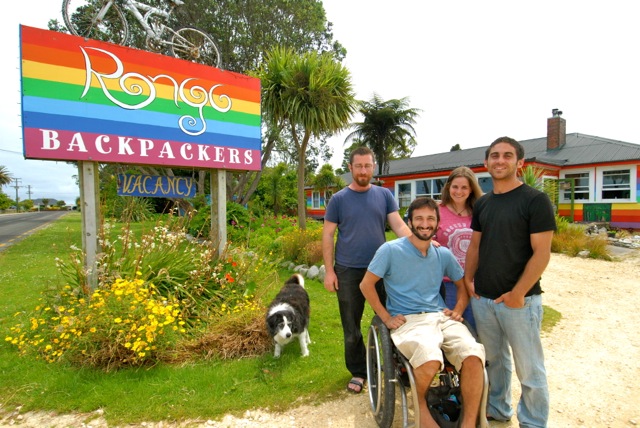
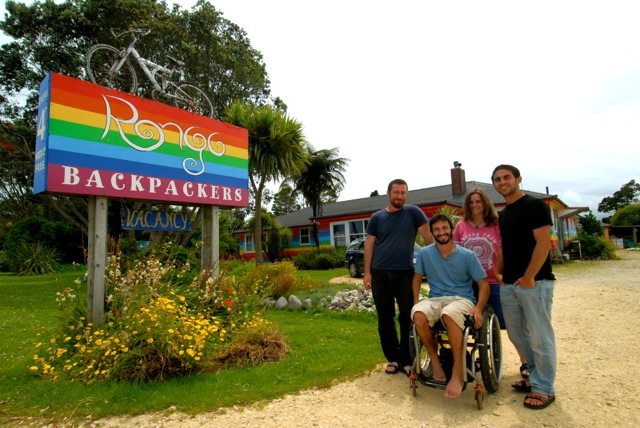
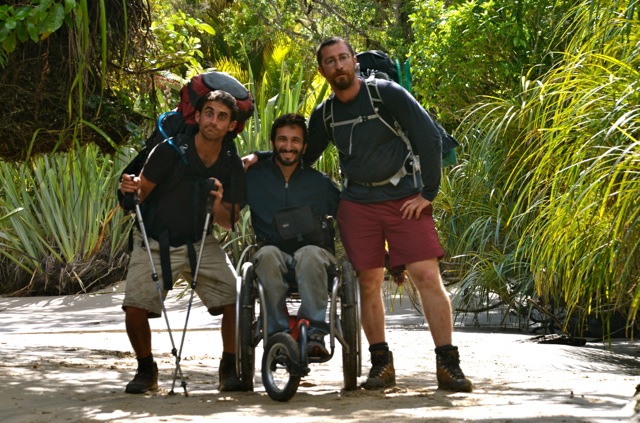
Left to Right Nadav Amit, Arnon Amit, Gul Janovsky and Maayan Kalo at Rongo Backpackers & Gallery in Karamea, New Zealand on January 3, 2015. (Photo by Paul Murray)
Off the Top of My Head
By Paul Murray
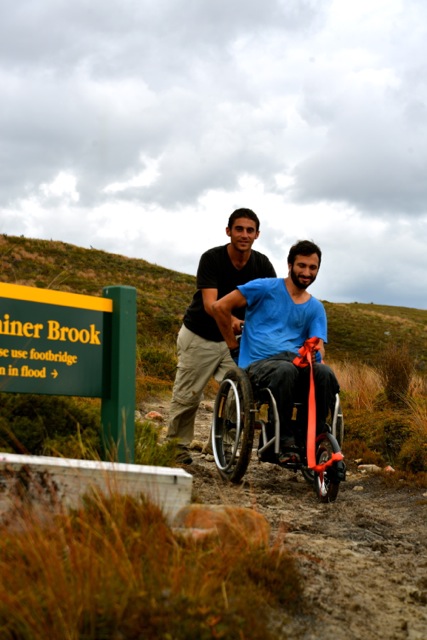
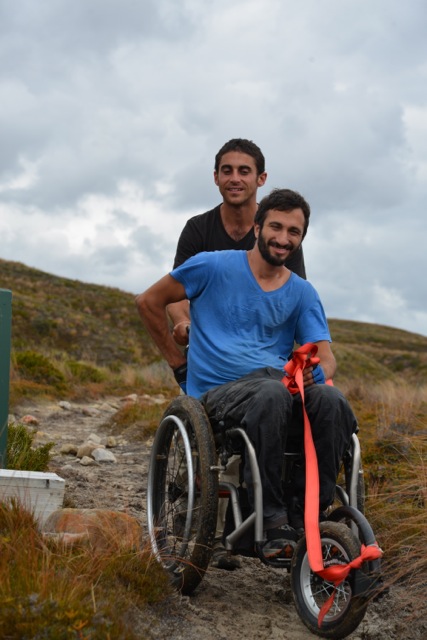
Arnon Amit from Israel arrived in Karamea at the top of the West Coast of the South Island of New Zealand on January 2, 2015, after successfully negotiating the Heaphy Track in a wheelchair.
The Heaphy Track is one of New Zealand’s nine “Great Walks” and the only one on which mountain biking is permitted (from May 1 to September 30). The track is approximately 80 kilometers long and traverses the Kahurangi National Park at the top of the South Island. Most people walk, ride or now roll, the Heaphy Track from Collingwood in Golden Bay through to Karamea on the West Coast.
With a lot of determination and effort and the help of his brother Nadav and friends Maayan Kalo and Gul Janvosky, Arnon bounced over some rough terrain, through a flood and tacked swarms of sandflies to complete the track in five days to become what is thought to be the first person to complete the track in a chair.
Near the end of the Heaphy Arnon looks back on the Kohaihai River bridge. (Photo by Nadav Amit)
Arnon was injured in a car accident while doing his national service in the Israeli Army in 2008 and lost the use of his legs. He was an enthusiastic outdoors person before the accident and has managed to overcome his physical challenges and maintain his love of tramping and nature with a little help from his friends.
The Three Musketeers: Maayan Kalo (Left) Arnon and Nadav Amit. (Photo by Gul Janovsky)
A special off-road wheelchair manufactured in the United States and made of strong, lightweight titanium metal was Arnon’s Heaphy vehicle. The chair handled the track well, but the rigorous terrain took its toll on the machine and minor repairs were required en route to keep the show rolling.
(Photo by Gul Janovsky)
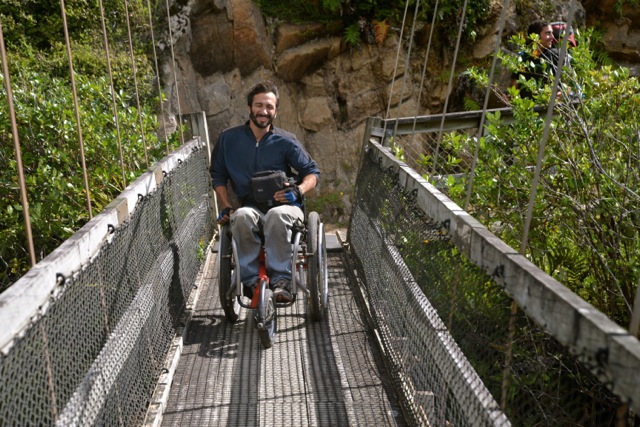
Recent work by the Department of Conservation (DOC) to improve the track surface and the width and stability of the swing bridges and other river crossings has made the Heaphy Track more easily negotiated by wheeled vehicles like chairs and of course mountain bikes. This may open the possibility of experiencing the wilds of the Kahurangi National Park and the pleasures of traversing the Heaphy Track to a whole range of people, like Arnon, who had previously not been able to tackle the track.
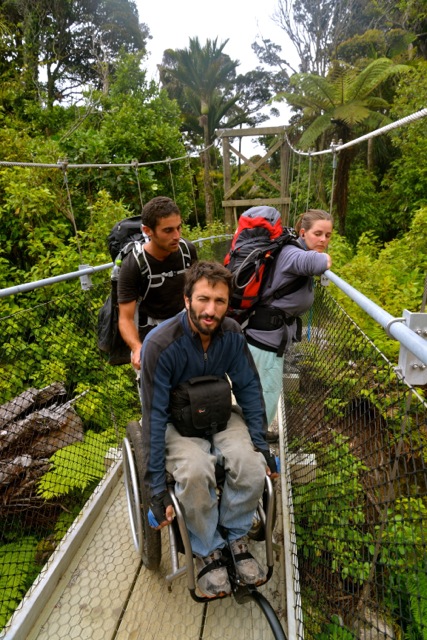
Arnon was able to propel himself over the new wider swing bridges on the Heaphy. (Photo by Nadav Amit)
The most challenging section for the man in the chair was the first uphill section of from the Collingwood end of the Heaphy from Brown Hut to Perry Saddle Hut. The track winds steeply uphill through beech forest and tree roots growing through the track make it rough and uneven, not necessarily the best surface for wheelchairs. However, with brother Nadav and friends Maayan and Gul pushing, Arnon made it to the Perry Hut, which is around the highest point of the track at 1,000 metres, in good shape.
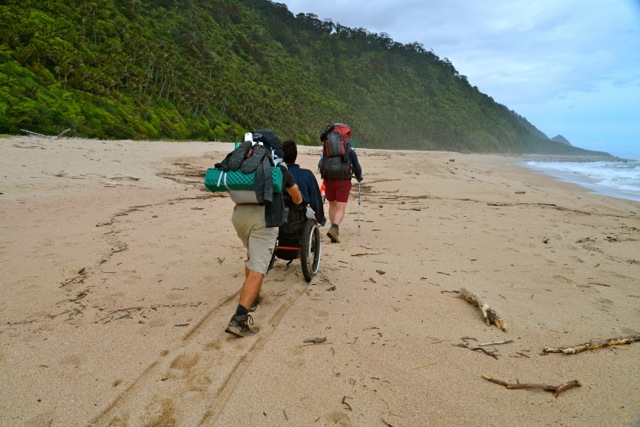
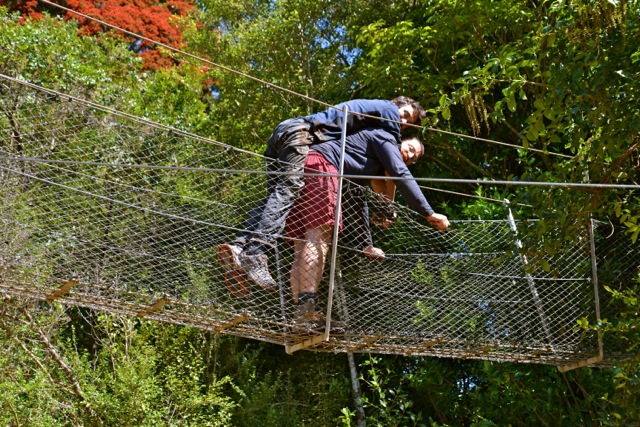
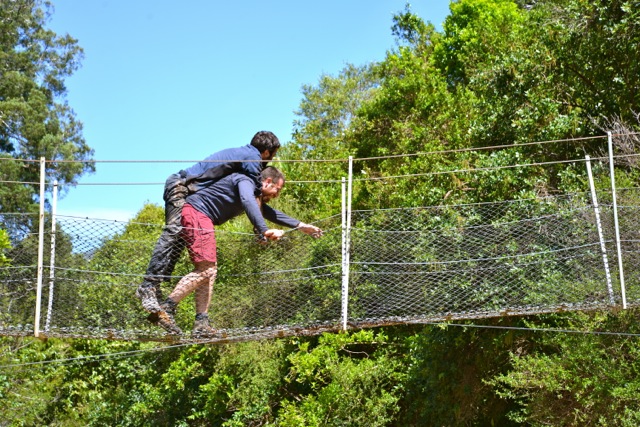
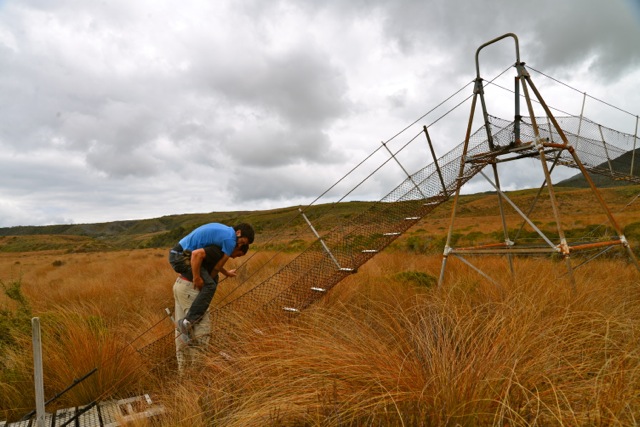
River crossings and sandy beaches also posed challenges that required assistance from the support crew. Nadav piggy-backed his brother across the narrow swing bridges and pulled him along the sand while Maayan pushed from behind.
Push-me-Pull-you: The team negotiate a sandy West Coast beach. (Photo by Gul Janovsky)
Arnon enjoys the view of the Tasman Sea while his buddies help him over a sandy stretch. (Photo by Gul Janovsky)
Nadav piggy-backed his brother Arnon over the older narrow swing bridges. (Photo by Gul Janovsky)
Photo by Gul Janovsky)
The weather turned somewhat inclement on the last day of 2014 and many sections of the track became flooded preventing the group from proceeding and creating a bottleneck at the MacKay Hut in the middle of the Heaphy. Fifty people, including Team Israel, were squeezed into a new hut built for 26. Fortunately, the old James MacKay Hut has yet to be demolished and, with DOCs permission, Nadav broke into the hut and everyone managed to get a bed.
The next day was much improved and Arnon was in his element on the downhill section from MacKay to Lewis Hut. The steep slope afforded him some gravity assisted speed and he apparently even got some air as he bounced the chair over some rocks on the way down.
Possibly the first person in a wheelchair ever to see the Heaphy River, Arnon enjoys the view at the end of a day on the track. (Photo by Nadav Amit)
Brothers Nadav (left) and Arnon Amit on Karamea Radio 107.5 FM (Photo by Paul Murray)
The four travellers are now heading south down the wonderful West Coast and plan on exploring some of the many attractions and tracks along the way and then on to Queenstown and Fiordland, if you see them say hello, they’re a great bunch of fine young folk.



















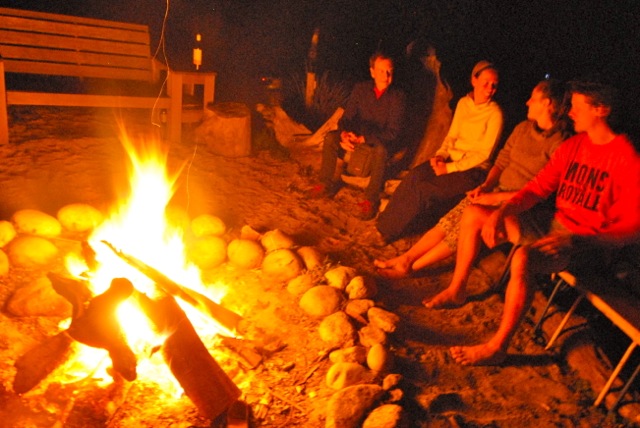
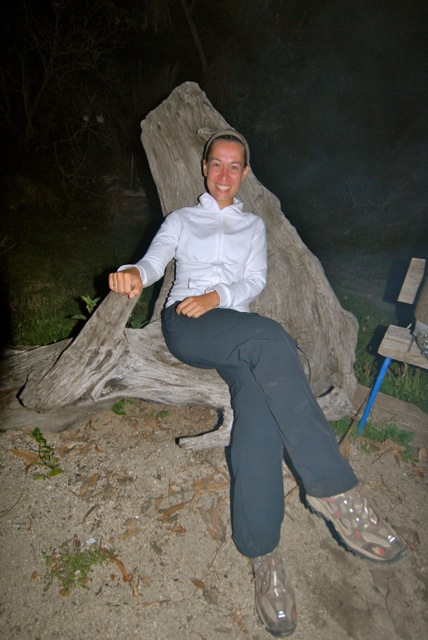

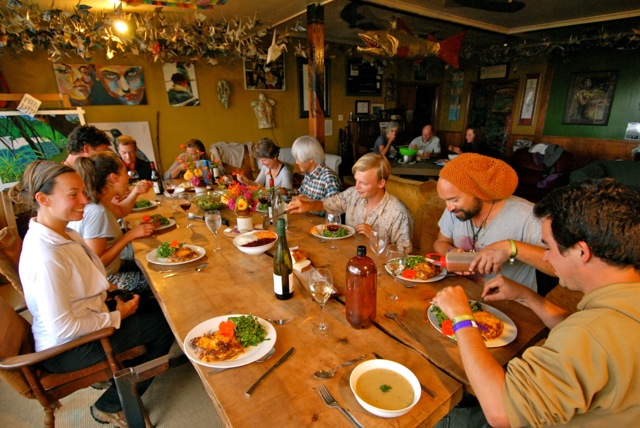

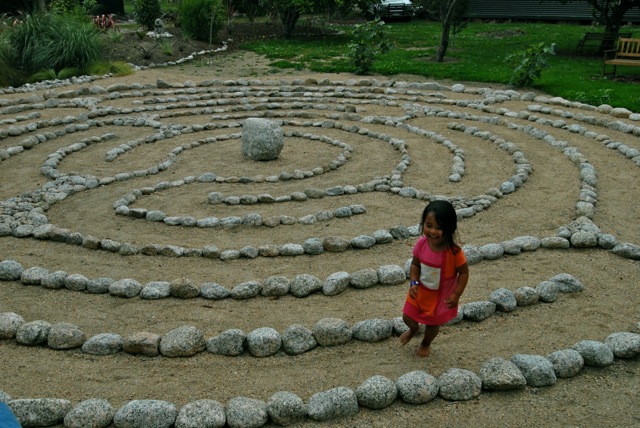

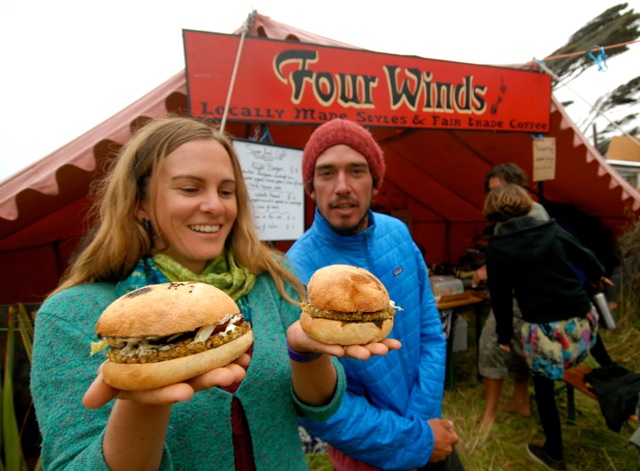


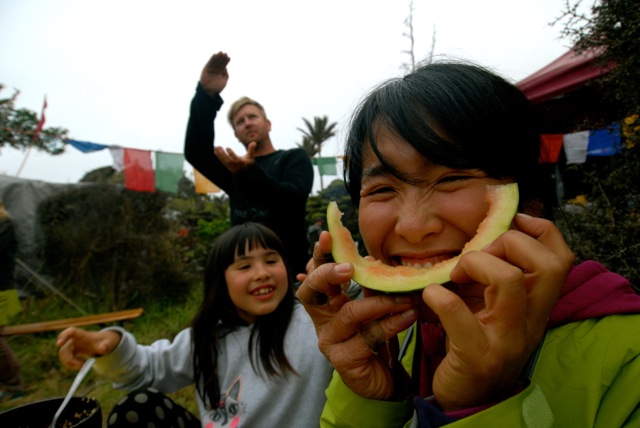


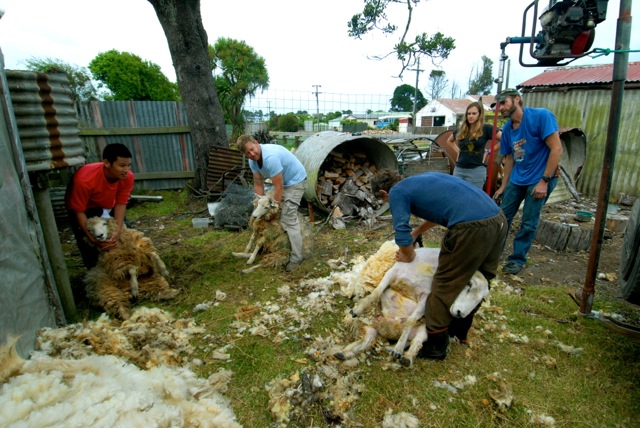


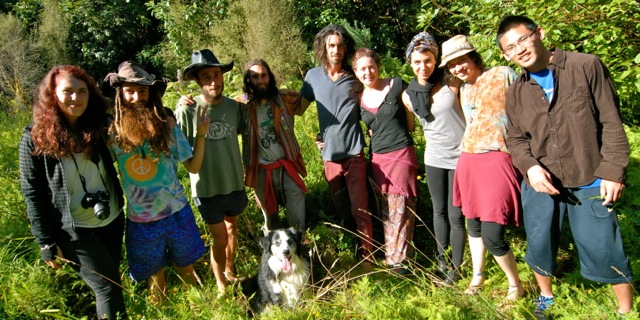


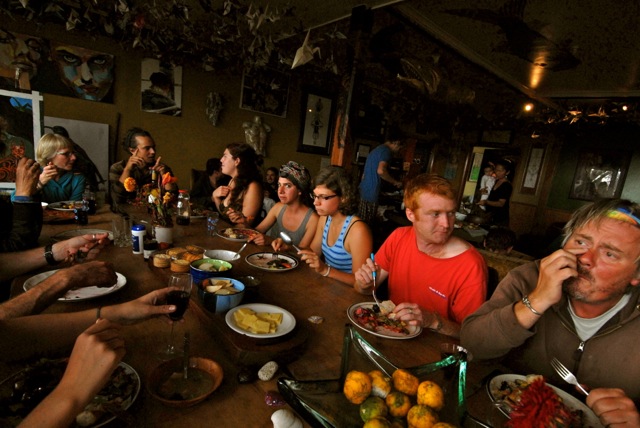

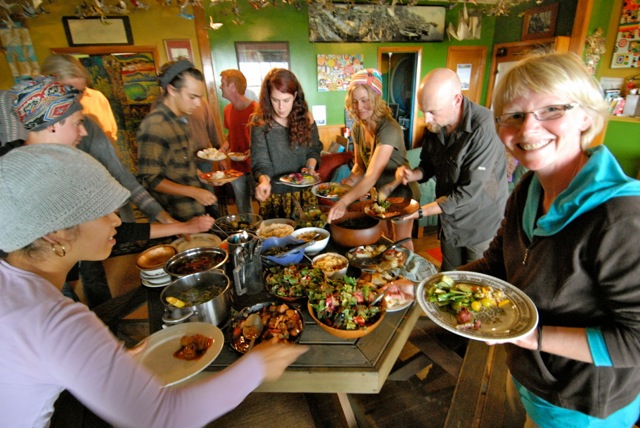
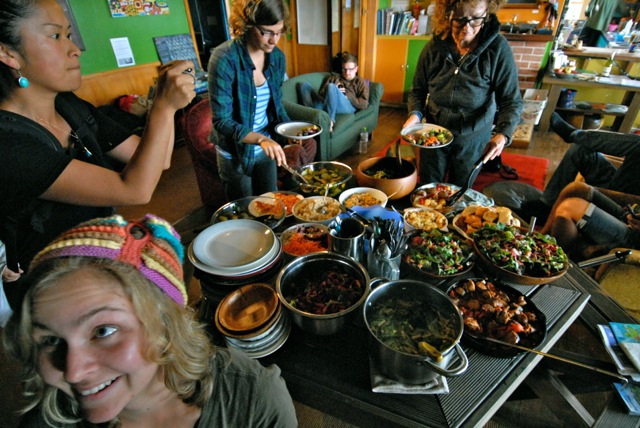
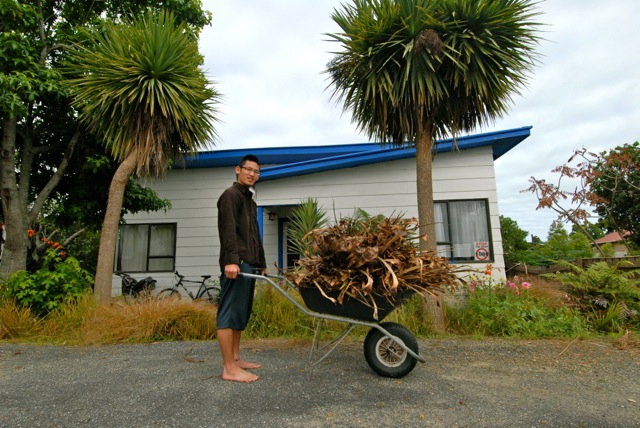









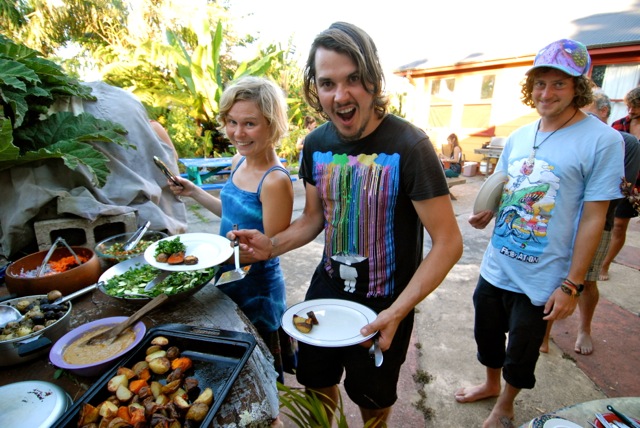

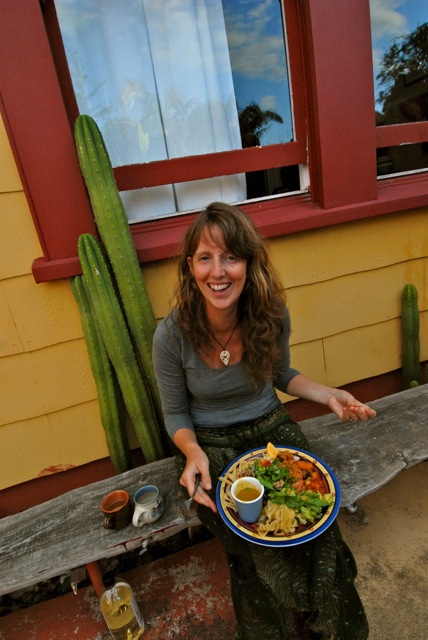



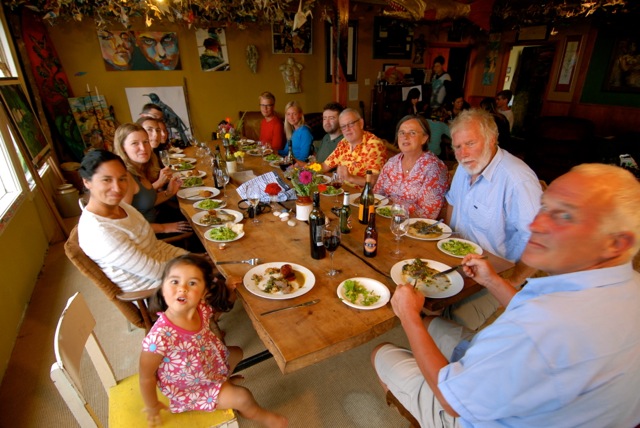
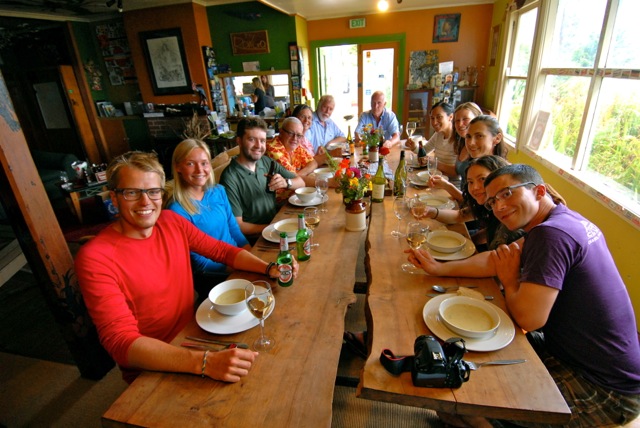













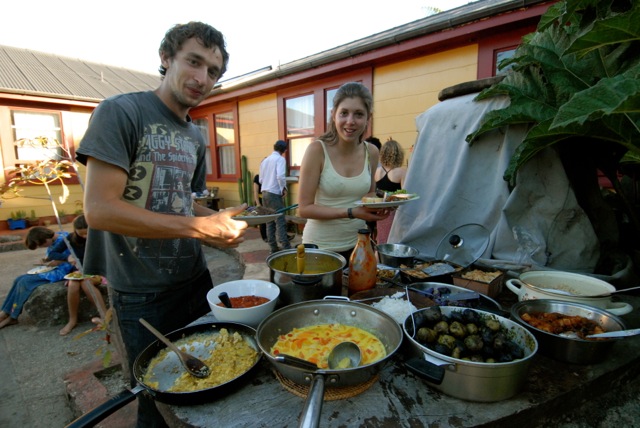


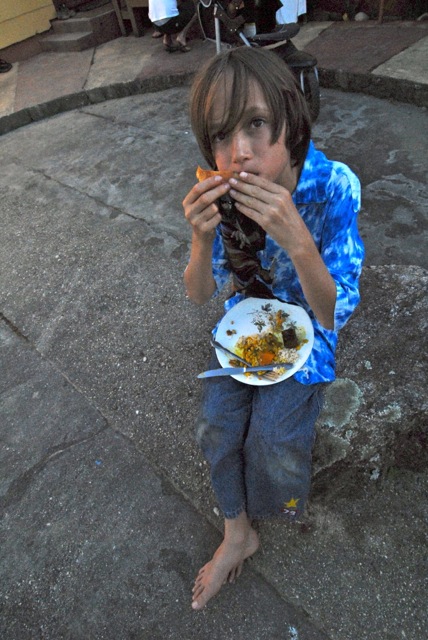

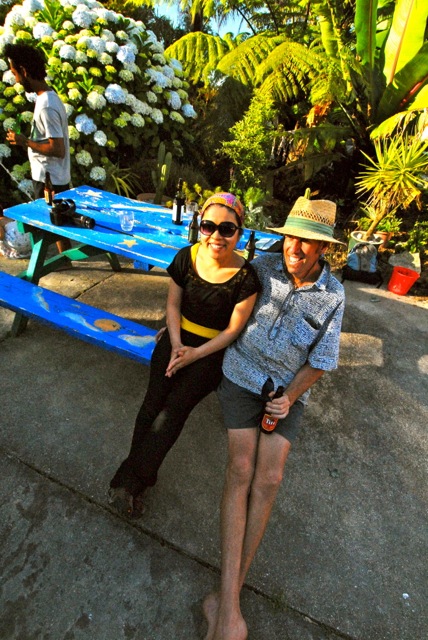

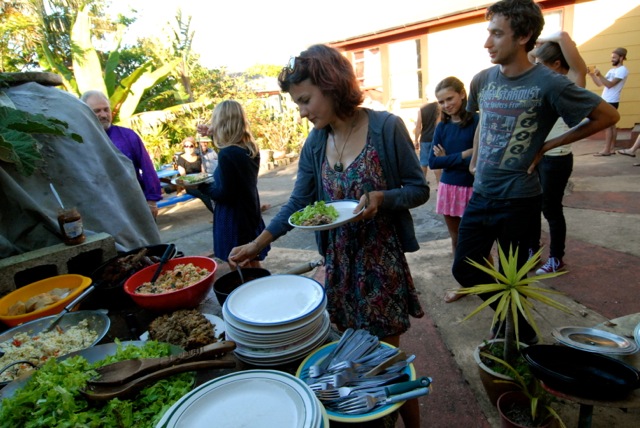
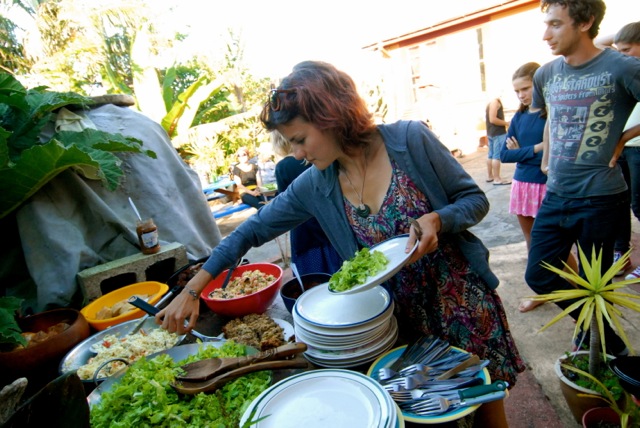
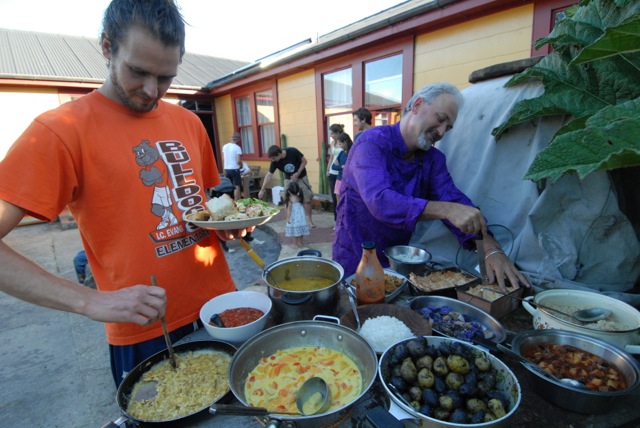
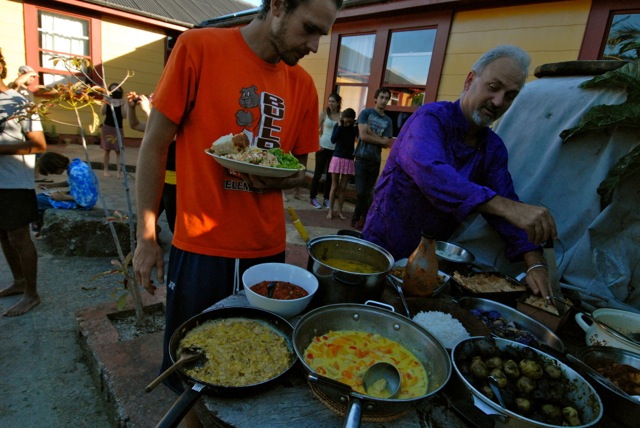
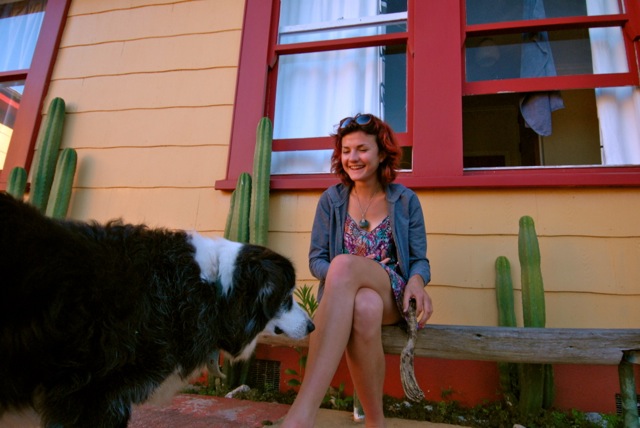





























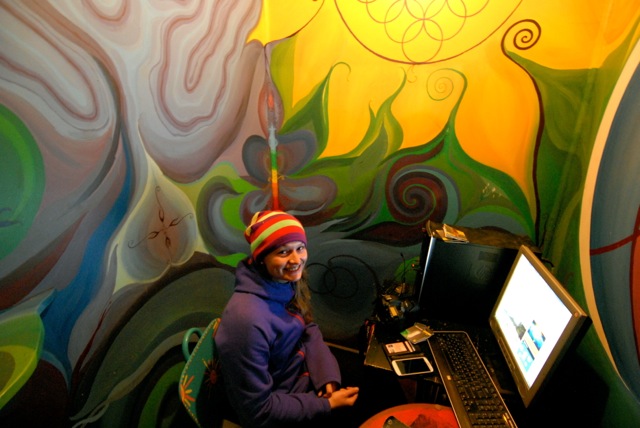

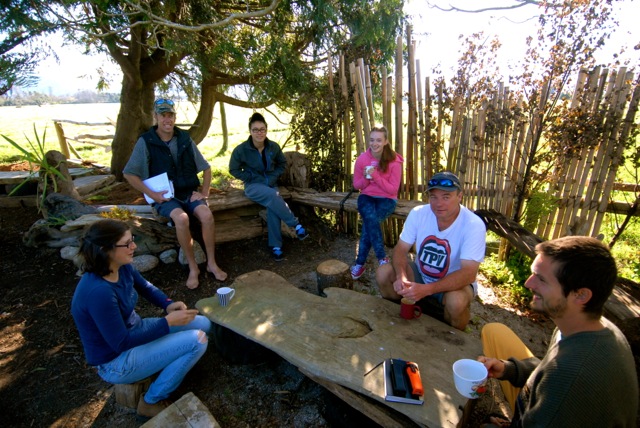
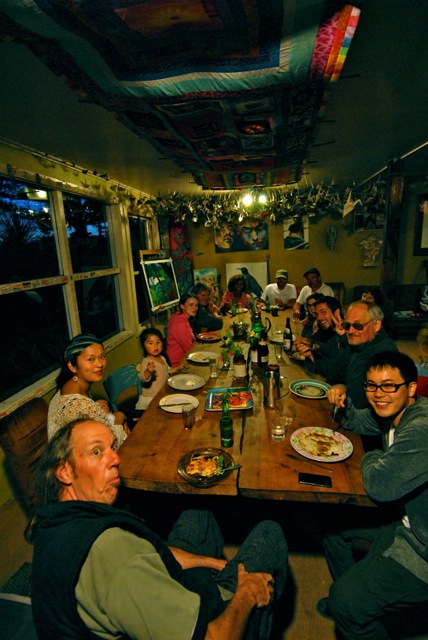
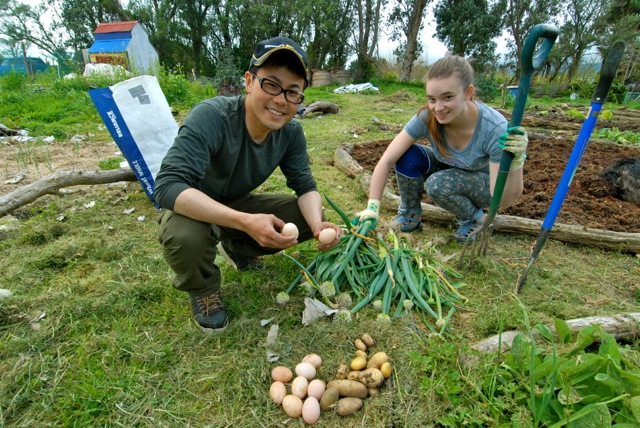



































































N.Z. National Permaculture Hui 2015: Let’s Get GROWING!
NZ National Permaculture Hui 2015
3rd-6th April 2015 (Easter Weekend)
Moving On
Basic Regeneration with Permaculture
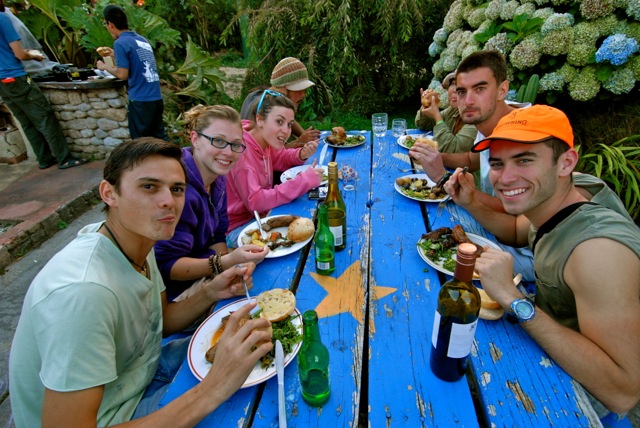
This year we’re bringing the Hui back to it’s roots with a 4 day immerse experience.
The Hui’s focus is Moving On, set to a timely backdrop of blossoming regeneration in the Garden City of Christchurch, Aotearoa. This year we’re incorporating Gift Culture and Open Space Technology (OCT) along with the usual PiNZ AGM.
All ages and levels of experience welcome.
We start with a Welcome Day on…Friday 3rd April –
Creating space, Arrivals & Introductions.
Workshops & Meetings.
Potluck Evening Meal.
Then we will take a day each to explore the 3 Permaculture Ethics…
Saturday – Earth Care – Kaitiakitanga
Provision for all life systems to continue and multiply.
Earth care encompasses care of the soil, care of all living systems, concepts like Gaia….
Sunday – People Care – Whanaungatanga
Provision for people to access the resources necessary for their existence.
People Care starts with the self – if you don’t take care of yourself you can’t care for anyone else! From the self, People Care spreads out to kin and community…
Monday – Fair Share – Manaakitanga
This is sometimes called “Surplus Share” or “Share our Resources”.
By governing our own needs, we can set resources aside to further our ethics.
Set limits to consumption, growth and population.
We’ll explore how to harness the ethics and principles of permaculture in all areas of our lives to move us towards Sustainability, Regeneration & Abundance by using a blend of Presentations, Talks, Open Circles and OST.
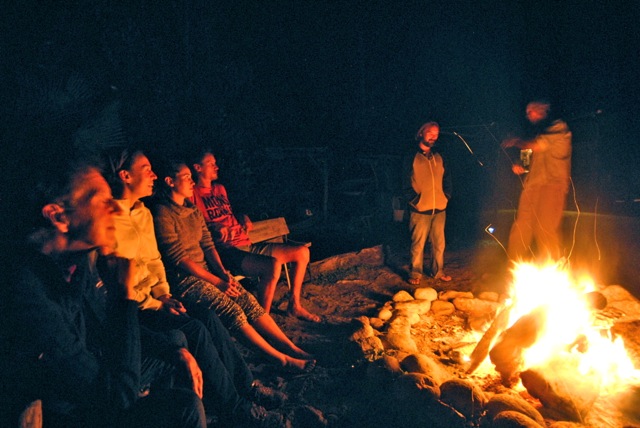
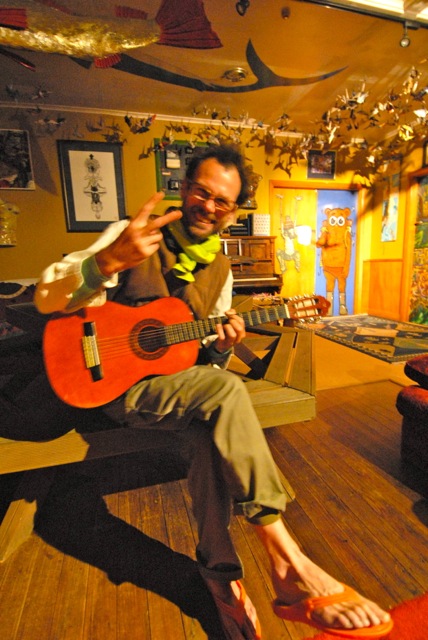
Plus Music, Movies and Stories to entertain us in the evenings.
And plenty of time for sharing, connecting and exploring all things permaculture & beyond!
Fresh local organic Food & Drink provided. Though, this year there is no accommodation at the Hui site. After careful consideration, Central New Brighton School Hall was chosen to host. This has kept the ticket prices as low as possible, and the hui easily accessible and open to more people. Watch this space for information on lift shares, accommodation & billeting options.
Planning the 2015 Hui has been a great adventure so far…. We invite you to join us for a long weekend of Learning, Sharing & Dancing!
Tickets on sale at www.permaculture.org.nz or email nzpchui15@gmail.com for information
Rate this: