50 Tips for Better Photography

By  
 
 
1. Understand aperture

The most fundamental element any photographer should understand is aperture. The aperture is the physical opening within your lens that allows light through to the sensor (or film in an older camera). The wider the aperture opening, the more light can pass through, and vice versa.The size of the opening, which is regulated by a series of fins encroaching from the edge of the lens barrel, is measured in so-called f-stops, written f/2.8, f/5.9 and so on, with smaller numbers denoting wider apertures. If you find this inverse relationship tricky to remember, imagine instead that it relates not to the size of the hole but the amount of each fin encroaching into the opening.

A narrow opening is regulated by a large amount of each fin encroaching into the barrel, and so has a high f-stop number, such as f/16, f/18 and so on. A wide opening is characterised by a small number, such as f/3.2, with only a small amount of each fin obscuring the light.

Picture the size of the fins, visible here inside this lens, when trying to understand the concept of f-stops.

2. Aperture measurements
Lenses almost always have their maximum aperture setting engraved or stamped on one end of the barrel. On a zoom lens you’ll see two measurements, often stated as f/3.5-f/5.9 or similar.

Rather than being opposite ends of a single scale these describe the maximum aperture at the wide angle and telephoto (maximum zoom) lens positions respectively. Always buy a lens with the smallest number you can afford in each position.

3. Avoid using aperture to compensate for poor lighting
Changing the aperture has a dramatic effect on the amount of light coming into the camera, as we have already said. You’ll notice this is the case when shooting landscapes with a narrower aperture (higher numbered f-stop) as your camera will often want to take a longer exposure — so much so that you may have to use a tripod to avoid motion blur.

You should avoid using the aperture scale to compensate for unfavourable lighting, however, as it also changes the amount of the image that remains in focus, as we’ll explain below.

The image on the left was taken with a wide aperture and so has a shallow depth of field; the image on the right was taken with a narrow aperture and so has a long depth of field.

4. Use a wide aperture for portraits
Anyone with a cat knows that when they’re hunting or playing their irises contract to enlarge the size of their pupils. This has the same effect as widening the aperture in a camera lens: it makes the subject they are focusing on very sharp while causing everything behind and in front of it to blur. We call this a shallow depth of field. This is perfect for portrait photography, as it draws forward your model within the scene, making them the central focus while the background falls away. Choose f/1.8 or similar wherever possible.

This image of a chicken was taken with a wide aperture to keep the subject in focus while blurring the background.

5. Use a narrow aperture for landscapes
For landscapes, on the other hand, you want to have everything from close-at-hand foliage to a distant mountain in focus. This is achieved by selecting a narrow aperture. If possible stray towards f/22, or whatever the tightest setting your camera allows.

This image of a Moroccan campfire is taken with a narrow aperture to maximise the depth of field.

6. ‘f/8 and be there’
Static models and immobile landscapes are easy to shoot as you can predict with a great deal of certainty which aperture setting you need to get the best out of either. Reportage and street photography, weddings, Christenings and so on are less predictable as your subjects will be moving in relation to the frame. In these circumstances, adopt the pro photographer’s adage, “f/8 and be there”.

Set your aperture to f/8 for a practical, manageable balance of fairly fast shutter speeds and broad depths of field, allowing you to spend more time thinking about composition within the frame than you do about optical algebra. When shooting indoors without a flash, and depending on the lighting conditions, you may need to increase your camera’s sensitivity setting at this aperture, but be careful not to push it so high that you introduce grain into your images, unless you are chasing that specific effect.

Filters and lenses

7. What does the ø symbol on my lens mean?
After the focal and aperture ranges, the other measurement you’ll see on most dSLR lenses is preceded by ø and describes the diameter of the screw mount on the front of lens barrel. Check this number each time you head out to buy a filter or hood as you can’t guarantee that it will be the same for each lens in your collection, even if they are all designed to be used on the same camera.

Check the diameter of your lens when heading out to buy a new filter.

8. If you only buy one filter…
…make it a circular polariser. This is the perfect beginner’s filter, and one that will have the biggest effect on your day to day photography, giving holiday skies a vibrant blue tone and accentuating the contrast between the sky and passing clouds to afford your images greater texture. Although you can add blue to your images in Photoshop or a similar post-production editing tool, the effect is never as believable when done that way as it is when shot using a lens.

Invest in an inexpensive circular polariser to improve the blue of skies in your images.

9. Don’t confine it to skies
Polarising filters also cut through glare and reflection. Use it to shoot through windows and water.

We used a polarising filter when shooting this frame to cut through reflections on the surface of the water.

10. Look for lenses where the zoom control doesn’t change the filter orientation
Rotating a circular polarising filter changes the strength of the polarising effect, making skies deeper or lighter, and changing the amount of reflection they cancel out. If you plan on using such a filter then wherever possible buy lenses where turning the zoom control doesn’t simultaneously rotate the end of the lens, and with it the filter, as this will change the effect. If you have no choice, set your zoom first and adjust the effect afterwards, being careful not to throw the lens out of focus in the process.

11. Don’t forget about white balance
When using a filter set your the white balance on your camera to the appropriate conditions, rather than auto, to stop the camera compensating for the filter in front of the lens.

Make sure you set your white balance manually when using a filter.

12. Don’t rush out to buy a skylight filter
Putting a clear filter on the front of your lens to protect its surface sounds like a great idea. After all, your lens was an expensive investment. The end of your lens is stronger than you might think, however, and easy to clean if you don’t let the dirt build up. Dispensing with a skylight filter will not only save you money, but also avoid the chance of introducing light problems due to increased reflections or the slight reduction in the level of illumination reaching the sensor.

13. Cheat’s macro mode (add-on filters)
Dedicated macro lenses are expensive, but you can quickly and easily improve your existing lens’ macro credentials by using screw-on magnifiers. They’re not a perfect solution as they decrease the level of light coming into the lens, but for occasional work they are very effective, easily sourced and cheap. We bought ours, below, first-hand from eBay, where you should expect to bid around £15 for a set of four screw-on filters.

If you can’t afford a dedicated macro mode, you can achieve the same result using an inexpensive set of add-on magnifiers.

14. Avoid stacking up too many filters
It’s tempting to add multiple filters to the end of each lens to achieve different results, but bear in mind that although they may look perfectly clear to you, each one reduces the amount of light passing through by a small amount. For the best results, use the smallest number of filters possible.

15. Choose a manual lens over a powered one
Some compact interchangeable lens cameras come with a choice of powered or manual zoom. The former is a great lazy option, allowing you to press a button to get the framing you’re after, but the latter is often cheaper and almost always quicker to use as it moves at whatever speed you turn it, without being hobbled by the speed of an internal motor. You can also often make finer and more predictable changes when zooming manually than you can with a powered zoom rocker.

16. Shoot slowly, zoom quickly… At the same time
If you’re shooting a static display, add some interest by turning the zoom control while shooting with a fairly slow shutter speed (you can only do this with a manual zoom, as a powered lens will be locked off when shooting). This works particularly well when shooting cars and other forms of transport as it gives them a sense of motion.

Give static subjects added dynamism and excitement by changing the zoom while using a slow shutter speed.

17. Try a prime lens for more creativity
Shooting with a fixed focal length — a prime lens — will make you think more carefully about how you want to frame a subject to tell a particular story. It will often also get you a cleaner, sharper result.

18. What do the measurements on my lens mean?
Lenses are measured in terms of their focal length, which broadly describes the effect they have on incoming light and the way it is focused on the sensor. A short focal length, such as 24mm, doesn’t have a very high level of magnification, so will focus a broad vista on the sensor. A long focal length, such as 240mm, has a high level of magnification, like a telescope, and so will fill the sensor with just the central part of the view.

This lens has a fairly long telephoto with the zoom topping out at 300mm.

19. Understand your lens’ true dimensions
Unless you’ve paid for a high-end dSLR, or a professional camera such as the Leica M9, your pocket snapper’s sensor will almost certainly be smaller than a frame of 35mm film, the standard point of reference against which all focal lengths are measured.

The 35mm in a frame’s name actually relates to the space between the top and the bottom of the film strip, which as well as the frame itself also contains some border areas and the sprocket holes used to move the film through the camera. A 35mm frame is positioned lengthwise on this strip, with its shortest dimension — top to bottom — perpendicular to the film’s direction of motion. As such, neither the height nor the width of the frame measures 35mm, but instead 24x36mm.

To understand how the stated focal length on any lens will affect the shot captured by your camera, you need to factor in the multiplier effect, which converts the size of your sensor to the size of that 35mm piece of film. The multiplier is often between 1.5 and 1.7 but varies between manufacturers and models.

So, if you’re buying a lens for the Canon EOS 600D with its 22.3×14.9mm sensor you’d need to multiply the stated focal length of the lens by 1.6. This would make a 50mm lens, commonly used in portrait photography, act like an 80mm lens, thus increasing the effective zoom and narrowing the amount of the scene seen in each frame. On a Nikon D5100, which has a slightly larger sensor (23.6×15.6mm) you’d need to multiply the lens’ measurements by 1.5, in which case an equivalent 50mm lens would act as though it were a 75mm unit.

20. Save money by opting for a smaller sensor
This means you can, technically, save money by opting for a smaller sensor, as you’ll be able to buy less powerful lenses to achieve the kind of results you would otherwise only get with a longer, more expensive zoom.

21. Use zone focusing
Related to point 6 — f/8 and be there — if you have a lens with both f-stop and focal measurements on the barrel, understanding how they relate to each other can help you take great spontaneous photos with a high degree of confidence.

In the image below we’ve set our aperture to f/5.6, as indicated by the red line pointing to the 5.6 reading on the lower gauge. We’ve then set the range on the yellow gauge to around 1.2 metres by positioning this at the top of the same line. We can now use the green scale to understand how far away from the camera our subjects need to be if they are to be accurately focused.

By following the lines running from the two green entries for 5.6 on either side to their measurements on the yellow scale, we can see that so long as we’re more than 1m away from our subjects they will be in focus (the green 5.6 on the left is linked to around 1m on the yellow scale, while the green 5.6 on the right is linked to the infinity symbol, which is like a number 8 on its side). Anything closer than that will be blurred.

This gives us a great deal of freedom to snap whatever we want without making any further adjustments, so long as it’s no closer to us than 100cm. To create a more intimate effect, adjusting the distance ring so that 0.4 sat at the top of the red marker would mean that only those objects between around 36cm and 50cm would be kept in focus.

Use zone focusing to understand which parts of your image will be in focus at any particular aperture setting.

Lighting

22. Invest in a cheap pair of lights
If you’re doing any kind of indoor photography, invest in a cheap pair of lights. Buy at least a pair, complete with tripod stands and reflectors to direct the light. Opt for continuous light rather than flash units, as they’re cheaper, easy to use and great for beginners, as you don’t have to take test shots to see how the shadows fall during setup.

23. Understand colour temperature
Different colours and levels of light are measured using the Kelvin scale. For the best results, look for studio lights with a temperature of around 5,500K-6,000K to emulate bright daylight. Lights with a lower colour temperature often render a colour caste in your images that will have to be corrected in Photoshop or an alternative image editor.

This professional studio bulb maintains a constant colour temperature of 5500K, as specified on the furthest end.

24. Buy a light box — but don’t spend more than £20
Minimise shadows in your studio-lit work by investing in an inexpensive light box. Effectively a five-sided cube with gauze sides and top, you position your lights so that they shine through the sides of the box, diffusing the light and softening the shadows. Light boxes usually ship with a felted back cloth that can be attached using Velcro to create an infinite field of view by obscuring the seams of the box.

An inexpensive light box makes it easy to shoot with artificial light without casting strong shadows.

25. Make best use of available light with a sheet of paper
If you can’t afford studio lights, even out harsh contrasts when shooting with natural light by positioning a large sheet of paper or card to reflect the incoming light onto the unlit side of your subject. If shooting people, ask them to hold the card themselves outside of the framed shot. Alternatively, invest in a set of reflectors. You can pick up a new, multi-part set with white, silver and gold reflective surfaces for around £12 on eBay.

This shot would have benefitted from a reflective surface positioned to the left of the frame to illuminate the right-hand side of our subject’s face.

26. Don’t be dictated by the sun
Using automatic settings to shoot into the sun will throw your subject into silhouette as the camera dials down the exposure to compensate for the bright background. Shooting people with the sun in front of them, meanwhile, solves the silhouette problem but introduces another one: squinting. Solve this by keeping their back to the sun and forcing the flash to fire (switch from it ‘auto’ to ‘on’ or ‘forced’) to correct the exposure on your subjects’ faces without leaving them squinting.

27. Observe the rule of thirds
The most aesthetically pleasing images are those in which the subjects are aligned with the one-third power points in every frame. Position horizons one third up or down the height of the image, and people one third in from the left or right. Likewise, if you’re snapping a frame-filling head shot, position the eyes so they’re one third down from the top of the frame.

Some cameras give you the option of displaying an overlaid grid on the rear LCD to help you line up your subjects along these lines. If yours does, go one step further and put key elements on the points where the horizontal and vertical lines intersect.

Here we’ve added short red ticks to the top and the bottom of this frame to show how the man warming his drum is positioned one third of the way in from the right of the frame, and the flames of the fire are one third of the way in from the left.

28. Exposure and focus come first, framing second
Half-pressing the shutter release fixes the focus and exposure settings for the shot you’re about to take. Pressing it all the way captures the frame.

Use this to your advantage by metering for particular conditions by putting your subject on one of your camera’s focus positions and half pressing the shutter to lock its settings then, without releasing the button, recompose the framing to align your subjects on the one-third power positions. This way you’ll get perfect exposures every time, whatever the composition.

29. Use your free light meter
If you don’t have a light meter, use your camera’s auto mode to gauge the optimum settings, even if you don’t want an immaculately exposed result. Examine the shot’s settings and then switch to manual mode and replicate them before pushing individual elements — shutter speed, sensitivity, aperture and so on — to achieve the moody result you’re after.

Let your camera do the hard work: take a picture in auto mode and use its self-selected settings as the basis for your manually dialled variables next time around.

30. Get up early, stay out late
Photography is all about painting with light. Light is what gives your pictures contrast, shape and texture, and often the best light it that which appears at either end of the day when the sun is lower in the sky. At these times of day it casts longer, more extreme shadows, which in turn pick out small details, bumps and texture.

By shooting early in the morning and late in the afternoon, you’ll achieve far more interesting results than you would at high noon when you’ll spend more time controlling the light coming into your lens than you will manipulating your subjects to best exploit the shadows.

It’s a cliche, but this shot of Whitby Abbey wouldn’t be nearly as atmospheric if it weren’t taken at sundown.

31. Embrace the grey day
Don’t let an overcast day put you off heading out with your camera. The softer light you get on an overcast day is perfect for shooting plants, flowers and foliage as it dampens the contrasts we were championing in our previous step. This allows the camera to achieve a more balanced exposure and really bring out the colours in petals.

Overcast days present the perfect conditions for shooting flowers and foliage.

Cheat’s tips

32. Travel without a tripod: tip 1
Packing a tripod when you head off on holiday is a great way to extend the shooting day, allowing you to take some stunning night-time shots with streaking lights and illuminated landmarks. If you’re pushed for space, though, check out this trick. Balance your camera somewhere sturdy and safe, disable the flash and set a slow shutter speed or two seconds or more.

Now set your self timer, fire the shutter release and let go of your camera so that you won’t cause it to wobble. By the time the self timer countdown expires, any residual movement caused by your hand letting go should have evened out, so your camera will sit still and steady throughout the exposure for a crisp, sharp result.

We took this using the self timer and a long exposure. Avoid the temptation to squat in Rome’s rush hour traffic.

33. Travel without a tripod: tip 2
It’s not always possible to find a flat surface on which to perform the previous trick. Try and find a flat surface on some castle battlements and you’ll see what we mean. Combat this by packing a small beanbag in your camera bag.

Check out school sports and games categories on eBay to find 100g beanbags (a pack of four costs less than £5), which can be pressed into shape on uneven surfaces, with your camera snugly settled on top. It’s more stable and less likely to either fall over or wobble during the exposure.

Paris this time, and we’re once again employing the delayed shutter trick.

34. Travel without a tripod: tip 3
Professional tripods use quarter-inch screws to fix your camera in place. You can easily source a screw of the same size from a normal hardware store. To avoid travelling with a bulky tripod, drill a hole in a standard bottle top (the type you’d find capping a 500ml drinks bottle) and thread the screw through it, fixing it in place using strong glue.

Keep this in your camera bag as you travel, but don’t bother carrying the rest of the bottle, as these are easily sourced wherever you happen to end up. Fill an empty bottle with grit to give it some weight and screw your cap to the top. Instant tripod.

35. Banish long-arm self portraits
Self portraits are great for capturing holiday memories, but if you can’t find somewhere suitable to balance your camera while also framing the scene behind you, the only way you can take them is to hold your camera at arm’s length and press the shutter release. The results are rarely flattering.

Invest in a cheap monopod (search eBay for handheld monopod) and use this to hold your camera away from you while keeping your hands in a more natural position and the great scenery you want to stand in front of behind you. Use your camera’s self-timer to fire the shutter 2 or 10 seconds later.

Your author in Greece, without the aid of a monopod, where the arm and watch strap somewhat distract from the Acropolis.

36. Look at the eyes, not around the eyes, look at the eyes
Ever wondered why so many magazines have faces on the cover? It’s because we identify with such pictures, which in turn helps us identify with the magazine. Art editors know that our inclination is to connect with the eyes staring out of the cover, and the same is true of your portraits.

When shooting a person, if only one part of your image is in focus, make it the eyes. That’s the first place your audience will look. So long as they’re in focus, they’ll consider the whole image to be accurately shot, no matter how shallow your depth of field and how blurred the rest of the frame.

The eyes are in focus in this shot, so we read it as being accurately focused overall.

37. Use burst mode when shooting pets
Pets are unpredictable, so don’t wait for them to pose before shooting. The chances are you’ll miss the crucial moment.

Don’t wait until you’ve attracted their attention — start shooting while you’re trying to do it, as they don’t understand the concept of cameras and will move at the worst possible moment. Switch your camera to burst mode and start shooting while you’re trying to attract their attention towards the lens for a better chance of capturing something close to the picture you wanted.

Use burst mode when shooting animals and pets to increase your chances of capturing the shot you’re after.

38. Make use of scene modes
Your camera knows better than you do how to use its own settings to create special effects. Don’t be afraid to use its in-built scene modes for punchy monochrome or high-key effects. If possible, set your camera to save raw and JPEG images side by side so you also have a copy of the original unadulterated scene should you later change your mind.

39. How to shoot fireworks
Frequently the most impressive spectacle, fireworks are nonetheless tricky to shoot. For your best chance of capturing a display, set your sensitivity to ISO 100 and compensation to 0EV so that you don’t unnecessarily lighten the sky, which you want to keep as black as possible.

Mount your camera on a tripod and set your shutter speed to at least 8 seconds. Zoom out so that the fireworks just fill the frame, preferably without being cropped by the borders and be careful not to wobble the camera during the exposure or you’ll end up with blurred results. All being well, the result should be pin-sharp streaks of light falling to the ground.

We shot these fireworks using an 8-second exposure with the help of a tripod and timed shutter release.

40. How to shoot moving water
Short shutter speeds do a good job of capturing a waterfall and its surroundings, but you’ll achieve a far more attactive result by slowing things down. To do this without overexposing your image, start by switching out of auto and reducing your camera’s sensitivity to its lowest setting (usually around ISO 100 or ISO 80), then either use a neutral density (ND) filter or, if you don’t have one or can’t fit one to your camera, dial down the exposure compensation to its lowest level (usually -2EV, -3EV or -5EV).

Mount your camera on a tripod, half press the shutter release to fix the focus point and exposure and then press it all the way to take the picture, being careful not to shake the camera while it’s taking the shot. It’ll take some experimentation to get this right, so don’t be put off if you don’t get the perfect results first time around.

By taking this picture with a slower shutter we’ve softened the water both in the waterfall and passing in front of the lens.

41. Focus on the details
When a scene is simply too big to fit in your picture without it getting uncomfortably close to the edge of the frame, focus instead on one of the details that makes it unique. An abstract crop can often have greater impact and give a more original view of a tired, over-used view we’ve all seen before.

Zoomed and cropped: an unusual night-time view of the Louvre Pyramid, reflected in the pools that surround it.

42. You can’t shoot speed head-on
You can’t properly capture speeding subjects as they come towards or move away from you. If you’re shooting track events, position yourself side-on to the action so that it passes across your field of view rather than coming towards it. Shooting into a chicane works well on TV where we delight in seeing the cars snake around it in sequence, but fares poorly in static frames.

43. Focus on the action
If you really want to convey an impression of speed in your images, pan your lens in line with speeding cars, horses and runners and shoot with a fairly slow shutter speed — 1/125 second or below — to blur the background. Keeping the subject sharp in the frame while blurring the background gives a more effective impression of speed than static backgrounds and blurred subjects.

44. Reflect on things
Do rainy days and Sundays get you down? Don’t let them: embrace the photo opportunities afforded by the puddles. The rain is as much a part of the story of your holiday as the food you ate and the sights you saw. Use reflections wherever possible for a different take on otherwise well-known scenes.

Even ugly urban decay can sparkle with the help of a reflective puddle.

Smart shopping

45. Don’t believe the megapixel myth
We’re glad to see manufacturers are starting to see sense here, with many high-end cameras now sporting comparatively modest pixel counts. At the lower end, however, some manufacturers continue to cram 16 megapixels and more on tiny sensors that can’t cope with high levels of incoming light. Pay for quality, not quantity, remembering that as few as 10 megapixels is plenty for printing at A3 using online photo-printing services.

This squirrel was shot using the 10.1-megapixel Nikon 1 J1. Despite the conservative resolution, the quality is great and we’d be happy to print this as a poster to pin on the wall.

46. Flickr: your shopping assistant
Baffled by numbers and stats? If you can’t get your hands on a camera to try before you buy, at least have a look at the shots it produces. Flickr uses the metadata attached to every photo shot by a digital camera to catalogue them by manufacturer and model, allowing you to click through a representative sample of output in its enormous online archive. Find it atflickr.com/cameras.

47. Don’t be a memory cheapskate
Buy the fastest memory cards you can afford to minimise the time it takes for your camera to write each shot to the media, and how long you’ll have to wait before you can take the next shot. Wait too long and you’ll miss something.

Cards are ranked using a simple class system, where the class number is simply the number of megabytes the card can store per second. So, your camera will be able to write to a Class 4 card at up to 4MBps, and a Class 10 card at up to 10MBps. Faster cards are more expensive, so if you’re having trouble justifying to yourself the extra expense, compare them to the speed boost you get from upgrading the memory in your PC or Mac.

This Class 10 card is the fastest you can get, minimising the time you’ll have to wait between taking multiple sequential shots.

48. Size really is everything
Think carefully about how you want to balance the convenience of carrying fewer large cards with the security of travelling with a larger number of lower capacity ones. On the one hand you’ll spend less time swapping 16GB cards than 2GB media, but if you lose a single 16GB card, or it corrupts, you could lose all of the shots from your trip.

Splitting them across several cards, and locking full cards in your hotel safe so you’re only carrying around empty cards plus the one on your camera means you’ll be taking fewer risks with your digital memories.

Travelling with several smaller cards than one large card means you can lock your photos in a room safe while out and about.

49. Replace your cards every couple of years
Memory cards might not have any moving parts, but that doesn’t mean they don’t wear out. On the contrary they each have a finite life, and every time you write to, delete from or read the card you’re bringing it another step closer to the end of that life. If you don’t want to risk corrupting your pictures far from home, replace heavily used cards every couple of years.

And finally…

50. Break all the rules
Be truly original. Ignore the rule of thirds. Shoot at high noon. Shoots sports photos at slow shutter speeds for blurred results. Whatever you do, make your pictures stand out from the crowd and relish the results.

Notre Dame, obeying the rule of thirds, but otherwise not as we know it.
Posted in Art, Education, Media, Photography | Tagged , , , , , | Leave a comment

The Power of Permaculture

“A person of courage today is a person of peace. Our only possible decision is to withhold all support for destructive systems and to cease to invest our lives in our own annihilation. Whether we continue without ethics and philosophy like abandoned or orphaned children, or whether we create opportunities to achieve maturity, balance, harmony, is the only real question that faces the present generation. This is the debate that must never stop!” 

––Bill Mollison

Quality over Quantity

The meek shall inherit the Earth…if it’s OK with everyone else…

Off the Top of my Head

By Paul Murray
 

We’re the lucky ones. Permaculturalists may not be draped in diamonds, holidaying in Monaco, driving the latest Bentley and drinking Cristal champagne with supermodels, but we have plenty or good food to eat, warm comfortable homes, clean fresh air and water, security and sufficiency to live life well.

scarlett_johansson-moet-chandon-bottle1

Collectively humans are interesting animals, we’re by our very nature competitive, we’re constantly looking for the bigger, better deal, we’re rampant resource plunderers and seem compelled to always want what we haven’t got…this leads us to be aggressive and into conflict and ultimately conflict with others who have what we want to gratify our avarice.

In the Western industrialised world, we are living comfortably from the labour of others less fortunate and have been doing so for some time. International fair trade agreements, globalisation, multi-national corporatisation means that we can enjoy the fruits of others sweat, pay them peanuts and live comfortably in our imported clothing, in front of our wide-screen TVs, while somewhere a team of less affluent people in a country far away are laboring in a factory churning out more products for us to mindlessly consume. The champagne guzzling Bentley drivers are only part of the problem, we are also living WAY beyond our means and it’s high time for a rethink.

Many of the world’s people lack even the most basic provisions for a simple life, but we’re doing just fine thanks Jack. Permaculturalists for the time being are part of this a fortunate minority, but we’re planning for a future without all the comforts we’ve complacently accepted to be forever and incorporated into our lives while still looking for more…well soon there’ll be no more, in fact it’s likely there is going to be a LOT less…and that is a good thing, for permaculturists can accept that less is more.

We might not consider ourselves extravagant, excessive, self-indulgent and rich, but to someone without all the comforts and luxuries we complacently take for granted, our lives are opulent and decadent.

Excess and opulence are very subjective measures…to someone without a house, a dry corner of a shed is a luxury, if you have no food, an apple is gold. Is the businessman in first class on an international flight on a commercial airline overindulgent compared with the corporate head in his own Learjet? Is he decadent compared with the owner of the airline who has mansions all over the world, his own island and is planning commercial flights to the moon? To the passenger cramped up the back in cattle class they all are, but to the peasant farmer watching the planes fly overhead decadence has no meaning for he will never experience flight in any form and sees only people in a parallel universe to his own reality.

Right now, a minority of the world’s people are driving it over a cliff…fiscal cliff, ecological cliff, technological cliff, call it what you like, but we’re already right on the edge and the brakes are out…we’re going over for sure and certain as it’s basic human nature to always want more, that’s how we got here and there’s no end in sight…we will destroy the Earth, of this I am certain…we’re already well on the way and the rapidity of the destruction is exponential…it’s all over folks, our nest is fouled…it’s good night nurse, thanks for playing…game over…but permaculturalists are waiting in the solar-powered ambulance at the bottom of the cliff ready to rebuild the broken corporate model and industrial infrastructure in line with natural systems.

Nature’s propensity for recovery is infinite…it never gives up, it overcomes, finds a way, is the solution to all problems…our behavior is of no consequence, when she’s had enough Mother Earth will just burp and we’re all gone…she’ll then set about recovering, it may take a few million years, but that’s but a moment in the billion year timeline of Gaia…the scale is immense.

People will destroy the world, but permaculturalists will have their day…as the end nears, our skills and talents will be highly sought after because basic necessities will have top value and everything else will be insignificant to the provision of nutritious food, clean water, fresh air and warm dry, comfortable housing…permaculturalists have a deep understanding of and empathy with nature…to be at one with nature is to be at peace…Power to the PEACEFUL…it’s in the post people…permaculturalists shall inherit the Earth, we shall breathe together and be part of nature rather than bending it to sate our avaricious tendencies.

I pledge to devote my life to the pursuit of peace through permaculture…I will fight for my right to do this and I enjoy being part of the rising tsunami of like-minded people who are dissatisfied with the status quo…less is more, quality over quantity, reduce, reuse, recycle, rethink everything and recover from the belief that more is better, let’s live simply so that others may simply live…let’s not be the biggest, let’s be the best and in the process, find peace for ourselves and for the good ship Earth and all who sail upon her.

woman_oak_lookingup


“We are buried beneath the weight of information, which is being confused with knowledge; quantity is being confused with abundance and wealth with happiness. We are monkeys with money and guns.”

― Tom Waits


 “What permaculturalists are doing is the most important activity that any group is doing on the planet. We don’t know what the details of a truly sustainable future are going to be like, but we need options, we need people experimenting in all kinds of ways and permaculturalists are one of the critical groups doing that.” 

––David Suzuki


“Look deep into nature, and then you will understand everything better.” 

––Albert Einstein

The LivinginPeace Project: Art. Travel, Permaculture, Education: Sustainable Business

The LivinginPeace Project: www.livinginpeace.com

Paul Murray founded the LivinginPeace Project in 2003 after becoming disillusioned with the democratic process after the peace movement failed to prevent the unprovoked invasion of Iraq. Millions of people worldwide marched in support of a peaceful resolution and he believed that for the first time in history the peace movement would prevent a war. 

Out of that disappointment came and understanding that peace cannot exist without war, it’s part of the yin-yang duality of all things. Up has no meaning without down to define it and in the same way, peace cannot exist without war to confirm it. 

He learned that balance is important; there will always be people who devote their lives to the pursuit of war, so there also needs to be peaceful people working to maintain the balance. He decided to be on the peace side of the ledger and to work to balance the scales. 

The LivinginPeace Project combines the elements of Art, Travel, Permaculture and Education into a sustainable business. 

Art because it enables expression of beauty, creativity and perspective, Travel, because it’s the best form of self-education available, Permaculture, because it makes sense and Education to share such sensibilities. 

The LivinginPeace Project is based in Sunny Karamea at the top of the West Coast of the South Island of New Zealand and incorporates a backpackers hostel, a motel complex, a developing 7-acre permaculture farm, a radio station, a local transport service, an organic food and recycled clothing store, permaculture design courses and workshops, an artist-in-residency programme among other things…come on over to Aoteaora and see us sometime.

 LiP Logo

Posted in Agriculture, Business, Economics, Education, Environment, Funny, Humor, Humour, Kahurangi National Park, Karamea, Karamea Radio, LivinginPeace Project, Media, Money, New Zealand, Peace, Permaculture, Photography, Social Commentary, Travel, Uncategorized, War, West Coast | Tagged , , , , , , , , , , , , , , , | Leave a comment

LANZ Bulldog

 By Camcoh Kazakov
 

 In the 21st century motor vehicles and farm machinery are highly technical computerised machines. A flat battery does not allow these futuristic rocket ships on wheels to be clutch started, kick started or crank handle started.  Kaputski!!! A blown fuse can microwave all the inboard computer systems.

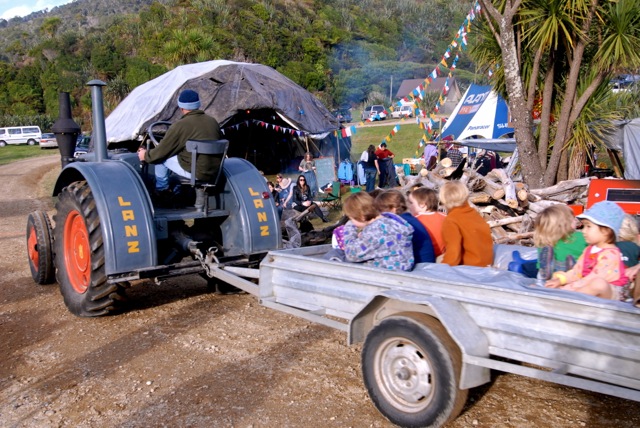
In sunny Karamea, Jack Simpson of Umere owns a veritable dinosaur. A 1938 LANZ Bulldog tractor. Built like a locomotive, the engine casing is solid cast iron evoking visions of German World War 1 tanks used during trench warfare.

Jack LANZ

Jack Simpson using the LANZ Bulldog for kiddie rides at the Karamea Music Festival in 2010

Jack LANZ II

…and don’t the kiddies LOVE it!

First manufactured in 1921 by Heinrich Lanz AG in Wurttemberg, Germany, the Lanz Bulldog was an inexpensive, simple and easily maintained vehicle due primarily to its simple power source : a single cylinder horizontal, two stroke, hot bulb engine,

Initially the engine was a 6.3 litre 12 horsepower unit, but as the Bulldog evolved the engine was increased to 10.3 litres and 55 horsepower. While hot bulb engines were crude they were easy to maintain and could burn a wide variety of low grade fuels, even waste oils. The Bulldog is similar to other European hot bulb tractors produced in a similar time frame, such as SF Vierzon in France, Landini in Italy and HSCS in Hungary. It is also similar to the Field Marshall produced in England except that the Field Marshall has  a diesel engine and not a hot bulb engine.

The Bulldog was also produced in France, Poland and Argentina.

In Australia the KL Bulldog was produced by Kelly and Lewis of Springvale, Victoria, Australia from 1948 to December 1952. Just over 860 were built, based on the 35 horse power model N Bulldog.

Listening to the slow methodical beat of the single cylinder piston at rotating at 600 rpm transports one back to a simpler time when the All Blacks were paid 2/-6 and a meat pie, smoko lasted all day and porridge was a luxury!

Posted in Agriculture, Business, Education, Historical, Humor, Humour, Karamea, LivinginPeace Project, New Zealand, Photography, West Coast | Tagged , , , , | 4 Comments

Karamea Ministry of Red Tape # 20

A New Zealand Government Department authorised by a covertly suspicious and deliberately rhetorical Act of Parliament and compounded by a tacitly implied Royal authority to receive Official Complaints.


Office Manager:     Red Scarlett

Senior Complaints Officer:   Billy Connolly

Office Receptionist:   Steve Martin

Office Security Guard:   Alexei Sayle

Tea Slut:     Jim Carey

Karamea Ministry of Red Tape Offices, Market Cross, April Fools’ Day 01/01/2013 0935 hrs

Steve Martin:    Chow!!!!

Herr Dim Bong Goon:    Hi ye wau ha!

Billy Connolly:    Are you taking the f…… proverbial Jimmy?

Herr Dim Bong Goon:   Nein!! Standing on ze rusty nail kamerad!

Billy Connolly:   Welcome to the  Karamea Ministry of fu….. Red Tape Jimmy!


Herr Dim Bong Goon:     Ya! Ist goot! I vishing to make ze complaint about ze Vestern forces of imperialistic capitalism laughing at my empty whetoric!

Billy Connolly:     An Official fuc…. Complaint Jimmy?

Herr Dim Bong Goon:   Ya! I intend to nuke the decaying edifices of Vestern imperialism and I have ze red button right here in my brief case!

Steve Martin:     Love the swaztika dude!


Herr Dim Bong Goon:  Don’t call me Dude! A dude is a camel’s genital proboscis! Do I look like ze camels long driver?

Steve Martin:    Yeah!

Jim Carey:        Well yeah!!!!

Billy Connolly:       You’re the fuck… crazed meglomaniac that’s going to annihilate Glasgow Rangers!  Procreate me Jimmy!


Herr Dim Bong Goon:   I am going to destroy Disneyland, the Out House, McDonalds and WWF!!!

Billy Connolly:      Never!! Not fucki.. McDonald’s!! Noooooooooooooooo!!!!!!!!!!!!!!!!!!!!

Steve Martin:     Nooooooooooooooooooooooooo!!!!!!!!!!!!!!!!

Jim Carey:          Nooooooooooooooooooooo!!!!!!!!!!!!!!!!!!!!!!

Alexei Sayle:         Didn’t you kill my bruvver???

Herr Kim Bong Goon:     Ha ha ha!!!  Aufwiedersein to Gentle Ben, Lassie, Ed and Skippy!! Ha ha ha!!

Billy Connolly:   No! Not fuckin. Skippy!!!!  Nooooooooooooooooooooo!!!!!!!!!!!!!!

Steve Martin:     Nooooooooooooooooooo!!!!!!!!!!!!!!!!!!!!!

Jim Carey:        Nooooooooooooooooooo!!!!!!!!!!!!!! (Who the fuck is Skippy?)

Jim Carrey

Alexei Sayle:    Oi you! Yeah you! I’m talking to you, I’m talking to you!

Gang Nam:       Excuse me! Allow me to introduce myself I am Gang Nam and I am ze Fuhrehr’s Minister of Information. Ze glorious farterland is going to totally obliterate all memory of Voodstock!!!   Ha ha ha!!

Billy Connolly:    Are you fucking crazy Jimmy !!!!!!??!!!!! You would kill a poor innocent wee birdie!! ……. Christ!

Kaboom!!!!!

Jim Carey:     Alrighty!!!  What a shot, what a weapon!!!

Red Scarlett:  My new designer Russian PK 126 Bazooka!!!

Billy  Connolly:  What a fucking mess JimmY! Someone get a vacuum cleaner!!!!

Gang Nam:        Anyone want to see me dance???

Red Scarlett:  We are the saviours of Western democracy! Let’s party!!

“Gang nam style, gang nam style…….

Jim Carey:                 Cup of tea????

Posted in Uncategorized | 2 Comments

Permaculture Solutions for a SUSTAINABLE Future

“What permaculturalists are doing is the most important activity that any group is doing on the planet. We don’t know what the details of a truly sustainable future are going to be like, but we need options, we need people experimenting in all kinds of ways and permaculturalists are one of the critical groups doing that.” — David Suzuki

Join the New Permaculture Generation

 By Arthur Lewis Gordon Jackson
 

Looking out over the lifeless brown quilt of drought-stricken Midwest corn monoculture from the window of a Boeing 747-700, it was immediately apparent to me that permaculture farming practices would have prevented this ecological catastrophe. The hottest summer on record in the United States combined with aggressive commercial farming practices has created the potential for a biblical famine!

US Drought Monitor, July 24, 2012

I had been to New York City to attend the nuptials of a very close friend and was heading to a lush, green parallel universe to do a permaculture design course in Karamea on the West Coast of the South Island of New Zealand.

However, New Zealand too has had a dry summer with much of the country being designated a drought zone. There is a change happening on weather systems, we should be focussing all of our available energy and resources to find solutions to overcome the challenges this will present. The permaculture fraternity appears to be doing just that…working with the forces of nature to create food production systems that will produce an abundance of food and can be sustained forever.

New York City from the Empire State Building

Flying over the land at 10,000 feet affords a perspective on life that is not possible at ground level. The view of a bird reveals clearly the perils of commercial agriculture and the devastating impact of human influence on natural systems

Vast tracts of flat fertile farmland devoted to the production of corn, which is now a staple food in the United States. Corn and its byproducts form the basis for most processed food products. The diverse natural landscape that must have once existed here is all gone…the diversity of flora and fauna has been replaced with a single crop.

The interior of the Unites States currently resembles the dry withered skin of an old elephant…with the occasional urban smogatropolis bursting through the leathery hide like a festering pustule as we flew over cities…surely this is not a healthy landscape? How long will it be before the great elephant succumbs to consumption?

As I look around the plane, I consider that I am possibly the only passenger pondering the subject of sustainability. I am one of the lucky 10% of the world’s population who can actually afford to fly and I’m feeling very decadent indulging myself the environmentally expensive luxury of international flight, but am I decadent compared with the businesspeople in first class who do this most every day? Are they decadent compared with the owner of the airline who has mansions all over the world, his own island and is planning flights to the moon? Thinking about the poor sodbusters below watching their cornfields wither and die as they pray for rain puts my self-indulgence into sharp perspective.

Looking down on the state of the land in the U.S. Midwest, it is clear land-use changes need to be made as the current system of food through the exploitation of land resources is clearly not sustainable and appears headed for collapse.

In permaculture, it is often stated that, “the problem is the solution” and that the solution to any problem already exists in nature. Broad-scale monoculture farming is the problem here, the solution is to reintroduce crop diversity, water harvesting, replanting trees along waterways, assisting nature to remediate the damage done and collectively applying permaculture principles over the entire region.

Another huge part of this problem is that there are many mouths to feed in the United States, food production is essential to the sustenance of the populace.  Midwest farmers no doubt feel the weight of responsibility to provide food.

The good news for U.S. farmers is that there is already a lot of permaculture activity in the United States and progressive farmers like Joel Salatin and his Polyface Farms in Virginia have working models of what is possible with a change of mindset from “we do it this way because that’s how my grandfather did it,” to it’s time to take a new approach, let’s learn about permaculture, and set about repairing our land for future generations. Doing what you’ve always done does not always produce what you’ve always got and cracks are appearing in the broad-scale commercial monoculture model…it’s time to have a rethink on food production in the Midwest and everywhere else.

Joel Salatin Sharing his Knowledge with other Farmers at a PolyFace Farm Field Day

With that in mind, Paul Murray decided to be part of the solution and study permaculture so that he could help find answers to the challenges of future food production and distribution and work towards rebuilding and replenishing the land so that it may produce an abundance of food and feed everyone forever .We need to help others to learn about permaculture and how to grow food for themselves without relying on corporate agriculture food production and distribution systems.

However, Permaculture Design Course students often come from large cities somewhere in the world. They may not have had an opportunity to gain hands-on practical experience necessary to apply the principles of permaculture in a practical situation.

Seeing the need to offer practical training for people who have completed a theoretical Permaculture Design Course to enable them to achieve the confidence and competence necessary to apply the permaculture theory they have learned in the classroom to their own permaculture ventures, Living in Peace Project founder Paul Murray decided to offer his property, facilities and services to people seeking practical permaculture experience and set about creating a centre for excellence in permaculture.

The LivinginPeace Project seeks to holistically apply the principles of permaculture to the establishment, development and management of a business venture. The stated goal of the LivinginPeace Project is to incorporate the elements of art, travel, permaculture and education into a sustainable business.

Inspired on completing a Permaculture Design Course with Bill Mollison and Geoff Lawton at Melbourne University in 2009, Murray, with a lot of help from people from all over the world, and with further inspiration from the Permaculture Master Plan, he began to establish a permaculture exhibition farm, education facility and centre for permaculture research, training and practice in the Karamea region at the top of the West Coast of the South Island of New Zealand.

In June 2004, Murray purchased an old maternity hospital and converted it into a hostel to offer reasonably priced accommodation to young and budget travellers visiting the region. A year later, he purchased a small farm and motel complex to cater to travellers looking for self-contained accommodation and organic gardens to grow food for his family, colleagues and customers.

Murray has a degree in agricultural science with a major in horticulture. The degree was essentially a study in commerce and taught students how to maximise the profit derived from every square inch of land with no real consideration for maintaining the fertility of the farm or for responsible stewardship. Permaculture made a whole lot more sense and the Permaculture Design Course with colourful, progressive-thinking characters like Mollison and Lawton and 100 students from all over the world convinced him of the way forward and his life changed as Lawton suggested it might.

The long-term objective for the Living in Peace Project is to gradually phase into permaculture and away from tourism, which Murray believes to be “an environmentally expensive form of entertainment” and into the provision of permaculture education, way of life and knowledge sharing with travellers. “Karamea is a stunning region, but it is also perhaps the most remote town on mainland New Zealand, people have to make a real effort to come here.” “I want to cater to travellers who make that effort––people who take the time to learn from their travel experience––and we have a great opportunity to share our permaculture knowledge with people from all over the world and, hopefully, gain new ideas and innovations from the people who come and stay.”

The hostel, Rongo Backpackers & Gallery, hosts travellers from over 50 countries each year and the Murray hopes the experience of living and working on a permaculture farm will spark a quest for knowledge among his guests and that they will take some of the energy-saving, self-sufficiency initiatives and permaculture practices home with them.

Bananas and avocadoes can be grown in Karamea and the region enjoys an almost sub-tropical microclimate. The soil is deep, well-drained alluvial loam, which enable a broad range of food crops to be grown. The annual rainfall is around 80 inches and it is evenly spread across the year, alleviating the need for irrigation and water storage.

“In all my travels, I’ve never come across a place with greater potential for growing food. The Living in Peace Project farm is a blank canvas for permaculture designers. People have the opportunity to learn how to go from bare earth to Eden rather than just seeing an established permaculture farm, we offer a very interactive experience and the chance to learn how to do it rather than merely seeing it after it’s done,” he said.

The project has employed Dave Tailby as the Permaculture Farm Manager this year and he has taken charge of the property and its development.

“Having Dave on board is fantastic! He’s a great people-person, a really hard worker and is as passionate about permaculture as anyone you’ll meet.  He’s an asset to the project and a really great teacher,” Murray said.

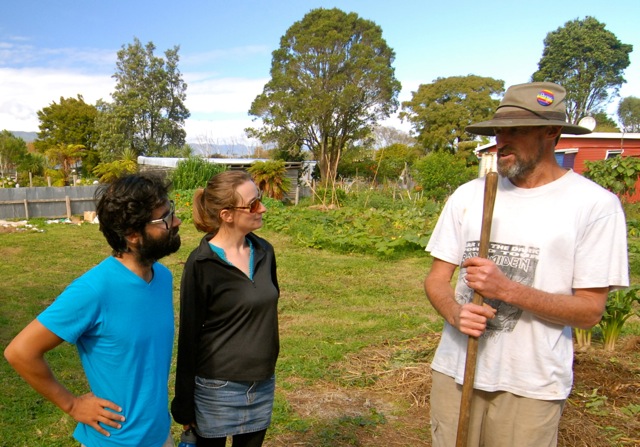
LivinginPeace Project Farm Manager Dave Tailby (right) Talking Compost with a Couple of Urban Permaculturalists

After doing his Permaculture Design Course and watching the Permaculture Master Plan video, Murray decided to devote his life to permaculture and saw his tourism accommodation facilities and farm performing a different function––spreading the word about permaculture, helping others to learn and offering an opportunity to urban permaculture people to learn practical farm skills so that they might be better able to establish their own permaculture projects.

In the meantime, the LivinginPeace Project still offers accommodation over the summer months to visitors coming to see the many regional attractions, but changes focus from May to December to host permaculture students as interns on the farm and will offer a permaculture design course from May 14 to May 28, 2013.

“We are very fortunate to have Tim Barker from the Permaculture Research Institute coming over to lead the course, Tim is a great guy and an experienced permaculture practitioner with lots of practical skills to pass on to students on the course,” Murray said. Barker is currently one of the farm managers at the PRI’s Zaytuna Farm in New South Wales, Australia and describes himself as “Mr Fix it.”

Eventually, Murray hopes to phase tourism out altogether and focus entirely on permaculture programmes year-round. “I don’t think international tourism is a good bet, but I do believe in international travel…it’s the best form of self-education you can get,” he said.

The LivinginPeace Project will therefore cater to travellers and provide opportunities for people to affordably stay in Karamea for an extended period and learn about New Zealand customs, culture, traditions, lifestyle, food while they also learn about permaculture, sustainable living and self-sufficiency.

For more information on the LivinginPeace Project, or to enrol in the LivinginPeace Project Permaculture Design Course, please contact Paul Murray:

E-mail: rongo@actrix.co.nz

Ph: 0064 (3) 7826-767

Incorporating Art, Travel, Permaculture and Education Into a Sustainable Business.

LivinginPeace Project Permaculture Design Course 2013

(May 14 to May 28, 2013)

The course will cover theory and practice in Permaculture and will be held on a developing permaculture farm in sunny Karamea at the top of the West Coast of the South Island of New Zealand.

Course Outline:

The PDC held at The Living Peace Project/Rongo Backpackers & Gallery from May 14 to May 28, 2013 will be slightly different to most other PDC’s. The full theoretical curriculum will be presented, but we will also be expanding the classroom out into the surrounding environment and conducting practical workshops so that students will go home with all the theoretical information, but also with confidence, ability and skills to put their course material into practice.

Practical aspects of the course will include:

  • A 21-day compost pile will be built and tended throughout the PDC.
  • Students will partake in practical permaculture demonstrations and activities.
  • A workshop on aquaculture/aquaponics.
  • An excursion to True Blue Organics to see the process of extracting essential oils.
  • Establish gardens and plant trees as well as examining the decomposing process in a natural forest system.
  • Visit permaculture farms in the Karamea region.
  • Visit old-growth forest systems in the Karamea region.
  • On completion of the PDC each graduate will receive a LivinginPeace Project Permaculture Design Course certificate

The students will also receive the diversity of 3 teachers all of whom are very experienced and knowledgeable in specific areas. Specialty subject teachers ensure the students receive the most critical information throughout the 72-hour programme.

On completion of the PDC, students may choose to stay on to experience life on a working permaculture farm.(Accommodation at the discounted rates as listed below)

LivinginPeace Project PDC CertificateLivinginPeace Project PDC Certificate

Course Fee Structure:

Course Fee: NZ$1,200 per person

Meals: $20 per person per day
(Breakfast/Lunch/Dinner) (Morning and Afternoon Tea supplied)

Transport: Transport supplied by Karamea Connections

*** 25% deposit required on booking the course.
Full payment to be made by commencement of the PDC.

*** Please e-mail us for Bank Account Details or
send a cheque made out to Iltamara Ltd to:

Rongo Backpackers & Gallery
130 Waverley Street
P.O. Box 54
Karamea 7864
NEW ZEALAND

Cancellation Policy:

Up until May 1, 2013: Full refund of deposit and course fee
Between May 1 and May 14: 50% refund of deposit and course fee
After May 14: No refund of deposit of course fee

Accommodation Options:

Rongo Backpackers and Gallery Sticker
Rongo Backpackers & Gallery
Camping/Van/Tent $15 p.p. per day
Dormitory $20 p.p. per day
Twin Room $30 p.p. per day
Private Room $50 p.p. per day
Karamea Farm Baches Logo
Karamea Farm Baches
Self-contained unit
(single occupancy)
$60 per day
Self-contained unit
(two people)
$75 per day

Tour of Old-Growth Forest in Karamea
 

Karamea Connections Oparara Basin Tour

Karmea Connections: Movement of the People

www.KarameaConnections.co.nz

Flock of Sheep on Farm
 Living in Peace Project Permaculture Farm
 

Hot Composting 101
 
PDC Lecturer Dave Tailby with PDC Students Luc Gregoire and Anneliese McNaughton

PDC Lecturer Dave Tailby with PDC Students Luc Gregoire and Anneliese McNaughton
 

On Contour: Plotting a Swale
 

The Economics of Permaculture with LivinginPeace Project Founder Paul Murray

Teachers’ Profiles

Tim Barker

Tim Barker

Aussie born, trained as a diesel fitter, began my Permaculture journey after reading Permaculture One by David Holmgren and Bill Mollison in 1981, still reading and learning. Ran an adventure tourism business in far North Queensland for 8 years, also contracted to the EPA as a guide for environmental impact studies on the cape York Peninsular, and in conjunction with Tourism Queensland and Aboriginal communities set up and ran turtle conservation camps as a test case for indigenous eco-tourism based business. Former treasurer of the Albatross bay catchment management group and served as environmental contracts administrator for a large contractor based in Far North Queensland. Received my PDC through Permaculture visions, and completed an internship at The Permaculture Research Institute under Geoff Lawton. Was invited back to the PRI as a MR Fix It and teacher. Favourite pastime; thinking, appropriate low tech and aquaponics.
Age: 48

Dave Tailby

Dave Tailby

Living In Peace Project Farm Manager, Dave was formerly a qualified builder and did his PDC with Geoff Lawton at the Permaculture Research Institute of Australia Zaytuna Farm in 2010 and joined the Living In Peace Project as the Farm Manager in March 2012. He has taken charge of the farm development and is creating a permaculture exhibition farm to help others learn about the principles of permaculture. Dave is a great people-person and loves to share his knowledge of permaculture and building.
Age: 50

Paul Murray

Paul Murray

Paul is the founder of the Living In Peace Project.
He did his PDC with Bill Mollison and Geoff Lawton at Melbourne University in 2009.
Grew up on a grazing property on Kangaroo Island in South Australia.

Degree in Agricultural Science (horticulture) from University of South Australia (Rosweworthy).
Grad Dip Arts (Journalism) University of Southern Queenland (Toowoomba).
Age: 47

Permaculture Farm Development

Farm Tour with Moo and Rusty
 

Wwoofers from all over the world
 

Potluck Dinner at Rongo

View of the Farm
 

Dinner at Rongo Backpackers
 

Peace Garden at Rongo
 

View of Mount Stormy, Karamea
 

LivinginPeace Project Permaculture Farm Manager Dave Tailby Shares his Knowledge
 

Aerial View of Karamea
 

Rongo Backpackers Gallery Aerial View
 

Big Rimu Tree in Karamea
 

Aquaculture Lecturer Annalise Runarson

PDC TESTIMONIAL by 2012 Students

Anneliese McNaughton and Luc Gregoire

We had been wwoofing for The LivinginPeace Project for four months. It was a really good time and an awesome experience.

We were offered the chance to do the PDC with the LivinginPeace Project for the end of October 2012. We receive a huge amount of theoretical and practical information. The lecturers, LivinginPeace Project Farm Manager Dave Tailby and Founder Paul Murray, covered what is usually done in PDC with Bill Mollison and Geoff Lawton, but also added their personal experiences, which was a real bonus.

Dave shared his knowledge about composting, practical design, landscaping-earthwork, working with animals (ducks, sheep, chickens) and Paul concentrated on Collective project around permaculture and the financial and legal possibilities of these projects with ecotowns, trusts, other ways of banking and fundraising.

They also included other guest speakers from around the community and throughout New Zealand.We visited Peter Curreen who has a long established permaculture farm in Karamea. We also recieved a presentation by Annalise Runarsson about aquaculture and the possibilities of growing food in conjunction withraising fish.

The LivinginPeace Project farm fits very well for a PDC. There is a big veggie garden, a food forest, sheep, chickens, ducks, some awesome people around to share their experiences and some very good food for the students in the garden. The LivinginPeace Project is a very good example of a collective project built around permaculture principles. This PDC has changed our way of thinking, of looking at things, we warmly recommend everybody to do their PDC there.

Dave’s Golden Permaculture Rule
 

Design Time
 

The PDC Graduates with LivinginPeace Project Permaculture Farm Manager Dave Tailby
 

Dave discusses Permaculture with thesis student Juliann Bertone
Posted in Agriculture, Business, Economics, Education, Environment, Kahurangi National Park, Karamea, LivinginPeace Project, Money, New Zealand, Permaculture, Photography, Social Commentary, Travel, United States, West Coast | Tagged , , , , , , , , , , , , , , , , | 11 Comments

Gerar Toye: Global Gypsy

Off the Top of my Head

By Paul Murray 

GerarA thirst for inspiration, wisdom, experience and understanding led Gerar Toye (52) on an international quest from his birthplace in South Auckland to Karamea at the top of the West Coast of the South Island of New Zealand.

The youngest of six children, Gerar spent his formative years in Manurewa––one of the most multi-cultural suburbs of Auckland and also one of the roughest and toughest––before moving to Borneo for a couple of years with his father Dallas, a school teacher, and mother Pauline, a volunteer nurse.

On returning to New Zealand and completing his primary education, Gerar developed a strong interest in photography and became a darkroom printer for New Zealand’s top professional photographers. The job satisfied his passion for photographic printing, but the formulaic style of the photography he was charged with printing and the sterile, safe and conservative images he constantly saw emerging in the developing fluid left him wanting to make his own images and express his creative ideas through photography.

Gerar quit the job that no longer inspired him and went to Australia in 1982 for a couple of years before returning to Borneo to hook up with childhood school friends there. The trip triggered his wonderlust and he spent the next two decades travelling the world and gaining the international experience, self-education and wisdom that travel affords.

Sri Lanka was next and there he met fellow travellers from the north, who had strange tales of India to share. “In Aragum Bay, I met people who had travelled through India who told me crazy stories about the country with sparkles in the eyes, which inspired me to visit the country,” he said. “I couldn’t believe the tales I heard and wanted to verify them for myself…I wanted to prove them wrong, but after seeing the country for myself, I found out that all I’d heard was true and more!”

His tourist visa allowed for six months in India, but that was in no way sufficient once his interest in the country and its diverse culture was piqued. He returned 10 times and travelled extensively all the while with his camera at the ready.

In 1989, he heard about the Kumbh Mela Festival, a Hindu pilgrimage that takes place every four years in four different locations in rotation. Hindu devotees flock to bathe in the sacred Ganges River and here he photographed the religious, cultural and anthropological spectacle of the largest gathering of humans on the Earth.

Om.svg

The experience was overwhelming, 30 million people assembled in one location, with 70 million attending the event over the course of one month inspired Gerar to return to participate in the Maha (large) Kumbh Mela festival in 2001, which occurs every 144 years and is held at Triveni Sangam the “meeting place” at the confluence of the Ganga, Yamuna and the Sarasvat rivers.

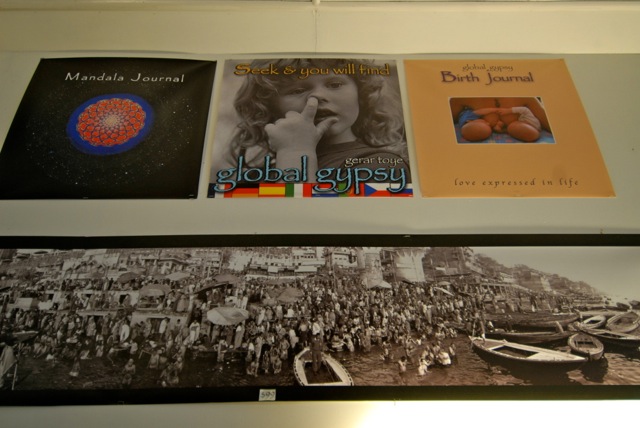
There Gerar photographed the myriad people assembled in the largest-ever congregation of religious pilgrims with his unique “shooting from the hip” style that enables him to capture candid moments, spontaneity and genuine emotion in his subjects. The hand-printed images are now being exhibited at the Global Gypsy Gallery in Karamea.

With the travelbug’s teeth now deep into his flesh and Gerar ventured to numerous countries, travelled through the Americas, Europe and Asia, all the while with camera at the ready to capture moments of human emotion, joy, expression and life moments. With three cameras and 200 rolls of film each year Gerar had no room for cold or wet weather clothes so spent his time in constant warmth with only one winter in his twenty years on the road.

Opportunities abounded and he helped everyone he met basically woofing before it was invented. These led to some marvellous experiences, including being invited to tour America with Paul Kelly and Crowded House, which he turned down to follow an affair of the heart. Using his darkroom skills he built a darkroom on a 1910 Danish Gaff rigged ketch from Fremantle West Australia through Indonesia, Micronesia and Japan and on to Alaska.

He now had a body of work that he could share with others and market to finance his vagabond lifestyle. Years on the road had also furnished him with wisdom and spiritual understanding well beyond his years and he decided to mix both his spirituality and photography to create postcards, posters and T-shirts of his images matched with inspirational quotations and put his experiences out into the retail market. Despite significant effort and attempts to offer his cards to retail outlets, shop owners were not keen to stock his products, so he decided to go it alone and sell them himself.

He returned to New Zealand in 1990 initially to Mangawhai Heads north of Auckland where his now retired parents live. While there, he painted an ecological mural on the public toilets as a move to think globally and act locally. The mural was graffiti-free until it started to peel ten years later and he was commissioned to return to repaint it for the locals.

He later travelled in a purple 1956 Bedford bus called “Carpe Diem” with the Kiwi Gypsy Fair for five years, circling the country six times and selling his wares at markets, festivals and fairs. The response to his products was very positive and the feedback he received encouraged him to produce a book compiling his photographic images and quotations. However, finding a publisher to handle the idea proved frustrating as the idea was considered unsaleable. “The images and quotes were very popular with the public, so I knew a book would work,” he said. Publishers thought otherwise and he was forced to go it alone and using all his credit cards to produce his first book “Reality is for Those with no Imagination,” which was published in 1997.

The next challenge was to find book retailers that would stock and sell his book. This again proved frustrating as he wasn’t backed by a publisher and as a sole trader, retailers were less than helpful and he met with similar resistance from bookshop owners he had experienced when marketing his quote cards.

Around that time the Internet was gathering popularity and he set up a Web site www.globalgypsy.com to stock his own work and market it online. This proved a good move and his product started to move. Retailers gradually came on board and his work is now stocked in over a hundred outlets across New Zealand and Australia. His book sold out and has been translated into French, German and 16 other languages. He now has eight books on the market and has sold over 14,000 copies making him one of New Zealand’s best-selling authors.

In 2002, Gerar and his then partner Amla had boy/girl twins Kiva and Rimu. His nomadic lifestyle quickly changed and he became a father, settled back into life in New Zealand,

He decided to pursue his creative passion and enrolled in a fine arts degree at Canterbury University in Christchurch. He initially decided to study painting, but on reflection switched to filmmaking as he felt the artform had a greater propensity to influence people in a positive way. “I didn’t feel I could change the world by painting,” he said.

The challenges and responsibilities of fatherhood forced him to leave university before graduating, but he managed to express his talent for directing and writing film and produced a low budget ($400) 20-minute short film titled “Zen and the Art of Hitchhiking,” which can be seen online:

Zen and the Art of Hitchhiking

By Gerar Toye

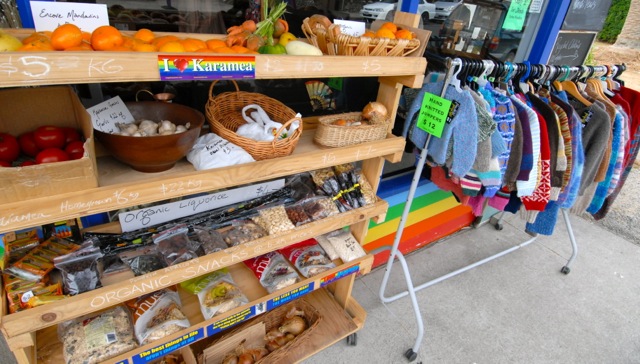
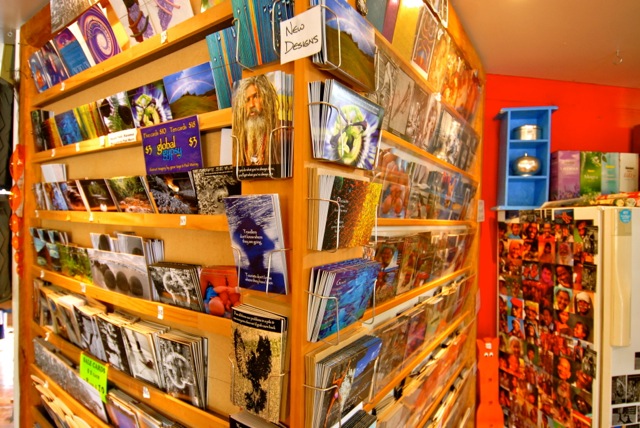
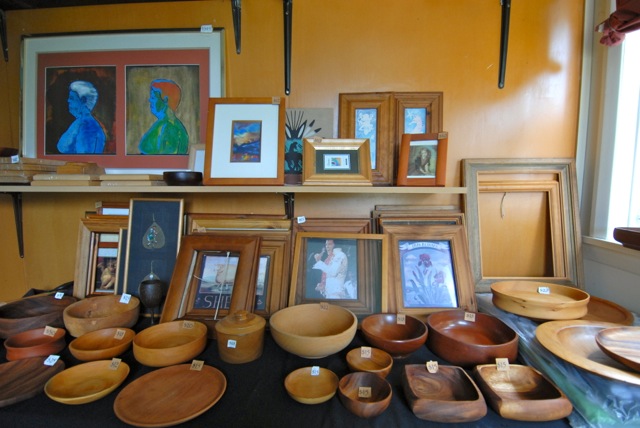
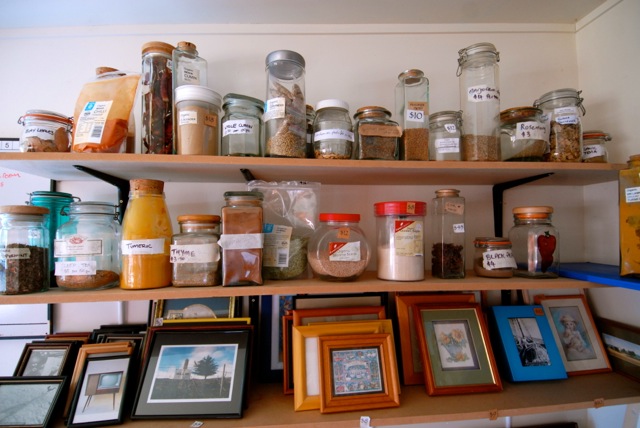
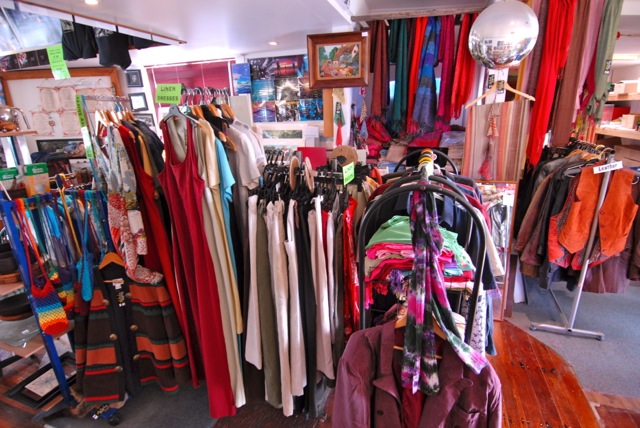
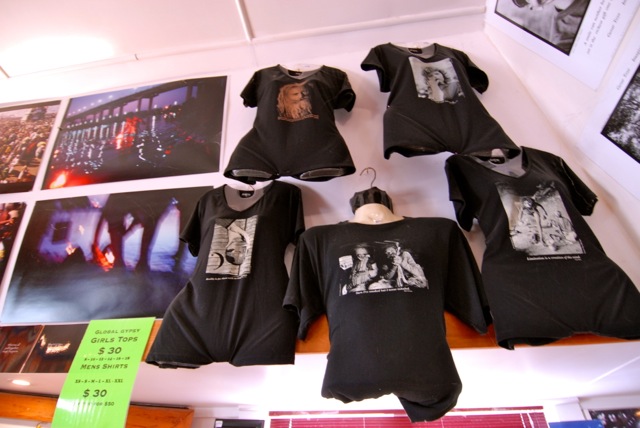
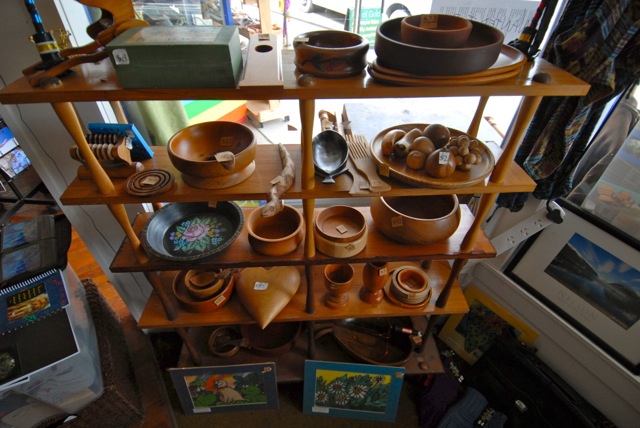
Invited by Paul Murray to revisit Karamea and the LivinginPeace Project he had started Gerar was inspired to be part of the dream to bring people together and he settled into life in the small remote rural community in 2007 after purchasing the old information centre building in the centre of town. He painted it in rainbow stripes and established a retail outlet of his own to market his growing range of books, postcards, T-shirts, fridge magnets, jigsaws, bumper stickers, framed photographs and posters and expanded with a range of goods and products including; organic food, local produce, artworks, fair trade items, second-hand goods, accessories, curios and pre-loved natural-fibre clothing…the Global Gypsy Gallery was born.

Today, the Global Gypsy Gallery is a veritable emporium and must-see shop for any visitor to Karamea. It has become a Farmer’s Market where local organic fruit and vegetable growers can sell their excess produce, local artisans can sell their creations, the best cup of tea and coffee in town and hours of browsing through a treasure trove of quality new and used products from around the world. Gerar’s photographs adorn the walls and he again has overcome the challenges of unsupportive retailers and conservative mindset by doing it himself…and doing it very well.

RGO_1417

Global Gypsy Gallery

RGO_1418

Farmer’s Market: Fresh Local Produce and Packaged Organic Foods

RGO_1422

Gerar Toye at he Helm of the Globl Gypsy Gallery

RGO_1424

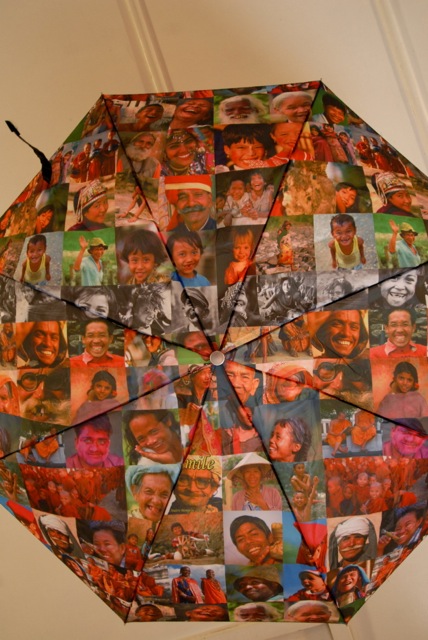
Smile Umbrella

RGO_1428

Gerar Toye’s Best-Selling Books

RGO_1429

Framed Photos from India

RGO_1435

The Endorphin Mat

RGO_1433

Gerar Toye

  RGO_1419 RGO_1421 RGO_1425 RGO_1426 RGO_1427 RGO_1430 RGO_1431 RGO_1432 RGO_1436 RGO_1437 RGO_1438 RGO_1439 RGO_1440 RGO_1441 RGO_1442 RGO_1443 RGO_1444 RGO_1445 RGO_1446 RGO_1447

Gerar commutes between Karamea in the summers and Bellingen N.S.W. Australia where his twins who are now ten attend the Chrysalis Steiner School. He is working on two film scripts “Holy Cow Shit” and “My Sweet Revenge,” which is about 7 strangers who kidnap former U.S. President George W. Bush and hold him captive for a week. Gerar is currently seeking funding for the film. 
 
His dream now is to make films that will inspire others to reflect and think for themselves and to connect with the love of giving and compassion.
 
Another long-term goal is to establish the Global Gypsy Cafe Project where cafes would be set up in countries of need and staffed by Wwoofer volunteers to train orphans and children of sex workers to grow food and run the cafes. Gerar considers that the way to freedom for many in their cycle is to receive skills and not handouts. 
 
Each cafe would be self-sustaining and provide healthy organic food to travellers, while encouraging people to see a notice board of locals that need assistance. It is hoped that graduates from the LivinginPeace Project Permaculture Design Course would be able apply and share their knowledge of food production though the project.
 
Disillusioned by charity tourism, Gerar sees a way that the efforts of travellers can be harnessed and directly helping those in need. After his time in Calcutta with Mother Teresa and working in Dr Jacques clinic, he saw a direct way he could help by creating a system where travellers can be placed where they can help the most without anyone flying anywhere and without money changing hands. 
 
His upcoming Holy Cow Shit film will express the concept in film and all that is required is $15,000 funding if you have more than you need and would like to share.
 
Gerar is seeking funding to establish a not for profit entity for the project, which could potentially place thousands of travellers in areas where they can give and receive the most and help needy people take charge of their lives. 
 
If you can assist Gerar realise his vision in any way, please e-mail Gerar Toye: nz@globalgypsy.com
 
Additional information is available on the Global Gypsy Web site www.globalgypsy.com
Posted in Art, Business, Gifts, Heaphy Track, Hippies, Hippy, Historical, Humor, Humour, Japan, Kahurangi National Park, Karamea, Karamea Radio, LivinginPeace Project, Money, Movie Review, New Zealand, Oparara, Peace, Permaculture, Photography, Politics, Quotes, Religion, Social Commentary, Travel, United States, West Coast | Tagged , , , , , , , , , , , , , , , , , , , , , | 3 Comments

Dying Veteran Lambasts George Bush & Dick Cheney

thioansnsnsnsn

To: George W. Bush and Dick Cheney
From: Tomas Young

I write this letter on the 10th anniversary of the Iraq War on behalf of my fellow Iraq War veterans. I write this letter on behalf of the 4,488 soldiers and Marines who died in Iraq. I write this letter on behalf of the hundreds of thousands of veterans who have been wounded and on behalf of those whose wounds, physical and psychological, have destroyed their lives. I am one of those gravely wounded. I was paralyzed in an insurgent ambush in 2004 in Sadr City. My life is coming to an end. I am living under hospice care.

I write this letter on behalf of husbands and wives who have lost spouses, on behalf of children who have lost a parent, on behalf of the fathers and mothers who have lost sons and daughters and on behalf of those who care for the many thousands of my fellow veterans who have brain injuries. I write this letter on behalf of those veterans whose trauma and self-revulsion for what they have witnessed, endured and done in Iraq have led to suicide and on behalf of the active-duty soldiers and Marines who commit, on average, a suicide a day. I write this letter on behalf of the some 1 million Iraqi dead and on behalf of the countless Iraqi wounded. I write this letter on behalf of us all—the human detritus your war has left behind, those who will spend their lives in unending pain and grief.

You may evade justice but in our eyes you are each guilty of egregious war crimes, of plunder and, finally, of murder, including the murder of thousands of young Americans—my fellow veterans—whose future you stole.

I write this letter, my last letter, to you, Mr. Bush and Mr. Cheney. I write not because I think you grasp the terrible human and moral consequences of your lies, manipulation and thirst for wealth and power. I write this letter because, before my own death, I want to make it clear that I, and hundreds of thousands of my fellow veterans, along with millions of my fellow citizens, along with hundreds of millions more in Iraq and the Middle East, know fully who you are and what you have done. You may evade justice but in our eyes you are each guilty of egregious war crimes, of plunder and, finally, of murder, including the murder of thousands of young Americans—my fellow veterans—whose future you stole.

Your positions of authority, your millions of dollars of personal wealth, your public relations consultants, your privilege and your power cannot mask the hollowness of your character. You sent us to fight and die in Iraq after you, Mr. Cheney, dodged the draft in Vietnam, and you, Mr. Bush, went AWOL from your National Guard unit. Your cowardice and selfishness were established decades ago. You were not willing to risk yourselves for our nation but you sent hundreds of thousands of young men and women to be sacrificed in a senseless war with no more thought than it takes to put out the garbage.

I joined the Army two days after the 9/11 attacks. I joined the Army because our country had been attacked. I wanted to strike back at those who had killed some 3,000 of my fellow citizens. I did not join the Army to go to Iraq, a country that had no part in the September 2001 attacks and did not pose a threat to its neighbors, much less to the United States. I did not join the Army to “liberate” Iraqis or to shut down mythical weapons-of-mass-destruction facilities or to implant what you cynically called “democracy” in Baghdad and the Middle East. I did not join the Army to rebuild Iraq, which at the time you told us could be paid for by Iraq’s oil revenues. Instead, this war has cost the United States over $3 trillion. I especially did not join the Army to carry out pre-emptive war. Pre-emptive war is illegal under international law. And as a soldier in Iraq I was, I now know, abetting your idiocy and your crimes. The Iraq War is the largest strategic blunder in U.S. history. It obliterated the balance of power in the Middle East. It installed a corrupt and brutal pro-Iranian government in Baghdad, one cemented in power through the use of torture, death squads and terror. And it has left Iran as the dominant force in the region. On every level—moral, strategic, military and economic—Iraq was a failure. And it was you, Mr. Bush and Mr. Cheney, who started this war. It is you who should pay the consequences.

I would not be writing this letter if I had been wounded fighting in Afghanistan against those forces that carried out the attacks of 9/11. Had I been wounded there I would still be miserable because of my physical deterioration and imminent death, but I would at least have the comfort of knowing that my injuries were a consequence of my own decision to defend the country I love. I would not have to lie in my bed, my body filled with painkillers, my life ebbing away, and deal with the fact that hundreds of thousands of human beings, including children, including myself, were sacrificed by you for little more than the greed of oil companies, for your alliance with the oil sheiks in Saudi Arabia, and your insane visions of empire.
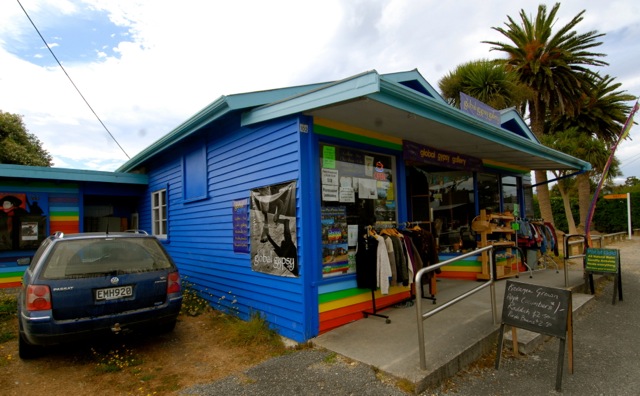
I have, like many other disabled veterans, suffered from the inadequate and often inept care provided by the Veterans Administration. I have, like many other disabled veterans, come to realize that our mental and physical wounds are of no interest to you, perhaps of no interest to any politician. We were used. We were betrayed. And we have been abandoned. You, Mr. Bush, make much pretense of being a Christian. But isn’t lying a sin? Isn’t murder a sin? Aren’t theft and selfish ambition sins? I am not a Christian. But I believe in the Christian ideal. I believe that what you do to the least of your brothers you finally do to yourself, to your own soul.

My day of reckoning is upon me. Yours will come. I hope you will be put on trial. But mostly I hope, for your sakes, that you find the moral courage to face what you have done to me and to many, many others who deserved to live. I hope that before your time on earth ends, as mine is now ending, you will find the strength of character to stand before the American public and the world, and in particular the Iraqi people, and beg for forgiveness.

—Tomas Young

georgeCHENEYbushsdhdhdhdhdhdhd


526951_498116910244649_209680409_n

Maureen Dowd / Repent, Dick Cheney

Vice comes clean: He was the real president, and he stands by all of his mistakes
March 7, 2013 12:24 am
By Maureen Dowd

Dick Cheney certainly gives certainty a black eye.

In a documentary soon to appear on Showtime, “The World According to Dick Cheney,” America’s most powerful and destructive vice president woos history by growling yet again that he was right and everyone else was wrong.

R.J. Cutler, who has done documentaries on the Clinton campaign war room and Anna Wintour’s Vogue war paint room, now chronicles Mr. Cheney’s war boom.

“If I had to do it over again,” the 72-year-old says chillingly of his reign of error, “I’d do it over in a minute.”

Mr. Cheney, who came from a family of Wyoming Democrats, says his conservative bent was strengthened watching the anti-Vietnam War protests at the University of Wisconsin, where he was pursuing a doctorate and dodging the draft.

“I can remember the mime troupe meeting there and the guys that ran around in white sheets with the entrails of pigs, dripping blood,” he said. Maybe if he’d paid more attention to the actual war, conducted with a phony casus belli in a country where we did not understand the culture, he wouldn’t have propelled America into two more Vietnams.

The documentary doesn’t get to the dark heart of the matter about the man with the new heart.

Did he change, after the shock to his body of so many heart procedures and the shock to his mind of 9/11? Or was he the same person, patiently playing the courtier, once code-named “Backseat” by the Secret Service, until he found the perfect oblivious frontman who would allow him to unleash his harebrained, dictatorial impulses?

Talking to Mr. Cutler in his deep headmaster’s monotone, Mr. Cheney dispenses with the fig leaf of “we.” He no longer feigns deference to W., whom he now disdains for favoring Condi over him in the second term and for not pardoning “Cheney’s Cheney,” Scooter Libby.

“I had a job to do,” he said.

Continuing: “I got on the telephone with the president, who was in Florida, and told him not to be at one location where we could both be taken out.” Mr. Cheney kept W. flying aimlessly in the air on 9/11 while he and Lynn left on a helicopter for a secure undisclosed location, leaving Washington in a bleak, scared silence, with no one reassuring the nation in those first terrifying hours.

“I gave the instructions that we’d authorize our pilots to take it out,” he says, referring to the jet headed to Washington that crashed in a Pennsylvania field. He adds: “After I’d given the order, it was pretty quiet. Everybody had heard it, and it was obviously a significant moment.”

This guy makes Al Haig look like a shrinking violet.

When they testified together before the 9/11 Commission, W. and Mr. Cheney kept up a pretense that in a previous call, the president had authorized the vice president to give a shoot-down order if needed. But the commission found “no documentary evidence for this call.”

In his memoir, W. described feeling “blindsided” again and again. In this film, the blindsider is the eminence grise who was supposed to shore up the untested president. The documentary reveals the Iago lengths that Mr. Cheney went to in order to manipulate the unprepared Junior Bush. Vice had learned turf fighting from a maniacal master of the art, his mentor Donald Rumsfeld.

When he was supposed to be vetting vice presidential candidates, Mr. Cheney was actually demanding so much material from them that there was always something to pick on. He filled W.’s head with stories about conflicts between presidents and vice presidents sparked by the vice president’s ambition, while protesting that he himself did not want the job.

In an unorthodox move, he ran the transition, hiring all his people, including Bush Senior’s nemesis, Rummy, and sloughing off the Friends of George; then he gave himself an all-access pass.

He was always goosing up W.’s insecurities so he could take advantage of them. To make his crazy and appallingly costly detour from Osama to Saddam by cherry-picking his fake case for invading Iraq, he played on W.’s fear of being lampooned as a wimp, as his father had been.

But after Vice kept W. out of the loop on the Justice Department’s rebellion against Mr. Cheney’s illegal warrantless domestic spying program, the relationship was ruptured. It was too late to rein in the feverish vice president, except to tell him he couldn’t bomb a nuclear plant in the Syrian desert.

“Condi was on the wrong side of all those issues,” Mr. Cheney rumbled to Cutler.

Mr. Cheney still hearts waterboarding. “Are you going to trade the lives of a number of people because you want to preserve your honor?” he asked, his voice dripping with contempt.

“I don’t lie awake at night thinking, gee, what are they going to say about me?” he sums up.

They’re going to say you were a misguided powermonger who, in a paranoid spasm, led this nation into an unthinkable calamity. Sleep on that.

Maureen Dowd is a syndicated columnist for The New York Times.
First Published March 7, 2013 12:00 am
Posted in Economics, Education, Historical, Media, Money, Obituary, Peace, Photography, Politics, Religion, Social Commentary, United States, War | Tagged , , , , , , , , , , | 2 Comments

Salt of the Earth: The Art of Polish Miners

Deep underground in Poland lies something remarkable but little known outside Eastern Europe. For centuries, miners have extracted salt there, but left behind things quite startling and unique. Take a look at the most unusual salt mine in the world.

From the outside, Wieliczka Salt Mine doesn’t look extraordinary. It looks extremely well kept for a place that hasn’t mined any salt for over ten years but, apart from that, it looks ordinary. However, over two hundred metres below ground it holds an astonishing secret. This is the salt mine that became an art gallery, cathedral and underground lake.

Situated in the Krakow area, Wieliczka is a small town of close to twenty thousand inhabitants. It was founded in the twelfth century by a local duke to mine the rich deposits of salt that lie beneath.

Until 1996, it did just that but the generations of miners did more than just extract. They left behind them a breathtaking record of their time underground in the shape of statues of mythic, historical and religious figures. They even created their own chapels in which to pray. Perhaps their most astonishing legacy is the huge underground cathedral they left behind for posterity.

It may feel like you are in the middle of a Jules Verne adventure as you descend into the depths of the world. After a one hundred and fifty metre climb down wooden stairs, the visitor to the salt mine will see some amazing sites. About the most astounding in terms of its sheer size and audacity is the Chapel of Saint Kinga. The Polish people have for many centuries been devout Catholics and this was more than just a long term hobby to relieve the boredom of being underground. This was an act of worship.

Amazingly, even the chandeliers in the cathedral are made of salt. It was not simply hewn from the ground and then thrown together; however, the process is rather more painstaking for the lighting. After extraction the rock salt was first of all dissolved. It was then reconstituted with the impurities taken out so that it achieved a glass-like finish. The chandeliers are what many visitors think the rest of the cavernous mine will be like as they have a picture in their minds of salt as they would sprinkle on their meals! However, the rock salt occurs naturally in different shades of grey (something like you would expect granite to look like).

Still, that doesn’t stop well over one million visitors (mainly from Poland and its eastern European neighbours) from visiting the mine to see, amongst other things, how salt was mined in the past.

For safety reasons, less than one percent of the mine is open to visitors, but even that is still almost four kilometres in length … more than enough to weary the average tourist after an hour or two. The mine was closed for two reasons:

… the low price of salt on the world market made it too expensive to extract here. Also, the mine was slowly flooding … another reason why visitors are restricted to certain areas only.

The religious carvings are, in reality, what draw many to this mine … as much for their amazing verisimilitude as for their Christian aesthetics. The above shows Jesus appearing to the apostles after the crucifixion. He shows the doubter, Saint Thomas, the wounds on his wrists.

Another remarkable carving, this time a take on The Last Supper. The work and patience that must have gone into the creation of these sculptures is extraordinary. One wonders what the miners would have thought of their work going on general display? They came to be quite used to it, in fact, even during the mine’s busiest period in the nineteenth century. The cream of Europe’s thinkers visited the site … you can still see many of their names in the old visitor’s books on display.

These reliefs are perhaps among some of the most iconographic works of Christian folk art in the world and really do deserve to be shown. It comes as little surprise to learn that the mine was placed on the original list of UNESCO World Heritage Sites back in 1978.

Not all of the work is relief-based. There are many life-sized statues that must have taken a considerable amount of time … months, perhaps even years … to create. Within the confines of the mine, there is also much to be learned about the miners from the machinery and tools that they used … many of which are on display and are centuries old. A catastrophic flood in 1992 dealt the last blow to commercial salt mining in the area and now the mine functions purely as a tourist attraction. Brine is, however, still extracted from the mine and then evaporated to produce some salt, but hardly on the ancient scale. If this was not done, then the mines would soon become flooded once again.

Not all of the statues have a religious or symbolic imagery attached to them. The miners had a sense of humour, after all! Here can be seen their own take on the legend of Snow White and the Seven Dwarfs. The intricately carved dwarfs must have seemed to some of the miners a kind of ironic depiction of their own work.


The miners even threw in a dragon for good measure! Certainly, they may have whistled while they did it but the conditions in the salt mine were far from comfortable and the hours were long … the fact that it was subterranean could hardly have added to the excitement of going to work each morning.

To cap it all, there is even an underground lake, lit by subdued electricity and candles. This is perhaps where the old legends of lakes to the underworld and Catholic imagery of the saints work together to best leave a lasting impression of the mine. How different a few minutes reflection here must have been to the noise and sweat of everyday working life in the mine.


Posted in Art, Education, Historical, Mining, Photography, Religion, Social Commentary, Travel, Uncategorized | Tagged , , , , , , , , | Leave a comment

Japanese TV Show Features LivinginPeace Project

The Japanese TV Programme “Sekkai no Hate no Nihon Gin” (“Japanese at the Ends of the World”) heard about Sanae Murray, the wife of LivinginPeace Project Founder Paul Murray and came to Karamea at the top of the West Coast of the South Island of New Zealand in November 2012 to discover why she left Tokyo to live in Karamea.

The TV crew were here for five days and filmed the daily life of Sanae and her family and the happenings at their businesses Rongo Backpackers & Gallery, Karamea Farm Baches, Karamea Connections, Global Gypsy Gallery and the beautiful scenery and nature of Karamea.

The programme is in Japanese, but non-Japanese speakers will be able to understand it visually, so please check it out and then come and visit us in Sunny Karamea!

Thank you to Tokyo Broadcasting System for allowing us to put the footage on our Web sites and to the Sekkai no Hate no Nihon Gin film crew…good job guys!

2012年11月、TBS「世界の果ての日本人」の撮影チームはニュージーランドの南島、西海岸の最北端にある小さな村カラメアに住む早苗・マリーを訪ねにやってきました。
彼女はリビング・イン・ピースプロジェクトの創設者、ポール・マリーの妻であり、カラメアに住み始めて8年。

撮影チームは5日間かけて、なぜ彼女が東京を離れこの小さな村カラメアへ移住したのか。彼女の日常生活、彼らのビジネスであるロンゴ・バックパッカーズ、カラメア・ファーム・バッチーズ、カラメア・コネクション、グローバル・ジプシー・ギャラリーでの出来事、そしてカラメアの美しい大自然の撮影をしました。とてもいい作品に仕上がっているので沢山の方々に見て頂けたら幸いです。

TBS、撮影スタッフの皆様。私達のウェブサイトへの番組投稿を認めて頂きありがとうございました。今後も「世界の果ての日本人」が末永く続く番組になりますように。

Posted in Business, Education, Environment, Funny, Heaphy Track, Historical, Humor, Humour, Japan, Kahurangi National Park, Karamea, Karamea Radio, LivinginPeace Project, Media, Moo, Mountain Biking, MTB, New Zealand, Oparara, Peace, Permaculture, Photography, Radio, Social Commentary, SuperMoo the KarameaWonderDog, Tramping, Travel, West Coast | Tagged , , , , , , , , , , , , , , , | Leave a comment

LivinginPeace Project Permaculture Design Course 2013

(May 14 to May 28, 2013)

The course will cover theory and practice in Permaculture and will be held on a developing permaculture farm in sunny Karamea at the top of the West Coast of the South Island of New Zealand.

Course Outline:

The PDC held at The Living Peace Project/Rongo Backpackers & Gallery from May 14 to May 28, 2013 will be slightly different to most other PDC’s. The full theoretical curriculum will be presented, but we will also be expanding the classroom out into the surrounding environment and conducting practical workshops so that students will go home with all the theoretical information, but also with confidence, ability and skills to put their course material into practice.

Practical aspects of the course will include:

  • A 21-day compost pile will be built and tended throughout the PDC.
  • Students will partake in practical permaculture demonstrations and activities.
  • A workshop on aquaculture/aquaponics.
  • An excursion to True Blue Organics to see the process of extracting essential oils.
  • Establish gardens and plant trees as well as examining the decomposing process in a natural forest system.
  • Visit permaculture farms in the Karamea region.
  • Visit old-growth forest systems in the Karamea region.
  • On completion of the PDC each graduate will receive a LivinginPeace Project Permaculture Design Course certificate

The students will also receive the diversity of 3 teachers all of whom are very experienced and knowledgeable in specific areas. Specialty subject teachers ensure the students receive the most critical information throughout the 72-hour programme.

On completion of the PDC, students may choose to stay on to experience life on a working permaculture farm.(Accommodation at the discounted rates as listed below)

LivinginPeace Project PDC Certificate

LivinginPeace Project PDC Certificate

Course Fee Structure:

Course Fee: NZ$1,200 per person

Meals: $20 per person per day
(Breakfast/Lunch/Dinner) (Morning and Afternoon Tea supplied)

Transport: Transport supplied by Karamea Connections

*** 25% deposit required on booking the course.
Full payment to be made by commencement of the PDC.

*** Please e-mail us for Bank Account Details or
send a cheque made out to Iltamara Ltd to:

Rongo Backpackers & Gallery
130 Waverley Street
P.O. Box 54
Karamea 7864
NEW ZEALAND

Cancellation Policy:

Up until May 1, 2013: Full refund of deposit and course fee
Between May 1 and May 14: 50% refund of deposit and course fee
After May 14: No refund of deposit of course fee

Accommodation Options:

Rongo Backpackers and Gallery Sticker
Rongo Backpackers & Gallery
Camping/Van/Tent $15 p.p. per day
Dormitory $20 p.p. per day
Twin Room $30 p.p. per day
Private Room $50 p.p. per day
Karamea Farm Baches Logo
Karamea Farm Baches
Self-contained unit
(single occupancy)
$60 per day
Self-contained unit
(two people)
$75 per day

Tour of Old-Growth Forest in Karamea

Karamea Connections Oparara Basin Tour
Karmea Connections: Movement of the People
www.KarameaConnections.co.nz

Flock of Sheep on Farm
 Living in Peace Project Permaculture Farm

Hot Composting 101

PDC Lecturer Dave Tailby with PDC Students Luc Gregoire and Anneliese McNaughton

PDC Lecturer Dave Tailby with PDC Students Luc Gregoire and Anneliese McNaughton

On Contour: Plotting a Swale

The Economics of Permaculture with LivinginPeace Project Founder Paul Murray

Teachers’ Profiles

Tim Barker

Tim Barker

Aussie born, trained as a diesel fitter, began my Permaculture journey after reading Permaculture One by David Holmgren and Bill Mollison in 1981, still reading and learning. Ran an adventure tourism business in far North Queensland for 8 years, also contracted to the EPA as a guide for environmental impact studies on the cape York Peninsular, and in conjunction with Tourism Queensland and Aboriginal communities set up and ran turtle conservation camps as a test case for indigenous eco-tourism based business. Former treasurer of the Albatross bay catchment management group and served as environmental contracts administrator for a large contractor based in Far North Queensland. Received my PDC through Permaculture visions, and completed an internship at The Permaculture Research Institute under Geoff Lawton. Was invited back to the PRI as a MR Fix It and teacher. Favourite pastime; thinking, appropriate low tech and aquaponics.
Age: 48

Dave Tailby

Dave Tailby

Living In Peace Project Farm Manager, Dave was formerly a qualified builder and did his PDC with Geoff Lawton at the Permaculture Research Institute of Australia Zaytuna Farm in 2010 and joined the Living In Peace Project as the Farm Manager in March 2012. He has taken charge of the farm development and is creating a permaculture exhibition farm to help others learn about the principles of permaculture. Dave is a great people-person and loves to share his knowledge of permaculture and building.
Age: 50

Paul Murray

Paul Murray

Paul is the founder of the Living In Peace Project.
He did his PDC with Bill Mollison and Geoff Lawton at Melbourne University in 2009.
Grew up on a grazing property on Kangaroo Island in South Australia.

Degree in Agricultural Science (horticulture) from University of South Australia (Rosweworthy).
Grad Dip Arts (Journalism) University of Southern Queenland (Toowoomba).
Age: 47

Permaculture Farm Development

Farm Tour with Moo and Rusty

Wwoofers 2011

Potluck Dinner at Rongo

View of the Farm

Dinner at Rongo Backpackers

Peace Garden at Rongo

View of Mount Stormy, Karamea

LivinginPeace Project Permaculture Farm Manager Dave Tailby Shares his Knowledge

Aerial View of Karamea

Rongo Backpackers Gallery Aerial View

Big Rimu Tree in Karamea

Aquaculture Lecturer Annalise Runarson

PDC TESTIMONIAL by 2012 Students Anneliese McNaughton and Luc Gregoire

We had been wwoofing for The LivinginPeace Project for four months. It was a really good time and an awesome experience.

We were offered the chance to do the PDC with the LivinginPeace Project for the end of October 2012. We receive a huge amount of theoretical and practical information. The lecturers, LivinginPeace Project Farm Manager Dave Tailby and Founder Paul Murray, covered what is usually done in PDC with Bill Mollison and Geoff Lawton, but also added their personal experiences, which was a real bonus.

Dave shared his knowledge about composting, practical design, landscaping-earthwork, working with animals (ducks, sheep, chickens) and Paul concentrated on Collective project around permaculture and the financial and legal possibilities of these projects with ecotowns, trusts, other ways of banking and fundraising.

They also included other guest speakers from around the community and throughout New Zealand.We visited Peter Curreen who has a long established permaculture farm in Karamea. We also recieved a presentation by Annalise Runarsson about aquaculture and the possibilities of growing food in conjunction withraising fish.

The LivinginPeace Project farm fits very well for a PDC. There is a big veggie garden, a food forest, sheep, chickens, ducks, some awesome people around to share their experiences and some very good food for the students in the garden. The LivinginPeace Project is a very good example of a collective project built around permaculture principles. This PDC has changed our way of thinking, of looking at things, we warmly recommend everybody to do their PDC there.

Dave’s Golden Permaculture Rule

Design Time

The PDC Graduates with LivinginPeace Project Permaculture Farm Manager Dave Tailby

Dave discusses Permaculture with thesis student Juliann Bertone

Posted in Advertising, Agriculture, Art, Business, Economics, Education, Environment, Kahurangi National Park, Karamea, LivinginPeace Project, Moo, New Zealand, Permaculture, Photography, Social Commentary, SuperMoo the KarameaWonderDog, Travel, West Coast | Tagged , , , , , , , , , , | 1 Comment